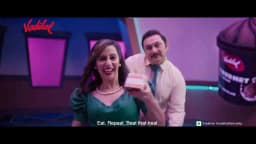
Sammontana's 'The Ice Cream of the Future' campaign, created by Auge Headquarter in Italy in May 2017, used a documentary-style social experiment to link

Sammontana Asks What Ice Cream Looks Like in a Warming World
Sammontana's 'The Ice Cream of the Future' is a documentary-style experiential campaign published in Italy in May 2017, created by agency Auge Headquarter, in which an independent Italian ice cream brand uses a social experiment format to explore how global warming threatens the future of ice cream and the culture surrounding it.
Sammontana is an authentic, independent Italian ice cream brand with deep roots in the country's confectionery and snacks landscape. Rather than promoting a product flavour or seasonal range, the brand chose to front a question with genuine cultural weight: if the planet continues to warm, what becomes of ice cream itself? The campaign's premise transforms a familiar summer pleasure into a lens through which Italian consumers are invited to consider environmental change, making the brand a participant in a broader cultural conversation rather than simply a vendor of frozen goods.
Published in Italy in May 2017, the campaign belongs to the experiential advertising category and was classified under the food industry by Ads of the World. It comprises a single media asset — a documentary-style film — that functions simultaneously as a social experiment and a brand statement. The timing was deliberate: May sits at the threshold of Italy's summer season, when ice cream occupies its most prominent place in Italian daily life and the relationship between warmth and the product is at its most emotionally resonant.
The campaign was brought to life through the combined creative effort of agency Auge Headquarter, whose prior work with Sammontana includes the 2014 'Cono 5 Stelle' campaign, establishing a continuity of partnership between brand and agency. With a Clapboard Score of 63 out of 100, 'The Ice Cream of the Future' registers as a campaign of moderate creative distinction — notable for its strategic ambition and conceptual clarity, while leaving room in its execution for greater impact. The score reflects Clapboard's editorial assessment of the archive record and is not a competitive award.

Sammontana identified a tension at the heart of Italian food culture. Ice cream is not merely a product in Italy — it is a seasonal ritual, a social institution, and a marker of collective identity, making it a uniquely powerful vehicle for communicating the consequences of climate change to a domestic audience. By anchoring an experiential campaign in this cultural specificity, Auge Headquarter gave the brand a strategic position that no price promotion or flavour launch could achieve.
The global ice cream market was valued at approximately US$78.35 billion in 2017, according to Envision Intelligence, with projected annual growth of roughly 4.8 to 6 percent, according to Research and Markets. Italy's confectionery and snacks sector sits within this expanding global context, yet faces the very environmental pressures the campaign foregrounds — warmer seasons alter consumption patterns even as they superficially boost short-term demand for frozen goods. This contradiction is precisely the insight Sammontana chose to dramatise.
In the competitive landscape of Italian ice cream, Sammontana operates as an independent domestic brand navigating a market where multinational players command significant structural advantages. Unilever, which held approximately 22 percent of the global ice cream market in 2017 according to Research and Markets, and Nestlé represent the two dominant international forces against which Italian independents must define their identity. Sammontana's decision to invest in a documentary-style social experiment rather than conventional television advertising reflects a clear-eyed reading of this competitive reality: differentiation through cultural relevance, not media weight. The experiential advertising format allowed the brand to generate editorial-quality content in Italy's food industry conversation without competing directly on budget with multinational rivals.
Director Giacomo Boeri shaped 'The Ice Cream of the Future' as a documentary-style social experiment, a format that places observed human reaction above scripted narrative and lends the film an authenticity that conventional advertising rarely achieves. The approach was produced in Italy in 2017 through a collaboration between two production companies: h film and The Blink Fish, whose combined involvement signals a production built for cinematic quality rather than broadcast economy.
The creative team at Auge Headquarter was led by creative directors Federica Ariagno and Giorgio Natale, with art direction by Veronica Ciceri and copy by Antonio Mitra. Project management was handled by Leonardo Zenoni. This depth of credited craft roles is notable for a campaign containing a single media asset — it suggests a production process in which each creative discipline was treated as essential to the film's coherence rather than subordinated to a single dominant vision.
The documentary format places real people in a constructed but genuine experiential situation, allowing their responses to carry evidential weight. Where a scripted advertisement asserts, a social experiment invites the audience to observe and conclude. In the context of global warming and its relationship to Italy's ice cream culture, this distinction matters: the format makes the campaign's environmental argument feel discovered rather than delivered, which is strategically consistent with Sammontana's positioning as an authentic, independent brand. The choice to release the film in May 2017 — as Italy entered the season most associated with ice cream consumption — amplified the experiential advertising logic by placing the film's question in direct dialogue with lived seasonal experience. Production credits for the full technical crew beyond those named above are not publicly documented in the campaign's archive record.
No verified performance data for 'The Ice Cream of the Future' is publicly available. No campaign-specific sales lift, revenue change, market-share movement, or brand-awareness metrics have been published in connection with this work, and no recognition at Cannes Lions, the Effies, The One Show, D&AD, the Clio Awards, the Webby Awards, or WARC Awards has been identified. The campaign received no substantive reviews in Campaign, Ad Age, Adweek, The Drum, or Contagious, according to the available archive record.
Structural analysis of the campaign's effectiveness points to both genuine strengths and identifiable constraints. The decision to use a documentary-style social experiment in Italy in 2017 was strategically ahead of the mainstream wave of climate-linked brand communications that would intensify across the food industry in subsequent years. The single-asset format concentrates creative investment but limits the campaign's capacity to generate sustained conversation across multiple touchpoints — a constraint that likely capped its reach within the Italian confectionery and snacks market.
The campaign's conceptual integrity is its clearest asset. Linking an independent Italian ice cream brand to the lived consequences of global warming through an experiential advertising format creates a memorable brand-idea alignment that transcends seasonal promotional logic. The Clapboard Score of 63 out of 100 reflects this balance: a campaign of real conceptual ambition whose structural reach and documented impact fall short of the distinction its central idea merits.
'The Ice Cream of the Future' is a documentary-style experiential campaign published in Italy in May 2017. Created by Auge Headquarter for independent Italian ice cream brand Sammontana, it uses a social experiment format to explore how global warming threatens the future of ice cream and the culture surrounding it in Italy.
Auge Headquarter created the campaign. The Rome-based agency had an established relationship with Sammontana, having previously produced the 2014 'Cono 5 Stelle' campaign. Creative directors Federica Ariagno and Giorgio Natale led the work, with direction by Giacomo Boeri and production through h film and The Blink Fish.
No awards for this campaign have been identified. No recognition at Cannes Lions, the Effies, The One Show, D&AD, the Clio Awards, the Webby Awards, or WARC Awards is recorded in the publicly available archive. The campaign earned a Clapboard Score of 63 out of 100, reflecting moderate creative distinction.
Sammontana and Auge Headquarter chose the social experiment format to make the campaign's environmental argument feel observed rather than asserted. A documentary-style approach lends authenticity that scripted advertising rarely achieves and aligned with Sammontana's positioning as an authentic, independent Italian brand in a market dominated by multinationals such as Unilever and Nestlé.
Sammontana identified ice cream as a uniquely powerful vehicle for communicating climate consequences to Italian audiences. Ice cream functions as a seasonal ritual and social institution in Italy, making global warming's threat to it viscerally relatable. The insight allowed the brand to enter a cultural conversation about the environment without competing on media budget with larger rivals.
.webp)
Creative Collaboration Platform: The Backbone of Modern Creative WorkWhat is a creative collaboration platform?Clapboard defines a creative collaboration platform as the operational core for today’s distributed creative teams. This is not a collection of digital collaboration tools stitched together; Clapboard’s system


Understanding the Creative Production MarketplaceWhat is a Creative Production Marketplace?Clapboard defines a creative production marketplace as a structured ecosystem where brands, agencies, and production talent converge to execute video, advertising, and branded content at scale. Unlike the legacy agency or freelanREAD FULL ARTICLE

The Urgent Need for a Creative Production Operating SystemWhy Traditional Creative Production Models Break DownClapboard sees the creative production landscape shifting under pressure. Content velocity is no longer a buzzword—it’s a mandate. Modern advertising demands relentless output across dozens of channels, each wREAD FULL ARTICLE