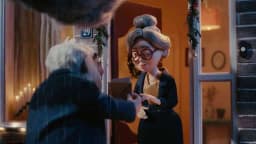
Purdy & Figg's 2025 festive campaign 'The Scent That Stole Christmas', created by 10 Days London, drove £1m in sales on its biggest day ever in the UK.

Purdy & Figg Turns Santa Into a Cleaning Convert This Christmas
Purdy & Figg's festive film 'The Scent That Stole Christmas', created by 10 Days London and published in the United Kingdom in November 2025, is a household cleaning campaign that reimagines Santa Claus as a convert to the brand's cult Frankincense & Myrrh fragrance, abandoning gift delivery to spend Christmas Eve cleaning instead.
The spot opens on a picture-perfect Christmas Eve. Santa arrives on schedule, but the moment he encounters the scent of Purdy & Figg's Frankincense & Myrrh, the narrative pivots entirely. Mesmerised, he abandons his sleigh, ditches the presents, and spends the night in an all-night cleaning frenzy. By dawn, stockings hang empty, but the house gleams. The comic inversion — the world's most famous gift-giver choosing cleaning over Christmas morning magic — is the entire proposition. The joke lands because the scent, not the brand, is the protagonist.
The campaign operates as both a brand-building exercise and a direct commercial driver for the Frankincense & Myrrh product, which Purdy & Figg positions as a strictly limited, six-week festive release in the United Kingdom. The urgency is built into the creative brief: in 2024, the same fragrance sold out within 48 hours, according to information published on purdyandfigg.com. The 2025 campaign capitalises on that proven demand, framing the product's scarcity as cultural currency. Purdy & Figg describes the return as a response to popular demand, with the cult status of the fragrance now central to how the brand positions itself in the premium household cleaning segment across the UK market. The Clapboard Score for this campaign is 72 out of 100, reflecting strong creative distinctiveness and commercially verified impact against a competitive festive advertising landscape.

Purdy & Figg competes in the premium, fragrance-led, natural household cleaning segment of the United Kingdom market. The brand's strategic position rests on a consumer insight that separates it from conventional cleaning brands: scent, not efficacy, is the primary purchase motivator for a growing cohort of UK consumers who treat home fragrance as an extension of personal taste rather than a functional necessity.
The household cleaning category in the United Kingdom is contested by significantly larger players. Method, owned by SC Johnson, and Ecover, owned by Christeyns, both occupy the natural and eco-conscious cleaning space and carry substantially greater distribution and marketing budgets. Purdy & Figg's answer to this competitive disadvantage is cultural specificity: the brand leans into the cult fragrance narrative that larger competitors cannot credibly replicate. Frankincense & Myrrh is not positioned as a cleaning product that happens to smell good. It is positioned as a sensory experience that also cleans.
The 2025 festive campaign deepens a strategy that demonstrated commercial proof in 2024. The previous year's limited run of Frankincense & Myrrh sold out within 48 hours in the UK, according to purdyandfigg.com, generating the waitlist demand that the 2025 campaign then converted. More than 60,000 people joined the waitlist before launch, as reported by retailtimes.co.uk, a figure that represents earned consumer intent rather than paid acquisition. Jack Rubin of Purdy & Figg described the campaign as the brand's "John Lewis moment," according to Marketing Week, a comparison that signals the brand's ambition to own Christmas in the household cleaning category the way John Lewis has owned it in retail. In the United Kingdom, where the festive advertising season is a genuine cultural competition, that ambition is strategically coherent rather than merely aspirational.
10 Days London built the campaign's creative logic on a single comedic premise executed with tonal precision. Santa does not endorse Purdy & Figg. He is defeated by it. The distinction matters because it positions the scent as something more powerful than celebrity endorsement — an involuntary, irresistible response that even the world's most disciplined gift-deliverer cannot override.
The film deploys the visual grammar of a classic Christmas advertisement — warm interiors, twinkling lights, the familiar silhouette of a rooftop sleigh — and then systematically dismantles it. The subversion is structural: every expectation the opening frames establish is undone by the scent. Production credits for the campaign include Dominic White as music composer and orchestrator, whose contribution was a jazzy rendition of Jingle Bells, as documented on linkedin.com. The musical choice reinforces the tonal register of the film: knowing, warm, slightly irreverent rather than earnest or sentimental. It signals to the audience that the brand is in on the joke.
Named contributors to the production, as documented across linkedin.com and Little Black Book, include Rufus Neville, Louise Canham, Georgia Johnson, Emily Warna, George White, Pia de Malherbe, Eleanor Harvey, Simon Pedersen, Serena Spring, Isabel Stordy, Anastasia Karageorge, Thomas van Driel, Adam Griffin, Áine Curley, Kevin Masters, Christine Turner, and Mark J. The breadth of the credited team reflects a production scaled to the brand's festive ambitions rather than to a typical independent cleaning brand's budget. The campaign was published in the United Kingdom in November 2025, positioning it within the most competitive window of the UK advertising calendar, when household and retail brands compete for emotional real estate in consumers' festive consciousness.
Purdy & Figg achieved £1 million in sales on Saturday, 1 November 2025, described by the company as its biggest day ever, according to marketingweek.com. The commercial result is the clearest available measure of the campaign's effectiveness: a single festive film, operating in support of a limited product release, moved enough volume in one day to constitute a record for an independent UK household cleaning brand.
The campaign video accumulated approximately 7.76 million views, as recorded on clapboard.com. More than 60,000 people joined the waitlist before the product launched, as reported by retailtimes.co.uk — a metric that demonstrates the campaign generated anticipation rather than simply awareness. Anticipation is structurally more valuable for a limited-release product, because it converts to purchase intent before the product is available to buy.
The Frankincense & Myrrh fragrance had sold out within 48 hours in 2024 in the United Kingdom, according to purdyandfigg.com, establishing the scarcity narrative that the 2025 campaign then dramatised. The 2025 film is, in commercial terms, a sequenced asset: it does not introduce the product, it re-introduces a product with a proven sell-out history to an audience that already understands what limited means in this context. No verified placements for this campaign at Cannes Lions, the Effies, D&AD, The One Show, the Clios, or the Webby Awards are publicly documented. The campaign's commercial performance, however, makes a credible case that effectiveness and award recognition do not always travel together, particularly for independent UK brands operating outside traditional agency-awards circuits.
'The Scent That Stole Christmas' is a 2025 UK festive film by Purdy & Figg, created by 10 Days London. The campaign features Santa abandoning Christmas gift delivery after being captivated by the brand's Frankincense & Myrrh cleaning fragrance, supporting a limited six-week product release in the United Kingdom.
Purdy & Figg achieved £1 million in sales on 1 November 2025, its biggest sales day ever, according to marketingweek.com. The result was supported by a festive film from 10 Days London and a waitlist of more than 60,000 people, as reported by retailtimes.co.uk, before the product launched.
10 Days London created 'The Scent That Stole Christmas' for Purdy & Figg. The campaign was published in the United Kingdom in November 2025. Music was composed and orchestrated by Dominic White, who arranged a jazzy version of Jingle Bells, as documented on linkedin.com.
The Purdy & Figg campaign video accumulated approximately 7.76 million views, as recorded on clapboard.com. The film supported the brand's festive Frankincense & Myrrh limited release in the UK and contributed to the brand's biggest single sales day, as reported by marketingweek.com.
Purdy & Figg positions Frankincense & Myrrh as a strictly limited six-week festive release in the United Kingdom. The scarcity strategy is grounded in precedent: the fragrance sold out within 48 hours in 2024, according to purdyandfigg.com, creating the waitlist demand the 2025 campaign then converted into record sales.
The Purdy & Figg 'The Scent That Stole Christmas' campaign holds a Clapboard Score of 72 out of 100. The score reflects the campaign's strong creative distinctiveness and commercially verified impact within the competitive UK festive advertising landscape, where household and retail brands compete intensively for seasonal consumer attention.
.webp)
Creative Collaboration Platform: The Backbone of Modern Creative WorkWhat is a creative collaboration platform?Clapboard defines a creative collaboration platform as the operational core for today’s distributed creative teams. This is not a collection of digital collaboration tools stitched together; Clapboard’s system


Understanding the Creative Production MarketplaceWhat is a Creative Production Marketplace?Clapboard defines a creative production marketplace as a structured ecosystem where brands, agencies, and production talent converge to execute video, advertising, and branded content at scale. Unlike the legacy agency or freelanREAD FULL ARTICLE

The Urgent Need for a Creative Production Operating SystemWhy Traditional Creative Production Models Break DownClapboard sees the creative production landscape shifting under pressure. Content velocity is no longer a buzzword—it’s a mandate. Modern advertising demands relentless output across dozens of channels, each wREAD FULL ARTICLE