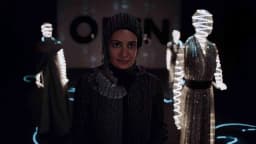
Porsche's #ElectricityTalks campaign by Grabarz & Partner launched in Germany in July 2019, using the London Eye, Hoover Dam, and Twitter to build anticipation

Porsche #ElectricityTalks Charged Germany Before the Taycan Arrived
Porsche's #ElectricityTalks campaign is a July 2019 German automotive advertising effort created by Grabarz & Partner that personified electricity as a fictional speaking character to build anticipation for the all-electric Taycan ahead of its global premiere.
The campaign launched in Germany in July 2019, several weeks before the Taycan received its public world debut in September of that year. Rather than revealing the car directly, Porsche and Grabarz & Partner constructed a narrative in which electricity itself became the protagonist — a voice communicating through iconic infrastructure. The London Eye in London was used to transmit a message in Morse code, and a large-scale projection was staged at the Hoover Dam, each stunt functioning as a dramatic signal that something significant was approaching. These experiential moments fed into a broader ecosystem of film, social, digital, outdoor, and owned-channel content, with Twitter serving as the connective tissue that allowed the campaign to extend across audiences in real time.
The campaign carried a dual title, referenced as both #ElectricityTalks and Electric Dialogue across different markets, as noted by adsoftheworld.com. Its primary geographic market was Germany, consistent with Porsche AG's home base and the cultural weight that market carries for the brand's identity. Oliver Hoffmann, Manager Marketing Communication at Porsche AG, stated publicly, as reported by LBBOnline, that the campaign was designed to give electricity an emotional component and to speak directly to younger consumers — a segment Porsche internally identified as the Driven Youth audience. The Clapboard Score for #ElectricityTalks is 73 out of 100, reflecting strong creative ambition and measurable audience engagement set against a campaign architecture that was tightly tied to a single product moment.
Porsche identified a clear strategic gap entering 2019. The all-electric vehicle segment in Germany was no longer a niche conversation — it was a commercial battleground attracting the full weight of established premium manufacturers and the disruptive momentum of Tesla.
In Germany, the transition toward electric vehicles was accelerating across the automotive industry, with regulatory pressure from the European Union and shifting consumer expectations among younger, urban demographics creating urgency for legacy performance brands. Porsche's Taycan was positioned directly against the Tesla Model S, which had established the benchmark for premium electric performance, as well as forthcoming products including the Audi e-tron GT, Mercedes-Benz EQ line, and Jaguar I-PACE, according to reporting by reuters.com and teslarati.com. The competitive stakes were significant: Porsche needed to assert that pure electric performance was not a concession to trend but a natural evolution of the brand's engineering heritage.
The strategic response from Grabarz & Partner was to sidestep direct product comparison entirely. Rather than benchmarking the Taycan against Tesla or Audi on specification, the campaign made electricity itself the subject of desire. By personifying electricity as a character with agency and voice — one capable of transmitting Morse code through the London Eye and projecting its presence onto the Hoover Dam — the campaign reframed the conversation from horsepower metrics to emotional resonance. This approach was specifically calibrated toward the Driven Youth audience, a younger consumer segment that, according to Oliver Hoffmann as reported by LBBOnline, Porsche was deliberately courting with the Taycan. VICE Media's involvement as both media partner and production partner reinforced this demographic targeting, given VICE's established reach among younger audiences globally and in the German market.
Director Ryan Booth led the film production at the centre of the #ElectricityTalks campaign. The creative was developed under the leadership of Ralf Heuel, Chief Creative Officer at Grabarz & Partner, with group head Julica Hauke and creative team lead Frederik Wetzel contributing to the campaign's overall creative direction, as documented by adsoftheworld.com and clapboard.com.
The campaign's creative conceit — electricity as a speaking, thinking character — demanded executional integrity across multiple formats simultaneously. The film gave electricity a literal voice, positioning it not as a technical feature of the Taycan but as a living force aligned with Porsche's performance values. This anthropomorphisation was not decorative; it was the structural logic that held together a campaign spanning film, social activation, outdoor presence, digital distribution, and large-scale experiential stunts.
The London Eye Morse code stunt was among the most structurally ambitious elements. As reported by LBBOnline, the activation reached sixty-five million users, transforming a recognisable piece of London's public infrastructure into a broadcast antenna for Porsche's message. The Hoover Dam projection extended the same logic to an American landmark — a deliberate internationalisation of what was nominally a Germany-anchored campaign. PHD Media served as the media agency responsible for orchestrating the distribution architecture that connected these physical activations to the digital conversation on Twitter and YouTube. The campaign contained two primary media assets, as documented on Clapboard, but the experiential and social layers amplified their reach substantially beyond a conventional two-asset film release. The combination of cinematic storytelling, precision media placement through PHD Media, and VICE Media's production and partnership capabilities produced a campaign whose craft operated at multiple registers — spectacular in its stunts and controlled in its narrative voice.
Verified performance data for #ElectricityTalks establishes the campaign as a measurable overperformer against automotive industry norms on both Twitter and YouTube.
According to the GWA case study published on gwa.de, Twitter engagement for #ElectricityTalks exceeded the global automotive benchmark by more than twelve times and the German automotive benchmark by more than fifteen times, against a category benchmark of 0.06%. These figures represent a substantial deviation from typical automotive social performance in Germany and indicate that the campaign's character-driven creative approach generated genuine audience interaction rather than passive impression delivery.
On YouTube, completion rates similarly outperformed category averages. Per the GWA case study on gwa.de, eighty-six percent of viewers globally and eighty-four percent of viewers in Germany watched the film beyond the twenty-five percent mark, compared to a category average of sixty-one percent. In a category where pre-roll skip rates are structurally high, retaining more than four in five German viewers past the opening quarter of the film reflects meaningful creative effectiveness.
As reported by LBBOnline, the London Eye Morse code activation alone reached sixty-five million users, giving the experiential component a distribution footprint that extended well beyond its physical location. No verified wins for #ElectricityTalks at Cannes Lions, the Effies, D&AD, The One Show, the Clios, Webby Awards, or WARC Awards are publicly documented. The campaign's structural effectiveness rests on its ability to convert a pre-launch teaser mechanic — one with no product to sell at the moment of release — into measurable audience engagement that outpaced the German automotive industry's established social benchmarks by a significant margin.
#ElectricityTalks was a July 2019 Porsche campaign created by Grabarz & Partner in Germany to build anticipation for the all-electric Taycan. It personified electricity as a fictional character communicating through Morse code on the London Eye and a Hoover Dam projection, distributed across film, Twitter, and digital channels ahead of the Taycan's September 2019 global reveal.
Grabarz & Partner created #ElectricityTalks for Porsche, with CCO Ralf Heuel leading creative, alongside group head Julica Hauke and creative team lead Frederik Wetzel. Director Ryan Booth helmed the film. PHD Media handled media planning and buying, while VICE Media served as both media partner and production partner, as documented by adsoftheworld.com and clapboard.com.
According to the GWA case study on gwa.de, #ElectricityTalks exceeded the German automotive Twitter engagement benchmark by more than fifteen times. On YouTube, eighty-four percent of German viewers watched past the twenty-five percent mark, against a category average of sixty-one percent, demonstrating strong creative retention in the German automotive market.
The London Eye stunt transmitted a Morse code message using the landmark's lights as part of the #ElectricityTalks campaign mechanics. As reported by LBBOnline, the activation reached sixty-five million users. It functioned as an experiential signal that electricity — and by extension the Taycan — was about to make itself known, connecting physical spectacle to the campaign's social conversation.
Porsche positioned the Taycan against Tesla, particularly the Model S, as well as forthcoming premium electric vehicles including the Audi e-tron GT, Mercedes-Benz EQ products, and Jaguar I-PACE, according to reuters.com and teslarati.com. Rather than competing on specification, #ElectricityTalks reframed the conversation around emotional storytelling, targeting a younger German and global audience Porsche called Driven Youth.
No verified award wins for #ElectricityTalks at Cannes Lions, the Effies, D&AD, The One Show, the Clios, Webby Awards, or WARC Awards are publicly documented. The campaign received a Clapboard Score of 73 out of 100, reflecting its strong creative mechanics and measurable social outperformance in Germany relative to the automotive industry benchmark.
.webp)
Creative Collaboration Platform: The Backbone of Modern Creative WorkWhat is a creative collaboration platform?Clapboard defines a creative collaboration platform as the operational core for today’s distributed creative teams. This is not a collection of digital collaboration tools stitched together; Clapboard’s system


Understanding the Creative Production MarketplaceWhat is a Creative Production Marketplace?Clapboard defines a creative production marketplace as a structured ecosystem where brands, agencies, and production talent converge to execute video, advertising, and branded content at scale. Unlike the legacy agency or freelanREAD FULL ARTICLE

The Urgent Need for a Creative Production Operating SystemWhy Traditional Creative Production Models Break DownClapboard sees the creative production landscape shifting under pressure. Content velocity is no longer a buzzword—it’s a mandate. Modern advertising demands relentless output across dozens of channels, each wREAD FULL ARTICLE