 ARCHIVE
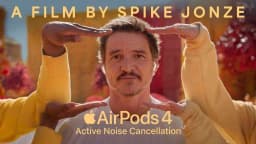
Spike Jonze Directs Pedro Pascal Through Heartbreak for Apple AirPods 4
How Spike Jonze Turned AirPods 4 Active Noise Cancellation Into a Five-Minute Emotional Journey...
Oculus Open Your Eyes and the Case for Standalone VR
Oculus launched 'Open Your Eyes' in May 2018 as a film campaign in the United States designed to introduce the Oculus Go, the brand's first standalone virtual reality headset, to a mainstream consumer audience at an entry price of $199, signalling that immersive VR no longer required a separate smartphone or a high-powered PC.
The campaign arrived precisely at the moment of the Oculus Go's commercial debut. According to Clapboard's archive, the campaign was published in the United States in May 2018, consisting of a single film asset that served as the centrepiece of a broader multi-channel rollout. As reported by Marcomm News, the campaign was created by agency Anomaly and distributed across digital video, out-of-home, cinema, Facebook, and Instagram, giving it a blended reach across both premium screen environments and social platforms where the target technology-curious audience already spent time.
The strategic proposition embedded in 'Open Your Eyes' was straightforward and deliberately accessible. Where earlier Oculus marketing, including work developed by HUb San Francisco around the Samsung Gear VR in 2015 and the Oculus Rift in 2016, had leaned into the language of deep immersion aimed at tech enthusiasts and gamers, according to HUb San Francisco's own account of those campaigns, 'Open Your Eyes' pivoted toward a broader emotional register. The Oculus Go's positioning as a device requiring no tethering to other hardware was central to that shift. In the United States, the campaign carried the implicit argument that virtual reality had crossed a threshold — that the technology category labelled Electronics and Technology had produced something approachable enough for audiences beyond early adopters. The Clapboard Score for this campaign is 66 out of 100, reflecting competent execution within a category still finding its narrative footing.
The Oculus Go addressed a specific friction point that had slowed virtual reality adoption in the United States. Prior to its launch, consumer VR required either a compatible smartphone slotted into a headset shell or a PC with dedicated graphics hardware — both conditions that limited the audience considerably. The Oculus Go removed both requirements, and 'Open Your Eyes' was the campaign tasked with communicating that removal in emotive rather than technical terms.
The broader market context made the timing deliberate. According to IDC, global VR and AR headset shipments reached approximately 8.9 million units in 2018, up from 8.3 million in 2017, representing growth of around seven percent. Within that market, standalone headsets were gaining ground rapidly. According to VentureBeat, standalone VR headsets accounted for approximately 20.6 percent of the VR market in the third quarter of 2018 and were growing sharply, driven in large part by Oculus Go. In the United States specifically, the country represented approximately 31 percent of global VR headset shipments in the first quarter of 2018, according to reporting by ChannelLife, making it the single largest national market for the category.
Oculus faced meaningful competitive pressure in the standalone segment. Samsung's Gear VR, a device Oculus had itself helped bring to market through its earlier partnership with HUb San Francisco, occupied the lower end of the tethered smartphone category, while HTC's Vive dominated the premium PC-connected tier. The Oculus Go's $199 price point, as confirmed by CNBC at launch, carved out a distinct position between those two competitive poles. 'Open Your Eyes' did not engage either competitor directly — instead, it attempted to expand the total addressable audience by reframing what virtual reality could mean to someone who had never considered buying a headset at all.
The 'Open Your Eyes' film campaign operates from an emotional premise rather than a product demonstration framework. Oculus chose to foreground human experience and the sensation of presence rather than lead with hardware specifications, a decision consistent with the product's own positioning as a device that disappears into the experience it delivers.
According to Marcomm News, the campaign was created by Anomaly, the agency responsible for the broader creative direction of the work. The film medium was selected as the primary asset, with that single piece of content anchored across cinema placements, digital video, and social channels including Facebook and Instagram. The choice of cinema as a distribution channel is worth noting: placing a virtual reality advertisement inside a physical theatrical environment creates a deliberate tension between the enclosed, shared experience of the cinema and the private, portable immersion the Oculus Go promised. That contrast is structurally argumentative — it positions the headset as the more intimate, more personal version of the immersive screen.
Production credits for the 'Open Your Eyes' campaign beyond the agency attribution to Anomaly are not publicly documented in available sources. The director, cinematographer, and client-side creative team are not identified in Clapboard's archive, nor in third-party trade coverage examined for this analysis. What the available record does confirm is that the campaign's creative strategy in 2018 marked a deliberate departure from the immersion-first language that HUb San Francisco had used in earlier Oculus and Samsung Gear VR campaigns, which according to HUb San Francisco's own documentation were aimed at tech enthusiasts and gamers seeking convincing simulation. 'Open Your Eyes' instead addressed a viewer who might not yet know they wanted virtual reality at all — a more demanding creative brief that required the film to build desire from scratch rather than validate an existing interest in the Electronics and Technology category.
No verified performance data for the 'Open Your Eyes' campaign is publicly available. Campaign-specific coverage was not identified in Ad Age, Campaign magazine, or Adweek, and no quantified campaign metrics appear in Clapboard's archive or in third-party sources consulted for this analysis. What can be assessed is the structural and contextual effectiveness of the work against the conditions it was designed to address.
The campaign launched on May 1, 2018, the same date the Oculus Go began shipping, according to CNBC. That synchronisation between product availability and brand narrative is a meaningful execution choice: the film was not building anticipation for something unreachable but was instead converting interest into a purchase decision that could be acted on immediately at $199. According to Strategy Analytics, as reported by Marcomm News, VR hardware revenue in 2018 reached approximately $1.8 billion in the United States and global markets, down slightly from approximately $1.9 billion in 2017 — a context that suggests the category needed the kind of audience-broadening creative work that 'Open Your Eyes' attempted.
The Clapboard Score of 66 out of 100 positions the campaign in the competent-to-solid range of the Clapboard creative effectiveness scale. It reflects a campaign that executes its brief with clarity and strategic alignment but stops short of the kind of cultural or creative distinctiveness that pushes scores higher. The multi-channel distribution plan — spanning cinema, digital video, out-of-home, Facebook, and Instagram, as reported by Marcomm News — demonstrates media ambition commensurate with a product launch of this significance in the United States, even if the creative execution did not generate the lasting trade recognition that would have produced a richer documented record.
Oculus 'Open Your Eyes' is a 2018 film campaign that launched in the United States to introduce the Oculus Go standalone VR headset. Created by Anomaly and distributed across digital video, cinema, out-of-home, Facebook, and Instagram, the campaign positioned the $199 device as accessible virtual reality requiring no smartphone or PC.
Anomaly created the Oculus 'Open Your Eyes' campaign, as reported by Marcomm News. Beyond this agency attribution, production credits including the director and client-side creative team are not publicly documented in available sources, including Clapboard's own archive of the campaign.
Oculus released the 'Open Your Eyes' campaign in May 2018 in the United States. According to CNBC, the Oculus Go began shipping on May 1, 2018, at a starting price of $199, making the campaign launch and product availability simultaneous — a deliberate strategy to convert awareness directly into purchase intent.
Oculus Go was a standalone virtual reality headset requiring no separate smartphone or PC, as confirmed by CNBC at launch. Earlier Oculus-associated products, including Samsung Gear VR, required a compatible smartphone. That distinction — full independence at $199 — was the central argument of the 'Open Your Eyes' campaign in the United States.
Standalone VR headsets accounted for approximately 20.6 percent of the global VR market in the third quarter of 2018 and were growing sharply, according to VentureBeat. The United States represented approximately 31 percent of global VR headset shipments in early 2018, per ChannelLife, making it the most significant single market for the Oculus Go launch.
The Clapboard Score for Oculus 'Open Your Eyes' is 66 out of 100. This score reflects competent, strategically coherent execution — the campaign aligns clearly with the Oculus Go's product positioning and launch timing — while stopping short of the creative distinctiveness associated with higher-scoring work in the Electronics and Technology category.
.webp)
Creative Collaboration Platform: The Backbone of Modern Creative WorkWhat is a creative collaboration platform?Clapboard defines a creative collaboration platform as the operational core for today’s distributed creative teams. This is not a collection of digital collaboration tools stitched together; Clapboard’s system


Understanding the Creative Production MarketplaceWhat is a Creative Production Marketplace?Clapboard defines a creative production marketplace as a structured ecosystem where brands, agencies, and production talent converge to execute video, advertising, and branded content at scale. Unlike the legacy agency or freelanREAD FULL ARTICLE

The Urgent Need for a Creative Production Operating SystemWhy Traditional Creative Production Models Break DownClapboard sees the creative production landscape shifting under pressure. Content velocity is no longer a buzzword—it’s a mandate. Modern advertising demands relentless output across dozens of channels, each wREAD FULL ARTICLE