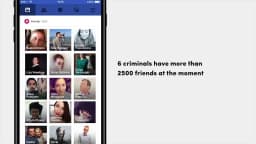
NYPD Wanted App Imagines a Social Network for Fighting Phone Theft
The NYPD Wanted app is a student digital campaign conceived by Miami Ad School Europe in Hamburg, Germany, published in December 2013, proposing a virtual phone-cop application that integrates with users' social networks to collectively mobilise civilians and law enforcement against smartphone theft.
Created as a speculative professional services concept rather than an officially commissioned NYPD initiative, the campaign represents a strand of student advertising work that attempts to solve a genuine civic problem through a digital campaign framework. Smartphone theft was a rising concern in urban environments in 2013, and the Wanted app positioned the NYPD as a forward-thinking institution capable of harnessing networked civilian behaviour to fight acquisitive crime. The single media asset produced for the campaign communicated this idea with directness: a social-network-integrated system, described internally as a "phone cop," would connect the reporting civilian to law enforcement and the broader community simultaneously, according to Vic Gov Au. In Germany, where the campaign was published, digital adoption was accelerating and social network penetration was growing steadily throughout the early part of the decade, making the concept legible and timely to a European student audience engaging with American institutional brands. The campaign earns a Clapboard Score of 63 out of 100, reflecting its conceptual ambition and clarity of idea within the constraints of a one-asset student execution. Its geographic origin in Hamburg, combined with its use of the NYPD as a globally recognisable government brand, gave the work a transatlantic quality that student campaigns targeting American institutions from European ad schools often pursue. The Wanted app stands as a 2013 snapshot of how emerging creative talent was beginning to imagine the future of government communication through the lens of platform-native digital behaviour.
Smartphone theft shaped the strategic premise of the Wanted app entirely. By 2013, mobile device theft had become a documented urban crisis across major cities, and the NYPD — as a globally recognised government and law enforcement brand — provided the conceptual client best suited to respond to it through digital means. The campaign's student creators at Miami Ad School Europe in Hamburg identified a gap between existing law enforcement communication and the networked, social behaviour of device owners, and built their concept around closing that gap.
The strategic logic rested on a simple but durable insight: civilians who experience smartphone theft are often isolated in their response, while the information they hold — location data, device identifiers, social connections — could, in theory, be aggregated into a collective law enforcement tool, according to Mvfp. The Wanted app concept proposed exactly that aggregation, framing the NYPD not as a reactive institution but as a platform facilitator within social networks. In Germany, where the campaign was published, public confidence in digital government services was an active area of discussion, and campaigns that imagined civic technology in accessible terms carried genuine resonance with both advertising audiences and student juries. Comparable professional services campaigns from government-adjacent brands such as Interpol and municipal police departments across Europe had begun exploring digital outreach by this period, but few had framed law enforcement as a participatory social network experience. The Wanted app's competitive distinction lay precisely in that participatory framing: it did not ask civilians to report crime passively but to become active nodes in a networked response system, according to Crsreports Congress Gov. For a student digital campaign produced in Hamburg in 2013, that positioning demonstrated an understanding of platform behaviour that preceded many official government digital campaigns by several years.
The Wanted app campaign was created by three Miami Ad School Europe students: Alex Petrache, Miruna Macri, and Valeria Gonzalez, according to Miamiadschool. Their execution distilled the campaign's central idea into a single media asset, a discipline that student digital campaigns in the performance genre frequently demand and that tests the clarity of a concept more rigorously than multi-asset productions, according to LinkedIn.
The creative approach centred on the "virtual phone cop" construct — a term that communicated both the digital nature of the intervention and the law enforcement authority lending it credibility. By anchoring the campaign to the NYPD brand, Petrache, Macri, and Gonzalez gave their concept an institutional weight that purely speculative civic technology ideas often lack. The visual and conceptual language of the asset drew on the familiar vocabulary of app interfaces and social network notifications, translating the mechanics of collective crime reporting into a format that 2013 audiences would immediately recognise from their daily digital behaviour. In Germany, where the work was published, this interface familiarity was particularly relevant: German smartphone adoption was growing consistently during this period, and the visual grammar of app-based services was already well established among the urban demographic most likely to experience device theft. The decision to frame the NYPD as a social network participant rather than a distant authority figure was a creative risk that the single asset had to carry entirely on its own. The work does so by making the collective action mechanic legible at a glance, prioritising functional clarity over decorative ambition. For a December 2013 student campaign produced at a European campus of an American ad school, the Wanted app demonstrates an economy of creative means that reflects the Miami Ad School Europe environment's emphasis on idea-led, platform-native thinking.
No verified performance data for the Wanted app campaign is publicly available. As a student digital campaign produced at Miami Ad School Europe in Hamburg and published in Germany in December 2013, the work was not subject to the media spend, audience measurement, or conversion tracking that accompanies officially commissioned government advertising. Its reach was therefore determined by editorial recognition rather than paid distribution.
According to Clapboard's editorial records, The Huffington Post and Fubiz.com provided coverage of the campaign, representing meaningful editorial amplification for a student concept with a single media asset. That level of pickup indicates the idea travelled beyond the student advertising circuit into broader digital culture publishing, which for a government-category concept created outside the United States is a structural achievement worth noting. The campaign's Clapboard Score of 63 out of 100 reflects a concept that is clearly articulated and strategically grounded but limited in execution depth by its single-asset format. Structurally, the Wanted app's effectiveness rests on the strength of its central mechanic: the social-network-integrated phone cop idea is immediately understandable, scalable in imagination, and connected to a real and growing problem. Had the campaign been developed into a fuller digital campaign with multiple touchpoints across social networks, its persuasive architecture would have been considerably more robust. As it stands, the 2013 work functions most effectively as a proof of concept — demonstrating that government brands, and the law enforcement category specifically, were ready territory for platform-native creative thinking well before official digital campaigns in that space became commonplace.
The NYPD Wanted app is a student digital campaign created by Miami Ad School Europe in Hamburg, Germany, published in December 2013. It proposed a virtual phone-cop application integrated with social networks to help civilians and law enforcement respond collectively to smartphone theft, using the NYPD as its conceptual client brand.
The Wanted app was created by three Miami Ad School Europe students: Alex Petrache, Miruna Macri, and Valeria Gonzalez, according to Clapboard's archive records. The campaign was produced at Miami Ad School's Hamburg campus and published in Germany in December 2013 as a speculative professional services concept.
The Wanted app is not an official NYPD campaign. It is a student concept produced at Miami Ad School Europe in Hamburg, Germany, in 2013, using the NYPD as a hypothetical government client. The work was never commissioned or endorsed by the New York Police Department.
The Wanted app proposed a virtual phone cop embedded within social networks, enabling users who experienced smartphone theft to alert both their personal networks and law enforcement simultaneously. The concept turned civilian social connections into a collective crime-reporting infrastructure, positioning the NYPD as a participatory digital platform rather than a reactive institution.
Clapboard assigned the NYPD Wanted app a score of 63 out of 100. The score reflects the campaign's clear conceptual ambition and strategic grounding in the smartphone theft problem, balanced against the limitations of a single-asset student execution published in Germany in December 2013.
The Wanted app was published in Germany in December 2013, created by Miami Ad School Europe in Hamburg. According to Clapboard's editorial records, the campaign received coverage from The Huffington Post and Fubiz.com, providing editorial amplification that extended the student work beyond the advertising school circuit into broader digital culture publishing.
.webp)
Creative Collaboration Platform: The Backbone of Modern Creative WorkWhat is a creative collaboration platform?Clapboard defines a creative collaboration platform as the operational core for today’s distributed creative teams. This is not a collection of digital collaboration tools stitched together; Clapboard’s system


Understanding the Creative Production MarketplaceWhat is a Creative Production Marketplace?Clapboard defines a creative production marketplace as a structured ecosystem where brands, agencies, and production talent converge to execute video, advertising, and branded content at scale. Unlike the legacy agency or freelanREAD FULL ARTICLE

The Urgent Need for a Creative Production Operating SystemWhy Traditional Creative Production Models Break DownClapboard sees the creative production landscape shifting under pressure. Content velocity is no longer a buzzword—it’s a mandate. Modern advertising demands relentless output across dozens of channels, each wREAD FULL ARTICLE