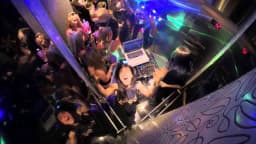
Museum of Science and Technology's 'Cinema Surprise' ambient campaign, created by McCann Beograd in Serbia in October 2016, transformed an unexpected cinematic

Museum of Science and Technology Stages a Cinema Surprise in Belgrade
The Museum of Science and Technology's 'Cinema Surprise' is an ambient advertising campaign created by McCann Beograd and published in Serbia in October 2016, designed to intercept leisure audiences at an unexpected cultural venue and redirect their curiosity toward the museum itself.
The campaign operates on a single, precisely engineered premise: audiences gathered in a cinema setting encounter an experience that dissolves the boundary between the screen and the institution behind it. Rather than placing the Museum of Science and Technology inside conventional media channels, McCann Beograd inserted the museum into a moment of recreation already claimed by a competitor for attention — the cinema. The campaign comprises one media asset, as documented by Clapboard, making its communicative ambition rest entirely on the power of that singular execution.
In Serbia, where cultural institutions compete for discretionary leisure time against an expanding entertainment landscape, the campaign's choice of an ambient format signals a deliberate departure from print or broadcast convention. The museum had previously worked with McCann Beograd on campaigns as far back as 2014, including work positioned under the line 'Samo za radoznale' — 'Only for the Curious' — as documented on YouTube and adsoftheworld.com. 'Cinema Surprise' extends that creative lineage into live, participatory territory, embedding the brand inside a situation rather than interrupting it from outside. The Clapboard Score for this campaign is 64 out of 100, reflecting a concept with clear strategic coherence and a memorable experiential mechanic, measured against the absence of documented performance outcomes and the limited public footprint the campaign has accumulated since its release.
 ARCHIVE
Ambient advertising targets audiences within the context of their existing behaviour. In Serbia in 2016, the recreation and leisure sector presented cultural institutions with a specific challenge: cinema attendance, live performance, and digital entertainment were each competing for the same discretionary hours that a museum visit requires. By choosing to activate inside a cinema environment, McCann Beograd positioned the Museum of Science and Technology not as an alternative to leisure but as an unexpected extension of it.
The global museum sector provides useful context for the strategic pressure institutions faced at this time. According to astc.org, 181 reporting science centres and museums recorded approximately 67 million visits in 2016, comprising around 59.3 million on-site visits and 8.3 million off-site programme visits. According to astc.org, approximately 67 percent of respondents reported increased attendance compared with the prior year, though most of that growth was concentrated in institutions with significant marketing investment or flagship status. According to e-architect.com, worldwide museum attendance had been growing at roughly two to three percent annually since 2012, with United States and European institutions growing at approximately one percent annually — a rate that places pressure on individual museums to earn visits actively rather than rely on passive footfall. The Museum of Science and Technology in Belgrade operates in a market where that pressure is acutely felt.
Competitors for the museum's core audience in Serbia include established cultural venues such as the National Museum of Serbia and the Nikola Tesla Museum in Belgrade, both of which draw on strong national identity narratives to attract visitors. McCann Beograd's strategic answer, as expressed through 'Cinema Surprise,' was not to compete on heritage but on spontaneity — placing the museum inside a moment of recreational anticipation and allowing the experience itself to do the persuasion, according to adsoftheworld.com.
Creative director Vladimir Ćosić led the 'Cinema Surprise' campaign for McCann Beograd, with art direction and illustration by Marija Milanković and copywriting by Milena Kvapil, as documented on adsoftheworld.com. Photography was handled by TunaFish, account management was led by Ljiljana Radosavljević and Lada Vukotić Stamatov, and pianist Katarina Ranković contributed to the execution — a credit that reveals the campaign's dependence on live performance as a core creative element.
The presence of a credited pianist is the most telling detail in the production record. It confirms that 'Cinema Surprise' is not a passive ambient installation but an activated, performative intervention. A cinema audience expecting recorded sound encounters live music — a structural inversion that mirrors the campaign's broader logic: the expected becomes unexpected, and the unexpected becomes an argument for visiting a museum dedicated to the mechanics of discovery. The campaign's single media asset, as noted on adsoftheworld.com, documents this moment rather than distributing it, suggesting the primary experience was designed for the room rather than for replication across channels.
Marija Milanković's role as illustrator alongside art director points to a visual layer within the execution, likely bridging the cinematic environment with the museum's identity. The creative team that produced 'Cinema Surprise' had previously worked together on the Museum of Science and Technology's 2014 campaigns, according to adsoftheworld.com and YouTube, establishing a continuity of creative voice across the relationship. Vladimir Ćosić's direction carries forward the 'Only for the Curious' positioning without stating it explicitly, encoding the museum's character into the mechanism of the surprise itself rather than into a tagline. The result is a piece of ambient work that treats its audience as participants rather than viewers, which is precisely the disposition a science and technology museum exists to cultivate.
No verified performance data for 'Cinema Surprise' is publicly available. No business results — including visitor uplift, ticket sales, awareness shifts, or return on investment — have been documented in sources including adsoftheworld.com, mccann.rs, media-marketing.com, or any identifiable trade-press review in publications such as Campaign, Ad Age, Adweek, The Drum, or Contagious, as confirmed by research conducted for this analysis. The campaign received no identified awards across Cannes Lions, Effies, One Show, D&AD, Clios, Webby, or WARC, as documented by Clapboard.
Structurally, however, the campaign carries genuine effectiveness logic. Ambient advertising earns attention by meeting audiences inside behaviour they have already chosen, which reduces the resistance that interruption-based formats generate. A cinema crowd in Serbia in October 2016 represents a pre-qualified leisure audience — people who have already committed time and money to an experiential cultural activity. Intercepting that audience with a live, surprising moment directly connected to the Museum of Science and Technology creates an associative link between the pleasure of the cinema experience and the prospect of a museum visit. The use of live performance, specifically a pianist whose presence cannot be explained by the cinema context alone, generates the dissonance that makes the moment memorable.
The campaign's limitation, from an effectiveness standpoint, is its single-asset format and the absence of any documented amplification strategy. Without a social or earned media extension, the surprise remains confined to the room in which it occurred. The Clapboard Score of 64 out of 100 reflects this tension between a sharply conceived ambient idea and the structural constraints that limited its reach and measurability.
'Cinema Surprise' is an ambient advertising campaign created by McCann Beograd for the Museum of Science and Technology in Serbia, published in October 2016. It placed the museum inside a cinema context to intercept leisure audiences through a live, performative intervention, using surprise as its primary persuasive mechanism to encourage museum visits.
McCann Beograd created the campaign. Creative director Vladimir Ćosić led the work, with art direction and illustration by Marija Milanković, copywriting by Milena Kvapil, photography by TunaFish, and live piano performance by Katarina Ranković, as documented on adsoftheworld.com. Account management was handled by Ljiljana Radosavljević and Lada Vukotić Stamatov.
No awards for 'Cinema Surprise' have been identified. Research found no recognition across Cannes Lions, Effies, One Show, D&AD, Clios, Webby, or WARC for this campaign. A separate McCann Beograd campaign for the same museum, titled 'Curios,' won in the Best Print category in 2015, according to available records.
McCann Beograd used ambient advertising — a format that activates inside an audience's existing environment rather than interrupting it. For 'Cinema Surprise,' the chosen environment was a cinema in Serbia, where a live piano performance created an unexpected experience directly connected to the Museum of Science and Technology's brand identity.
The Clapboard Score for 'Cinema Surprise' is 64 out of 100. The score reflects a coherent ambient concept with strong strategic logic and a memorable live execution, balanced against the absence of verified performance data and the campaign's limited public footprint since its release in Serbia in October 2016.
'Cinema Surprise' extends a creative relationship between McCann Beograd and the Museum of Science and Technology dating to at least 2014, when earlier campaigns used the positioning line 'Only for the Curious,' as documented on adsoftheworld.com and YouTube. The 2016 ambient campaign encodes that same spirit of curiosity into a live experiential format rather than a stated tagline.
.webp)
Creative Collaboration Platform: The Backbone of Modern Creative WorkWhat is a creative collaboration platform?Clapboard defines a creative collaboration platform as the operational core for today’s distributed creative teams. This is not a collection of digital collaboration tools stitched together; Clapboard’s system


Understanding the Creative Production MarketplaceWhat is a Creative Production Marketplace?Clapboard defines a creative production marketplace as a structured ecosystem where brands, agencies, and production talent converge to execute video, advertising, and branded content at scale. Unlike the legacy agency or freelanREAD FULL ARTICLE

The Urgent Need for a Creative Production Operating SystemWhy Traditional Creative Production Models Break DownClapboard sees the creative production landscape shifting under pressure. Content velocity is no longer a buzzword—it’s a mandate. Modern advertising demands relentless output across dozens of channels, each wREAD FULL ARTICLE