 ARCHIVE
How Harmless Harvest Made Suspiciously Good the Wellness Ad That Mocked Wellness Ads
How Harmless Harvest Coconut Water Turned Consumer Skepticism Into a Brand Platform Harmless...
Muscle Milk Bets on Everyday Athletes With Stronger Everyday
Muscle Milk's Stronger Everyday campaign is a 2016 United States brand repositioning effort created by ad agency Mekanism that pairs NBA star Stephen Curry with non-famous people doing yoga, running, dancing, and football to signal that the protein drink is for everyday athletes, not just hardcore weightlifters.
The campaign launched on April 19, 2016, with national television advertising as its primary channel, supported by digital, social, print, and radio placements. As reported by Advertising Age in coverage dated that same day, the creative ran across 15-second, 30-second, and 60-second spot formats, giving the brand flexible reach from social feeds to primetime broadcasts. The geographic market was the United States, where Muscle Milk's parent company CytoSport operated under Hormel Foods following its acquisition, as reported by Hormel Foods, for approximately $450 million in 2014.
Stronger Everyday represents a deliberate widening of the Muscle Milk audience. The brand had long been associated with young male athletes seeking performance gains, but this campaign set out to make the product relevant to women, recreational exercisers, and anyone seeking incremental physical improvement. Nikki Brown, Chief Marketing Officer at CytoSport, stated plainly in Advertising Age: "The goal for us is to make the Muscle Milk brand more approachable." That single strategic intent drives every creative and media decision visible in the work. The campaign contains one primary media asset and was submitted to Clapboard approximately nine years ago. Clapboard's editorial analysis assigns this campaign a score of 60 out of 100, reflecting solid strategic clarity and a credible spokesperson choice offset by execution that remains conventional within the sports-nutrition category.
Muscle Milk held a recognisable position in the United States sports-nutrition market before 2016, but that position carried a liability. The brand's equity was concentrated among hardcore gym culture, limiting its commercial ceiling at a moment when the broader category was expanding rapidly toward casual fitness consumers.
The United States sports-nutrition market was valued at $7.4 billion in 2016, according to Nutritional Outlook, and the category was drawing in new participants well beyond traditional bodybuilders. Competitors including Premier Protein and Orgain were accelerating their presence in everyday wellness channels such as club stores and mainstream grocery, targeting the same recreational fitness consumer that Muscle Milk needed to reach. Against that competitive backdrop, an inclusivity-first repositioning was both commercially logical and strategically urgent.
Tommy Means, Founder and Executive Creative Director at Mekanism, articulated the dual-audience strategy directly in Advertising Age: "We definitely wanted to not just speak to the hard core athletes, but also speak to everyday athletes. The idea of wanting to get a little bit stronger every day resonates with both groups." That insight — that aspiration, not extremity, is the common thread — became the organising principle of Stronger Everyday. Stephen Curry, who had endorsed Muscle Milk since 2013 according to Advertising Age, was retained as a cultural validator precisely because his public persona combined elite achievement with a relatability that star athletes with more physically imposing images would not have provided. The campaign's casting of non-famous individuals alongside Curry reinforced the message structurally, not just verbally, making the strategic intent visible in the creative itself rather than confined to a tagline.
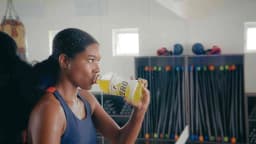
Mekanism structured the Stronger Everyday creative around a deliberate contrast. Stephen Curry, one of the most recognisable athletes in the United States at the peak of his Golden State Warriors success in 2016, appears alongside unnamed, non-famous individuals engaged in activities including yoga, running, dancing, and football.
That structural choice is the campaign's primary creative argument. Rather than using Curry as an aspirational apex — the unattainable ideal toward which consumers should strive — Mekanism positions him as a fellow participant in a shared pursuit of daily improvement. The tagline Stronger Everyday functions as the connective tissue, asserting that elite athletes and recreational movers are engaged in the same fundamental project, differing only in scale. As Tommy Means stated in Advertising Age, the idea of getting a little bit stronger every day was chosen precisely because it resonates with both groups simultaneously, without alienating either.
The campaign ran across 15-second, 30-second, and 60-second television formats, as reported by Advertising Age, allowing the creative team to build narrative depth in longer formats while distilling the core message to its essence in short-form placements suited to digital and social environments. The multi-length approach reflects disciplined production planning, ensuring the central idea survives compression without losing meaning. Managing Director Michael Zlatoper and Executive Creative Director Tommy Means led the work at Mekanism. The campaign's visual and tonal registers are calibrated to feel inclusive rather than intimidating, a distinction that required deliberate restraint in an industry category that frequently defaults to high-intensity imagery and extreme physical transformation narratives. Production credits beyond agency leadership are not publicly documented in available sources.
No verified performance data for the Stronger Everyday campaign is publicly available in terms of sales lift, brand-tracking shifts, or media delivery figures attributable to this specific effort.
Structural analysis of the campaign's design, however, points to several decisions that would typically support effectiveness. The choice of Stephen Curry at the height of his cultural visibility in the United States in 2016 ensured immediate earned media amplification alongside paid placement. As reported by Advertising Age, Muscle Milk CMO Nikki Brown indicated that additional athletes could appear in future campaign rounds, suggesting the brand viewed Stronger Everyday as a platform with intended longevity rather than a one-time flight — a signal of internal confidence in the strategic direction.
The multi-format production across 15-, 30-, and 60-second spots, paired with digital, social, print, and radio support, reflects a media architecture designed for broad reach rather than niche depth, consistent with a repositioning objective that required new audiences to encounter the brand, not just existing customers to be reminded of it. The United States sports-nutrition market's scale — $7.4 billion in 2016 according to Nutritional Outlook — indicates the commercial opportunity that a successful broadening of Muscle Milk's appeal could address. The campaign's Clapboard Score of 60 out of 100 reflects a strategically coherent and competently executed piece of work whose ambition to reframe a category-entrenched brand is clear, though the creative execution does not depart substantially from established conventions in performance drink advertising.
Stronger Everyday is a 2016 United States brand repositioning campaign created by Mekanism for Muscle Milk. It launched on April 19, 2016, starring Stephen Curry alongside non-famous everyday athletes. The campaign ran on television and across digital, social, print, and radio to broaden Muscle Milk's audience beyond hardcore gym culture.
Mekanism created the Stronger Everyday campaign for Muscle Milk. The San Francisco-based agency led the work under Executive Creative Director Tommy Means and Managing Director Michael Zlatoper. Mekanism's approach centred on making the brand feel accessible to everyday athletes, not only competitive or professional ones, as stated by Means in Advertising Age.
Stephen Curry had endorsed Muscle Milk since 2013, according to Advertising Age, providing continuity. His public persona combined elite achievement with broad relatability, making him an effective bridge between hardcore performance positioning and the everyday athlete audience Muscle Milk needed to reach with this 2016 United States repositioning effort.
The stated goal was to make Muscle Milk more approachable, as CytoSport CMO Nikki Brown told Advertising Age. The campaign specifically aimed to attract women and recreational exercisers in the United States, expanding beyond the young male weightlifter audience that had historically defined the brand's core consumer base.
The campaign ran in 15-second, 30-second, and 60-second television spots as its primary channel, as reported by Advertising Age. Supporting media included digital, social, print, and radio placements across the United States market, giving Mekanism and Muscle Milk flexible reach across both mass broadcast and targeted digital environments simultaneously.
Clapboard assigns Stronger Everyday a score of 60 out of 100. The score reflects the campaign's clear strategic intent and credible use of Stephen Curry as spokesperson, balanced against creative execution that remains largely conventional within the competitive United States sports-nutrition and performance drink advertising landscape of 2016.
.webp)
Creative Collaboration Platform: The Backbone of Modern Creative WorkWhat is a creative collaboration platform?Clapboard defines a creative collaboration platform as the operational core for today’s distributed creative teams. This is not a collection of digital collaboration tools stitched together; Clapboard’s system


Understanding the Creative Production MarketplaceWhat is a Creative Production Marketplace?Clapboard defines a creative production marketplace as a structured ecosystem where brands, agencies, and production talent converge to execute video, advertising, and branded content at scale. Unlike the legacy agency or freelanREAD FULL ARTICLE

The Urgent Need for a Creative Production Operating SystemWhy Traditional Creative Production Models Break DownClapboard sees the creative production landscape shifting under pressure. Content velocity is no longer a buzzword—it’s a mandate. Modern advertising demands relentless output across dozens of channels, each wREAD FULL ARTICLE