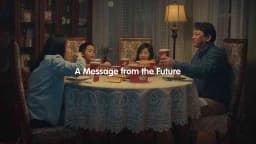
McDonald's Family Time Forever, created by Leo Burnett Dubai in September 2011, launched a family togetherness movement across the UAE and GCC with a 45-second

McDonald's Family Time Forever Captures Gulf Family Life in 2011
Family Time Forever is a 2011 integrated advertising campaign created by Leo Burnett Dubai for McDonald's in the United Arab Emirates, built around a single emotional truth: working parents in the Gulf are spending less time with their children, and McDonald's can be the place where that balance is restored.
The campaign launched in September 2011 across the GCC, anchored by a 45-second television commercial directed by Karen Cunningham and produced by Joy Films. The film places children at the centre of the narrative, showing them actively reclaiming their parents from the pressures of work and professional obligation, with McDonald's positioned as the destination where family time is protected and celebrated. The tone is warm and observational rather than aspirational, drawing on recognisable domestic moments that resonate with families living and working across the United Arab Emirates and the broader Gulf region.
The campaign's ambition extended well beyond the television screen. Leo Burnett Dubai built a fully integrated programme spanning print, outdoor, radio, digital, and in-store execution. On Facebook, Twitter, and Foursquare, the campaign created participatory moments for families to register their commitment to shared time. Inside McDonald's restaurants, the Parent Report Card tray liner allowed children to grade their parents on attendance at family events — a piece of in-store theatre that turned an everyday meal into a structured conversation between generations. A pledge mechanism further formalised the campaign's movement-building intention, inviting parents across the UAE to make a public commitment to prioritising family time. Clapboard scores Family Time Forever at 64 out of 100, reflecting a campaign with strong emotional architecture and genuine integration across channels.

McDonald's UAE identified a tension at the heart of Gulf family life. Rapid economic development across the United Arab Emirates had created a professional culture in which long working hours and career ambition were pulling parents away from family commitments, producing a measurable emotional gap that McDonald's could credibly address. Rather than promoting a product or a price point, Family Time Forever positioned the restaurant as a facilitator of reconnection — a strategy aligned with the brand's established role as a family dining destination across the Middle East.
Peter Bidenko, Regional Executive Creative Director at Leo Burnett, articulated the strategic intent clearly. As reported by Campaign Middle East on September 26, 2011, Bidenko stated: "As a family restaurant, McDonald's wanted to recognise a good work/life balance and do something about it. 'Family Time Forever' is creating a simple movement to remind us all to spend more time with our children." That framing — a movement rather than a campaign — signals a strategy designed for longevity and community participation, not a single burst of awareness advertising.
The competitive context in which McDonald's operated across the UAE in 2011 was meaningful. McDonald's had launched the global "i'm lovin' it" platform in 2003, according to Wikipedia, and Family Time Forever operated as a locally adapted execution within that broader brand architecture, shifting the register from product enthusiasm toward emotional family positioning. In the United States market, where competitive dynamics were most closely tracked, McDonald's sat alongside Burger King and Subway as the dominant quick-service restaurant chains, according to Studocu research drawn from period data. Burger King's revenue declined by approximately two and a half percent in 2010, according to the same source, a context that reinforced the strategic logic of McDonald's investing in deeper brand affinity rather than competing solely on product or price. In the United Arab Emirates, where the quick-service sector was growing rapidly during this period, a values-led campaign targeting family loyalty represented a differentiated position in the market.
Karen Cunningham directed the Family Time Forever film for McDonald's UAE. Production was handled by Joy Films, with Rita El Hachem serving as producer on the project. The creative leadership at Leo Burnett Dubai, under Regional Executive Creative Director Peter Bidenko, shaped a campaign that treated film not as a vehicle for product display but as a vessel for emotional storytelling rooted in Gulf family experience.
The 45-second commercial builds its impact through restraint. Children are the active protagonists, shown navigating the adult world of work and obligation to reach their parents and bring them back to the family table. The narrative logic is simple and transferable — any parent watching recognises the implicit accusation and the implicit invitation simultaneously. Cunningham's direction keeps the emotional temperature calibrated: the film does not lecture or moralize, it observes and gently provokes. The production company Joy Films brought the necessary craft to translate Leo Burnett Dubai's concept into a piece of work that could hold attention in a competitive GCC television environment.
The creative execution across the integrated campaign maintained tonal consistency with the film. The Parent Report Card tray liner, deployed inside McDonald's restaurants across the United Arab Emirates, demonstrated an understanding that the most powerful creative moments in an integrated campaign often occur at the point of purchase, when a consumer is physically present and emotionally receptive. Designing a piece of in-restaurant material that invites a child to formally evaluate their parent's performance as a family participant required both creative courage and a deep understanding of the parent-child dynamic that drives family dining decisions in the UAE. The digital activations on Facebook, Twitter, and Foursquare extended the campaign's participatory mechanics into the social spaces where Gulf families were increasingly spending time in 2011, ensuring the movement-building intention of the campaign had a platform for ongoing expression beyond broadcast media.
Family Time Forever received a Bronze award at the Dubai Lynx 2012 awards, as documented by LinkedIn and referenced by Clapboard. The Dubai Lynx is the region's most significant creative industry recognition event, and a Bronze acknowledgement for a campaign operating in the Food and Drink category against work from across the Middle East and North Africa reflects meaningful peer recognition of the campaign's creative and strategic quality.
No additional verified performance data — including sales uplift, brand tracking movement, or digital engagement metrics — for Family Time Forever is publicly available. What the campaign's structural design does make legible, however, is a clear theory of effectiveness. The Parent Report Card tray liner created a direct behavioural intervention at the moment of consumption, potentially influencing repeat visit intention by connecting the restaurant visit to a positive family narrative. The pledge mechanism generated a form of public social commitment that behavioural science consistently links to follow-through. The integration of broadcast film with in-restaurant activation and digital participation channels created multiple points of reinforcement for the campaign's central message, reducing reliance on any single medium to carry the full emotional and persuasive weight of the work.
Campaign Middle East reported the campaign as a major marketing drive across the GCC upon its September 2011 launch, a characterisation that confirms the scale of investment McDonald's and Leo Burnett Dubai committed to the initiative. For a regional campaign produced in the United Arab Emirates in 2011, that scale of integration — spanning television, print, outdoor, radio, digital, and in-store — represents a level of channel commitment consistent with a brand seeking durable emotional positioning rather than short-term sales activation. The Clapboard Score of 64 out of 100 reflects a campaign that executes its emotional strategy with discipline and creative craft, while leaving measurable room for the kind of performance transparency that would elevate the work's legacy.
Family Time Forever is a 2011 integrated campaign created by Leo Burnett Dubai for McDonald's in the United Arab Emirates. It centres on a 45-second film showing children reclaiming parents from work, supported by in-restaurant Parent Report Cards, a pledge mechanism, and digital activation across Facebook, Twitter, and Foursquare.
Karen Cunningham directed the Family Time Forever film for McDonald's UAE. Production was handled by Joy Films, with Rita El Hachem as producer. The campaign was created by Leo Burnett Dubai under Regional Executive Creative Director Peter Bidenko, who described the initiative as a movement to remind parents to spend more time with their children.
Family Time Forever received a Bronze award at the Dubai Lynx 2012, the region's leading creative advertising competition, as documented by LinkedIn and Clapboard. The award recognised the campaign's creative and strategic quality within the Food and Drink category across the Middle East and North Africa advertising market.
Family Time Forever launched across the GCC in September 2011, with the United Arab Emirates as the primary market. Campaign Middle East reported the initiative as a major marketing drive across the Gulf region, encompassing television, print, outdoor, radio, digital, and in-store channels simultaneously upon its September 2011 launch.
Family Time Forever operated as a locally adapted execution within McDonald's global i'm lovin' it platform, which launched in 2003 according to Wikipedia. Rather than replacing the global brand framework, the UAE campaign shifted its register toward family togetherness and parent-child emotional connection, tailored specifically to Gulf family culture and values in 2011.
The Parent Report Card was an in-restaurant tray liner deployed across McDonald's locations in the United Arab Emirates as part of the Family Time Forever campaign. It allowed children to formally grade their parents on attendance at family events, turning a standard meal moment into a structured, emotionally resonant conversation between parent and child.
.webp)
Creative Collaboration Platform: The Backbone of Modern Creative WorkWhat is a creative collaboration platform?Clapboard defines a creative collaboration platform as the operational core for today’s distributed creative teams. This is not a collection of digital collaboration tools stitched together; Clapboard’s system


Understanding the Creative Production MarketplaceWhat is a Creative Production Marketplace?Clapboard defines a creative production marketplace as a structured ecosystem where brands, agencies, and production talent converge to execute video, advertising, and branded content at scale. Unlike the legacy agency or freelanREAD FULL ARTICLE

The Urgent Need for a Creative Production Operating SystemWhy Traditional Creative Production Models Break DownClapboard sees the creative production landscape shifting under pressure. Content velocity is no longer a buzzword—it’s a mandate. Modern advertising demands relentless output across dozens of channels, each wREAD FULL ARTICLE