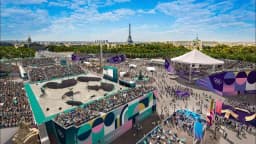
LVMH's 'À nous deux, Paris !' campaign, created by Havas Play in 2024, positions the luxury group as the artisan behind every Olympic victory across France.

LVMH Bets on Paris 2024 to Reframe Luxury as Athletic Mastery
LVMH's 'À nous deux, Paris!' campaign is a 2024 Olympic-era film created by Havas Play that places five elite French athletes across the rooftops of Paris to assert the luxury group's identity as the artisan behind every form of victory, athletic and cultural alike.
Launched in April 2024, fewer than 100 days before the opening ceremony of the Paris 2024 Olympic and Paralympic Games, the campaign positions LVMH not merely as a sponsor but as a native institution of the city it helped define. The work carries the subtitle 'The Rooftops,' a visual and conceptual framework that situates athletes — among them swimmer Léon Marchand, fencer Enzo Lefort, wheelchair fencer Pauline Déroulède, rugby union captain Antoine Dupont, and rhythmic gymnast Mélanie de Jesus dos Santos — against some of Paris's most recognisable architectural landmarks, including the Fondation Louis Vuitton, the Panthéon, and the heights of Montmartre, according to lvmh.com. The campaign's hashtag, #ArtisanDeToutesLesVictoires, translates as 'artisan of all victories,' a phrase that binds LVMH's centuries-old craft heritage to the pursuit of sporting excellence.
In France, the campaign ran across a comprehensive suite of formats: a 60-second hero film, a 30-second cut-down, event-schedule billboards, social media content, and five display and print formats, as documented by lvmh.com. This multi-channel deployment ensured the campaign registered across urban environments and digital platforms simultaneously, creating a unified presence as France prepared to host the world. The Clapboard Score for this campaign is 69 out of 100, reflecting strong cultural resonance and production ambition tempered by the inherent challenge of distinguishing a corporate Olympic sponsorship narrative from the broader noise of Games-adjacent advertising.
 ARCHIVE
LVMH secured a premium partnership with the Paris 2024 Olympic and Paralympic Games at a cost of approximately 150 million euros, according to luxurydaily.com. That investment reflects a deliberate strategic shift: rather than associating individual maisons with individual athletes, the group chose to present itself as a collective force — a single artisan identity underwriting the entire French athletic enterprise. The tagline 'Artisan de toutes les victoires' makes this logic explicit, drawing a direct line between the craft disciplines that built houses like Louis Vuitton and Dior and the physical disciplines that produce Olympic champions.
The strategic insight driving the campaign is that luxury and elite sport share a structural DNA: both are built on years of invisible preparation, technical mastery, and the pursuit of a singular moment of perfection. In France, where national identity is deeply entangled with both cultural prestige and sporting passion, this convergence carries particular emotional weight. The Paris 2024 Games offered LVMH a once-in-a-generation opportunity to assert that the city's greatness is inseparable from the group's own history within it.
The competitive landscape for Olympic sponsorship in France in 2024 was crowded with global sportswear brands, notably Nike and Adidas. Nike reported revenue of approximately 51.36 billion dollars in 2024, according to globaldata.com, while Adidas reported revenue of approximately 25.5 billion dollars in the same period, according to Businessday Ng. Against competitors whose core identity is performance sport, LVMH's strategic gamble was to reframe the terms of the conversation entirely, positioning craftsmanship and cultural legacy as performance attributes in their own right rather than competing on athletic-wear metrics the group does not occupy.
Director Louis de Caunes helmed 'À nous deux, Paris! / The Rooftops,' bringing to the film a sensibility tuned to the theatrical possibilities of the French capital itself, as credited by lvmh.com and confirmed via linkedin.com. The central creative idea is architectural and symbolic in equal measure: placing athletes on the rooftops of Paris allows the film to frame their bodies against the city's skyline, suggesting that the athletes and the city are coextensive — that Paris's monuments and its champions are made of the same material.
Each athlete's presence in the film is choreographed to reflect their discipline while remaining visually unified by the rooftop geography. Léon Marchand, who would go on to become the defining athlete of the Paris 2024 Games, appears alongside Antoine Dupont, Enzo Lefort, Pauline Déroulède, and Mélanie de Jesus dos Santos, a casting decision that spans aquatics, rugby, fencing, para-sport, and gymnastics, giving the film breadth without diluting its visual coherence. The inclusion of Pauline Déroulède, who competes in para-fencing, signals that LVMH's definition of athletic excellence under the Paris 2024 banner is explicitly inclusive of the Paralympic programme.
The production extended well beyond the hero film. Event-schedule billboards placed across France gave the campaign a functional civic dimension, turning LVMH's brand presence into genuinely useful public information during the Games period, as documented by lvmh.com. Five distinct display and print formats allowed the visual language of the rooftops — golden light, Parisian stone, athletic posture — to migrate into editorial and outdoor contexts without losing coherence. The campaign's French-language tagline, 'À nous deux, Paris,' is idiomatic and untranslatable in a single English phrase, a deliberate choice that roots the work in French cultural specificity rather than reaching for a globalised neutrality.
The campaign accumulated 36,868 views, 547 likes, and 31 comments on the platform where it was submitted, according to Clapboard's own archive data. These figures represent a snapshot of documented engagement rather than a complete media performance picture, as the campaign's primary distribution occurred across French out-of-home environments, broadcast placements, and LVMH's owned social channels in the months preceding the Paris 2024 Olympic Games.
No independently verified third-party audience reach or brand-lift figures for 'À nous deux, Paris!' are publicly available at the time of writing. What the structural evidence does confirm is that LVMH's broader Paris 2024 partnership, valued at approximately 150 million euros according to luxurydaily.com, created a platform of exceptional scale. In France, the Olympic Games drew one of the largest domestic and international media audiences in the country's broadcast history, meaning the campaign's distribution environment was inherently high-reach.
Structurally, the campaign's effectiveness rests on two durable advantages. First, the athlete roster proved prescient: Léon Marchand became the most decorated individual athlete of Paris 2024 by any measure, which retroactively amplified the credibility of LVMH's association with him. Second, the multi-format deployment — from 60-second film to event-schedule billboards — ensured that the campaign served both emotional and functional roles for audiences across France, a combination that tends to sustain brand salience beyond the immediate campaign window. The Clapboard Score of 69 out of 100 reflects these structural strengths while acknowledging that corporate Olympic narratives, however well executed, carry an inherent ceiling on distinctiveness within a saturated sponsorship environment.
LVMH's 'À nous deux, Paris!' is a 2024 Olympic film created by Havas Play that places five elite French athletes on Parisian rooftops to connect the luxury group's craft heritage with the pursuit of athletic excellence ahead of the Paris 2024 Olympic and Paralympic Games. The campaign's subtitle is 'The Rooftops.'
Five athletes appeared in 'The Rooftops' campaign. Léon Marchand, Antoine Dupont, Enzo Lefort, Pauline Déroulède, and Mélanie de Jesus dos Santos represented aquatics, rugby, fencing, para-fencing, and rhythmic gymnastics respectively, reflecting the breadth of both the Olympic and Paralympic programmes hosted in France in 2024.
Louis de Caunes directed the 'À nous deux, Paris! / The Rooftops' film for LVMH, as credited by lvmh.com. The campaign was created by Havas Play, with Chief Creative Officer Fabrice Plazolles leading the creative work on behalf of the agency for the Paris 2024 Olympic Games campaign.
LVMH paid approximately 150 million euros for its premium partnership with the Paris 2024 Olympic and Paralympic Games, according to luxurydaily.com. This investment underpinned a multi-format campaign spanning film, billboards, social media, and display formats distributed across France in the months leading up to the Games.
The campaign ran across a 60-second hero film, a 30-second cut-down, event-schedule billboards, social media content, and five display and print formats, as documented by lvmh.com. This multi-channel approach gave 'The Rooftops' campaign simultaneous presence in outdoor, digital, and editorial environments across France throughout the Paris 2024 Olympic period.
LVMH's 'À nous deux, Paris!' campaign receives a Clapboard Score of 69 out of 100. The score reflects strong cultural resonance, a well-cast athlete roster, and high production ambition, offset by the structural challenge of achieving distinctiveness within the saturated sponsorship environment surrounding the Paris 2024 Olympic Games in France.
.webp)
Creative Collaboration Platform: The Backbone of Modern Creative WorkWhat is a creative collaboration platform?Clapboard defines a creative collaboration platform as the operational core for today’s distributed creative teams. This is not a collection of digital collaboration tools stitched together; Clapboard’s system


Understanding the Creative Production MarketplaceWhat is a Creative Production Marketplace?Clapboard defines a creative production marketplace as a structured ecosystem where brands, agencies, and production talent converge to execute video, advertising, and branded content at scale. Unlike the legacy agency or freelanREAD FULL ARTICLE

The Urgent Need for a Creative Production Operating SystemWhy Traditional Creative Production Models Break DownClapboard sees the creative production landscape shifting under pressure. Content velocity is no longer a buzzword—it’s a mandate. Modern advertising demands relentless output across dozens of channels, each wREAD FULL ARTICLE