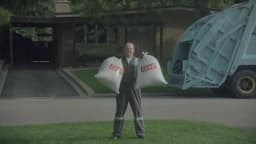
Loctite's 2018 Brazilian campaign pits strongman athletes Ivan Campos and Marcos Ferrari against Super Bonder Ultra, generating 57 million digital impacts

Loctite Puts Super Bonder Ultra Against Brazil's Strongest Men
Loctite's "World's Strongest Men vs. Loctite Super Bonder Ultra" is a 2018 Brazilian film campaign created by Talent Marcel in São Paulo, in which two professional strength athletes attempt to break bonds formed by Super Bonder Ultra adhesive on metal, wood, and rubber surfaces, demonstrating the household product's performance through a direct physical challenge.
Published in October 2018, the campaign features Brazilian strongman athletes Ivan Campos and Marcos Ferrari as its central protagonists, according to adsoftheworld.com. The premise is straightforward: if the world's strongest men cannot pull apart what Super Bonder Ultra has bonded, the product's performance case is made without a single technical claim. The film was produced by Malabar Filmes and directed by Guilherme Festa, with creative direction shared between Sleyman Khodor and Rodrigo Lugato at Talent Marcel. Loctite is owned by Henkel, as confirmed by henkel.com, giving the campaign the institutional backing of one of the world's largest adhesive manufacturers.
In Brazil, the campaign was distributed across YouTube, Loctite's Facebook page, and online portals, according to Gkpb Com Br. Pre-launch activity extended the narrative beyond the film itself: an interview with Marcos Ferrari aired on Rádio Transamérica, after which Loctite's social media channels issued a direct challenge to the athlete, generating anticipation before the film's release, as reported by gkpb.com.br. The campaign contains a single media asset and sits within the house and garden category. According to clapboard.com, the campaign generated approximately 57 million digital impacts, establishing it as a measurable performance exercise for a household product in the Brazilian market. Clapboard rates this campaign 60 out of 100.
Loctite structured the campaign around a consumer insight rooted in scepticism. Household adhesive products compete in a category where performance claims are routine and largely interchangeable, making differentiation through product demonstration a more credible strategic lever than brand storytelling alone. In Brazil, where Loctite operates as a Henkel brand alongside its Pattex adhesive line, the challenge is to convert category awareness into product-specific conviction.
The strength-test format addresses this directly. Rather than asserting that Super Bonder Ultra is the strongest adhesive in its class, the campaign externalises the proof by recruiting Ivan Campos and Marcos Ferrari — two Brazilian athletes whose professional identities are built on physical strength — and placing the product's performance claim in their hands, as documented by adsoftheworld.com. If the bond holds against their effort, the argument requires no further elaboration. This is a demonstration mechanic with a long lineage in adhesive advertising: Fallon's 2015 Super Bowl campaign for Loctite in the United States, as reported by mediapost.com, also leaned on irreverent performance theatre, though it targeted a mass American audience through humour rather than through direct physical test.
In the Brazilian market, Loctite faces competition from global players including 3M and Gorilla Glue, both identified as major competitors in the instant adhesives category by researchandmarkets.com. According to researchandmarkets.com, the global instant adhesives market is estimated to reach approximately 2.92 billion US dollars by 2025 and 5.51 billion US dollars by 2032, reflecting a compound annual growth rate of 9.48 percent, though these figures are forward projections rather than 2018 estimates. The pre-launch radio and social media sequencing, as reported by gkpb.com.br, suggests a deliberate attempt to build earned engagement in Brazil before the primary film asset was released, extending the campaign's reach without proportionate paid media investment.

Director Guilherme Festa helmed the production for Malabar Filmes, working from a creative concept developed by Talent Marcel's São Paulo team under creative directors Sleyman Khodor and Rodrigo Lugato, as documented by clapboard.com. The film's craft proposition rests on restraint: the strongest argument for a household adhesive is not a laboratory setting or an animated demonstration, but a real physical contest captured on camera with sufficient production value to convey authenticity.
Art direction was handled by Rodrigo Lugato, Francine Ther, and Guilherme Serato, with copywriting by Lucas Siqueira, according to clapboard.com. The creative and interactivity direction was led by Marcello Droopy, with interactivity and strategy managed by Lúcio Freitas. The interactivity team — Pedro Aranha, Júlio Cesar Figueredo, Guta Silva, Maria Eugênia Lucchesi, and Maria Clara Passos — suggests the campaign was conceived with digital engagement mechanics built into its architecture from the outset, not appended as an afterthought, as listed by clapboard.com.
The pre-launch radio interview on Rádio Transamérica with Marcos Ferrari, followed by Loctite's social media challenge, reflects an integrated content sequencing strategy that treats the film as the centrepiece of a broader activation rather than a standalone broadcast asset, as reported by gkpb.com.br. Client services were managed by Janaina Pacheco, Antonio Agrelli Neto, and Guilherme Alcatrão, with planning led by Gabriela Soares and Mariana Crepaldi, per clapboard.com. The production approach for a house and garden household product category prioritises visceral credibility: the audience in Brazil is invited to watch the claim fail or succeed in real time, which is a more demanding creative commitment than a standard product demonstration format.
Loctite's "World's Strongest Men vs. Loctite Super Bonder Ultra" generated approximately 57 million digital impacts, the sole verified performance metric publicly available for this campaign, according to clapboard.com. For a single-asset film campaign distributed through YouTube, Facebook, and online portals in Brazil, that figure represents a substantial organic and paid reach outcome for a household product in the house and garden category.
No additional performance data — including completion rates, engagement figures, or sales uplift metrics — is publicly available for this campaign. Structurally, however, the campaign demonstrates several characteristics associated with high-distribution performance. The pre-launch earned media sequence on Rádio Transamérica and across Loctite's social channels, as reported by gkpb.com.br, created a narrative arc that gave audiences in Brazil a reason to seek out the film rather than simply encounter it passively. The strength-test format, featuring Ivan Campos and Marcos Ferrari, generates a binary tension — the bond either holds or it does not — that functions as a natural sharing prompt. According to adsoftheworld.com, the campaign was submitted to international creative databases, indicating recognition within the advertising industry of its craft and strategic construction. Henkel, as the parent company behind Loctite, operates in Brazil with a portfolio broad enough to sustain campaigns of this production scale, as confirmed by henkel.com. The Clapboard Score of 60 out of 100 reflects a campaign that executes its core demonstration mechanic with confidence but does not significantly extend the creative or strategic boundaries of the household adhesive category.
Loctite's 2018 Brazilian campaign challenges two professional strongman athletes to break bonds formed by Super Bonder Ultra on metal, wood, and rubber surfaces. Created by Talent Marcel in São Paulo and directed by Guilherme Festa, the film was distributed across YouTube and Facebook in Brazil, generating approximately 57 million digital impacts, according to clapboard.com.
Brazilian strength athletes Ivan Campos and Marcos Ferrari appeared in the campaign. Marcos Ferrari also participated in a pre-launch interview on Rádio Transamérica, after which Loctite's social media channels issued a direct challenge to him, as reported by gkpb.com.br, building audience anticipation before the film's October 2018 release in Brazil.
Talent Marcel, based in São Paulo, created the campaign. Creative directors Sleyman Khodor and Rodrigo Lugato led the concept, while Guilherme Festa directed the film for production company Malabar Filmes. Copywriter Lucas Siqueira and art directors Francine Ther and Guilherme Serato also contributed, according to clapboard.com.
The campaign generated approximately 57 million digital impacts in Brazil, according to clapboard.com. This is the only verified performance metric publicly available. The campaign was distributed across YouTube, Loctite's Facebook page, and online portals, supported by a pre-launch radio and social media sequence designed to build earned engagement before the film's release.
Clapboard rates the campaign 60 out of 100. The score reflects confident execution of a physical demonstration mechanic for a household product but notes the campaign does not significantly extend the creative boundaries of the instant adhesive category. The film remains a well-constructed single-asset execution for the Brazilian market.
Henkel owns Loctite, as confirmed by henkel.com. Henkel also markets the Pattex adhesive brand in Brazil, making it a significant competitor to itself within the broader instant adhesives category. Globally, Loctite competes against 3M and Gorilla Glue, both identified as major category players by researchandmarkets.com.
.webp)
Creative Collaboration Platform: The Backbone of Modern Creative WorkWhat is a creative collaboration platform?Clapboard defines a creative collaboration platform as the operational core for today’s distributed creative teams. This is not a collection of digital collaboration tools stitched together; Clapboard’s system


Understanding the Creative Production MarketplaceWhat is a Creative Production Marketplace?Clapboard defines a creative production marketplace as a structured ecosystem where brands, agencies, and production talent converge to execute video, advertising, and branded content at scale. Unlike the legacy agency or freelanREAD FULL ARTICLE

The Urgent Need for a Creative Production Operating SystemWhy Traditional Creative Production Models Break DownClapboard sees the creative production landscape shifting under pressure. Content velocity is no longer a buzzword—it’s a mandate. Modern advertising demands relentless output across dozens of channels, each wREAD FULL ARTICLE