 ARCHIVE
Liquid Death Turns Half a Million Cases Into the Biggest Ad Ever
Liquid Death's "The Biggest Ad Ever" is a February 2024 United States campaign that auctioned branding rights on a national run of more than 500,000 cases of its canned water to any bidder via eBay, positioning retail packaging as a higher-reach alternative to a Super Bowl television spot during the Big Game advertising period.
The campaign launched on eBay on February 6, 2024, at 8:00 a.m. Pacific Time, according to valueaddedresource.net, with bidding opening at just $500. The auction closed on February 13, 2024, at 8:00 a.m. Pacific Time, per the same source. The mechanic was deliberately simple: one winning brand would receive their logo or creative printed across the side of Liquid Death cases distributed through the brand's top national retail partners. The proposition was framed not as a novelty but as a media buy — one with a measurable audience claim at its centre.
In the United States, Liquid Death argued that over 200 million people walk through the doors of its top retailers every week, compared with the roughly 110 million viewers reached by a Big Game television commercial, which commands upward of six million dollars per spot. That contrast formed the entire strategic and creative backbone of the campaign. By putting a dollar figure and an audience size next to each other and letting the arithmetic do the work, the brand converted its own packaging infrastructure into a media product — and then sold that product publicly, to whoever wanted it most. The Clapboard Score for this campaign is 79 out of 100, reflecting its structural originality, media logic, and the verifiable commercial outcome it generated.
ARCHIVEAndy Pearson serves as Vice President of Creative at Liquid Death. Speaking to Muse by Clio on February 6, 2024, Pearson stated that Super Bowl advertising prices have "gotten so astronomical, we couldn't justify it," and noted that Liquid Death already gets "twice as many impressions in stores every single week" compared with a single Super Bowl spot. His follow-on question — "So, why not give someone else the chance to reach a big audience who didn't want to plunk down all that money for an ad in one football game?" — encapsulates the entire strategic rationale of the campaign, as reported by Muse by Clio.
The insight driving the campaign is that mass consumer exposure in the United States does not depend exclusively on expensive, one-time broadcast events. Purchase decisions happen in physical retail environments, and a brand with genuine national distribution can plausibly claim that its packaging constitutes a continuous advertising surface — one that travels through supply chains, sits on shelves, and passes through millions of hands each week. Liquid Death's campaign made that claim auditable by attaching a live auction to it, turning an abstract distribution argument into a publicly tested commercial proposition.
The competitive context matters here. In the sparkling and flavoured water segment, Liquid Death competes against established players including LaCroix, owned by National Beverage Corp, and Bubly, owned by PepsiCo — both brands with significantly larger legacy media budgets and conventional advertising presences. Rather than match that spend, Liquid Death converted its retail footprint into a differentiator, as noted by contagious.com in their April 17, 2024, editorial framing of the campaign as an act of subversion against traditional media logic. The flavoured sparkling water segment was valued at growing at a strong compound annual rate through the mid-2030s, according to emergenresearch.com, underscoring how competitive the broader non-alcoholic drinks category had become in the United States by 2024.
Andy Pearson led the creative development of "The Biggest Ad Ever" in his dual capacity as Vice President of Creative and, per musebyclios.com, as writer and creative director on the campaign. The execution took deliberate aim at the conventions of Big Game advertising — not by producing a cinematic television spot but by refusing to produce one at all, and then turning that refusal into the advertisement itself.
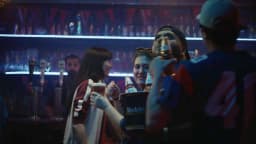
The film asset at the centre of the campaign is built around direct comparison. It presents the audience size and cost figures for a Super Bowl commercial, then immediately offers a competing set of numbers: over 200 million weekly retail visits versus approximately 110 million television viewers, and a starting bid of $500 against a media buy exceeding six million dollars. The creative choice to present this as a straight-faced media pitch — delivered in the deadpan register that has defined Liquid Death's brand voice since its founding — means the campaign functions simultaneously as a provocation, a product launch, and a genuine commercial transaction. There is no ironic distance between the joke and the offer; the offer is the joke, and the joke closes at real money.
The eBay auction format was itself a creative decision. By hosting the sale on a consumer marketplace rather than through a bespoke branded portal or agency intermediary, Liquid Death signalled that this was a real transaction with real stakes. The resulting media coverage — which was substantial across trade and consumer press in the United States — was structurally earned by the auction mechanic rather than purchased separately. As contagious.com observed in its April 2024 analysis, the campaign's willingness to let the market set the price was central to its credibility and its cultural impact. The campaign contains one documented media asset, a film, as recorded on clapboard.com.
Coinbase won the eBay auction for "The Biggest Ad Ever." According to News Designrush, the winning bid was reported at approximately $355,000 to $355,500. However, Coinbase itself reported the total transaction value as $500,114, paid in USDC — a figure cited by Directtoconsumer Co — reflecting what appears to be the full commercial value of the placement including any associated fees or agreed terms. Coinbase received branding on approximately 500,000 Liquid Death cases distributed through national retail, per directtoconsumer.co.
No third-party verified audience measurement for the resulting in-store impressions is publicly available. However, the structural effectiveness of the campaign can be assessed independently of that figure. The auction itself generated substantial earned media across the United States during the Big Game advertising period — a window when advertising coverage is at its annual peak and competition for editorial attention is highest. By entering that conversation with a novel, verifiable, and genuinely purchasable product, Liquid Death secured coverage that a conventional media buy of equivalent value would be unlikely to replicate.
The campaign's film recorded 456,839 views and 614 likes on the platform where it was distributed, as documented on clapboard.com. The eBay auction format also introduced a layer of participatory engagement — any brand, including small businesses, could have entered the bidding — that extended the campaign's reach beyond its direct media spend. As a demonstration that retail packaging can function as a traded media surface in the United States non-alcoholic drinks market, the campaign produced a commercially verifiable outcome that most advertising stunts of comparable ambition do not.
"The Biggest Ad Ever" is a February 2024 Liquid Death campaign that auctioned branding space on more than 500,000 cases of its canned water via eBay during the Big Game advertising period. The campaign positioned retail packaging as a higher-reach alternative to a Super Bowl spot, with bidding starting at $500 and the winning bid reported at over $500,000.
Coinbase won the eBay auction for Liquid Death's "The Biggest Ad Ever" campaign. Coinbase reported paying $500,114 in USDC for the placement, according to directtoconsumer.co, and received branding across approximately 500,000 Liquid Death cases distributed through national retail partners in the United States.
Liquid Death claimed over 200 million people visit its top US retail partners every week, compared with roughly 110 million viewers for a Super Bowl broadcast. Andy Pearson, Vice President of Creative at Liquid Death, stated the brand already earns twice as many weekly in-store impressions as a single Super Bowl spot, as reported by Muse by Clio.
Liquid Death hosted the auction on eBay to signal that the transaction was real and open to any bidder, including small businesses. The public marketplace format meant the auction mechanic itself generated earned media coverage across the United States during the Big Game period, as noted by contagious.com in its April 2024 analysis of the campaign's strategic logic.
Andy Pearson, Vice President of Creative at Liquid Death, led the campaign as writer and creative director, according to musebyclios.com. The agency behind the work was not publicly disclosed. The campaign launched in the United States in February 2024 and centred on a single film asset paired with a live eBay auction for packaging space on more than 500,000 cases.
Liquid Death's "The Biggest Ad Ever" receives a Clapboard Score of 79 out of 100. The score reflects the campaign's structural originality in converting retail packaging into a traded media surface, the verifiable commercial outcome produced by the eBay auction, and the earned media impact achieved during the highest-attention advertising window of the United States calendar year.
.webp)
Creative Collaboration Platform: The Backbone of Modern Creative WorkWhat is a creative collaboration platform?Clapboard defines a creative collaboration platform as the operational core for today’s distributed creative teams. This is not a collection of digital collaboration tools stitched together; Clapboard’s system


Understanding the Creative Production MarketplaceWhat is a Creative Production Marketplace?Clapboard defines a creative production marketplace as a structured ecosystem where brands, agencies, and production talent converge to execute video, advertising, and branded content at scale. Unlike the legacy agency or freelanREAD FULL ARTICLE

The Urgent Need for a Creative Production Operating SystemWhy Traditional Creative Production Models Break DownClapboard sees the creative production landscape shifting under pressure. Content velocity is no longer a buzzword—it’s a mandate. Modern advertising demands relentless output across dozens of channels, each wREAD FULL ARTICLE