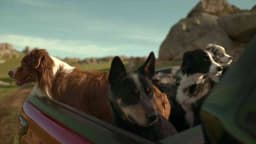
John Deere's Arctic Watch campaign by EP+Co follows the Weber family using a Gator utility vehicle in the Canadian Arctic to dramatise rugged reliability.

John Deere Arctic Watch Bets on the Canadian Arctic to Sell Gator Reliability
Arctic Watch is a 2022 film campaign by John Deere, created by agency EP+Co and published in the United States in April 2022, that follows the Weber family using a John Deere Gator utility vehicle in the Canadian Arctic to explore waterfalls, visit beluga nurseries, and manage their remote land and business.
The campaign's full title — "Tuesday in the Canadian Arctic | John Deere Gator™ Utility Vehicles" — signals its strategic intent immediately. By framing extreme conditions as an unremarkable weekday, John Deere positions the Gator not as exceptional hardware for exceptional people, but as dependable equipment that real owners rely on without ceremony. The Webers are not professional adventurers; they are working landowners whose business and lifestyle happen to unfold in one of the most demanding environments on earth. That distinction carries the entire narrative.
In the United States, where John Deere competes for utility vehicle buyers across agricultural, recreational, and commercial segments, the ability to dramatise reliability without retreating to a test track or a laboratory setting represents a meaningful creative choice. The campaign deploys two media assets and directs viewers in the US market to Deere.com/RunWithUs and Canadian viewers to Deere.ca/RunWithUs, embedding Arctic Watch within the broader "Run With Us" brand platform that EP+Co had been developing for John Deere since its appointment as consumer-equipment agency of record in May 2018, as reported by Little Black Book Online. The campaign belongs to the industrial industry classification and carries a Clapboard Score of 63 out of 100, reflecting execution that is visually confident but constrained in measurable commercial reach.
John Deere grounds Arctic Watch in a consumer insight that runs deeper than product specification: the most persuasive proof of equipment reliability is a real owner who cannot afford failure. The Weber family's dependence on the Gator in the Canadian Arctic is not aspirational storytelling dressed as documentary — it is the conditions under which utility vehicle buyers in remote and rural United States markets already think about their equipment choices. When land management is a livelihood and mechanical failure has no nearby remedy, trust in a brand becomes a purchasing criterion that pricing and feature sheets alone cannot address.
The competitive landscape surrounding the John Deere Gator in the United States utility vehicle segment includes Polaris, whose RANGER lineup commands substantial shelf space at powersports retailers, and Kawasaki, whose MULE series targets comparable utility buyers. Both competitors invest heavily in performance-oriented creative that emphasises speed and versatility. John Deere's counter-positioning through Arctic Watch leans instead into custodianship — the idea that a Gator owner is someone who tends land and sustains a way of life, rather than someone who pushes a machine to its limits for recreation. This distinction aligns with the "pride of ownership and connection to the land" ethos that, according to Little Black Book Online, defined the broader "Run With Us" platform EP+Co built for John Deere across broadcast, web, and social assets.
In the United States, the utility terrain vehicle market represented the largest regional share of global demand. According to Allied Market Research, North America accounted for approximately 43 percent of global UTV demand, with utility cargo vehicles comprising 44 percent of the North American product mix. John Deere's choice to anchor its 2022 campaign on a working family rather than a recreational scenario directly addresses the dominant purchase motivation in its home market.
Arctic Watch earns its visual authority through location. The Canadian Arctic is not a set or a surrogate landscape — it is the actual operating environment of the Weber family, and every frame confirms that the production travelled to capture conditions that could not be reproduced on a soundstage. The film's cinematographic palette privileges the scale of the terrain against the compact silhouette of the Gator, a compositional choice that reinforces the brand's reliability argument through proportion rather than through voiceover.
The credited creative team reflects a focused structure. According to production credits documented for the campaign, Group Creative Director Cory Schearer oversaw the work, with Art Director Jason Lane and Copywriter Chris Vanderkleed responsible for the campaign's visual and verbal identity. Videographer and photographer Matt Charland executed the location photography and film capture, a dual role that speaks to the logistical reality of shooting in the Canadian Arctic, where crew size and equipment access are necessarily constrained. Account Supervisor Ray Reulbach managed the client relationship on behalf of EP+Co.
The narrative structure avoids product demonstration in the conventional advertising sense. There is no comparison grid, no torque figure, no payload specification delivered to camera. Instead, the Webers' Tuesday — exploring waterfalls, observing beluga nurseries, moving across land that demands constant navigation — performs the demonstration implicitly. This is a creative risk, because implicit proof requires a viewer willing to extend trust to the scenario, and it is a risk the film earns through the specificity of the Weber family's situation rather than through manufactured drama. In the United States market, where consumer durables advertising frequently defaults to feature recitation, the restraint of Arctic Watch is both its distinction and its limitation.
No verified campaign-specific performance data — including sales lift, market share movement, or independently audited reach figures — is publicly available for the Arctic Watch campaign. What the campaign's own YouTube metrics indicate is a modest earned audience: the film recorded 3,994 views and 53 likes at the point of documented measurement, figures that reflect a limited organic distribution footprint rather than a large-scale paid media deployment.
No verified recognition for Arctic Watch is recorded across Cannes Lions, the Effie Awards, The One Show, D&AD, the Clio Awards, the Webby Awards, or WARC Awards databases.
John Deere as a corporate entity operates at significant scale. According to filings available via Sec Gov, John Deere — formally Deere and Company — is a publicly traded manufacturer with diversified revenue across equipment and financial services segments. That institutional weight, however, does not transfer directly to the reach of any individual campaign, and Arctic Watch appears to have functioned as a targeted brand-narrative asset within the Run With Us platform rather than as a mass-market launch.
The Clapboard Score of 63 out of 100 reflects a campaign that demonstrates genuine creative craft — authentic subjects, purposeful location, disciplined restraint in its product messaging — but whose structural reach and measurable commercial impact remain undocumented. In the United States consumer durables category, where the gap between creative quality and distribution investment can be significant, Arctic Watch sits closer to the former than the latter.
Arctic Watch is a 2022 John Deere film campaign created by EP+Co. It follows the Weber family using a John Deere Gator utility vehicle in the Canadian Arctic to explore remote terrain and manage their land and business, communicating the brand's core reliability proposition through documentary-style narrative rather than conventional product demonstration.
EP+Co created Arctic Watch for John Deere. The agency was appointed as John Deere's consumer-equipment agency of record in May 2018, as reported by Little Black Book Online, and Arctic Watch was published in April 2022 as part of the broader Run With Us brand platform EP+Co developed for the brand.
The Webers are real John Deere owners featured in the Arctic Watch campaign film. They use a John Deere Gator utility vehicle to manage their land and business in the Canadian Arctic, visiting waterfalls and beluga nurseries. Their authentic situation grounds the campaign's reliability argument in lived experience rather than staged demonstration.
The John Deere Gator is a utility terrain vehicle designed for land management, agricultural, and commercial use. Arctic Watch centres on the Gator because the Canadian Arctic conditions the Weber family operates in provide an extreme, credible proof-of-concept for the vehicle's durability and reliability in the United States utility vehicle market.
No verified awards for Arctic Watch are recorded across Cannes Lions, the Effie Awards, The One Show, D&AD, the Clio Awards, the Webby Awards, or WARC Awards databases. The campaign received a Clapboard Score of 63 out of 100, recognising its creative craft while reflecting limited documented distribution reach and commercial impact data.
Arctic Watch was led by Group Creative Director Cory Schearer at EP+Co, with Art Director Jason Lane and Copywriter Chris Vanderkleed shaping the campaign's identity. Matt Charland served as videographer and photographer on location in the Canadian Arctic, and Ray Reulbach acted as Account Supervisor on the John Deere relationship.
.webp)
Creative Collaboration Platform: The Backbone of Modern Creative WorkWhat is a creative collaboration platform?Clapboard defines a creative collaboration platform as the operational core for today’s distributed creative teams. This is not a collection of digital collaboration tools stitched together; Clapboard’s system


Understanding the Creative Production MarketplaceWhat is a Creative Production Marketplace?Clapboard defines a creative production marketplace as a structured ecosystem where brands, agencies, and production talent converge to execute video, advertising, and branded content at scale. Unlike the legacy agency or freelanREAD FULL ARTICLE

The Urgent Need for a Creative Production Operating SystemWhy Traditional Creative Production Models Break DownClapboard sees the creative production landscape shifting under pressure. Content velocity is no longer a buzzword—it’s a mandate. Modern advertising demands relentless output across dozens of channels, each wREAD FULL ARTICLE