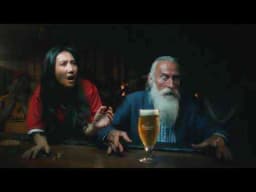
France Televisions and Publicis Conseil launched Champions in September 2016 to promote Rio 2016 Paralympic Games coverage, featuring 126 disabled athletes

How France Televisions Made 126 Paralympic Athletes the Stars of Rio 2016
Champions is a September 2016 film campaign created by Publicis Conseil, Paris for Francetvpro.clapboard.com/archive/france-televisions-silent-olympics-media">France Télévisions, designed to promote the broadcaster's live coverage of the Rio 2016 Paralympic Games by casting 126 real disabled athletes across more than 23 sports as the sole protagonists of a single emotionally charged film, according to LinkedIn.
France Télévisions launched the campaign in France ahead of the Rio 2016 Paralympic Games, which ran from 7 to 18 September 2016. The objective was direct: build public anticipation for the Games and reinforce the broadcaster's positioning as the dedicated home of Paralympic coverage for French audiences. Rather than framing disability sport as an act of courage to be observed from a distance, the campaign repositioned the 126 athletes as competitors defined entirely by their performance, placing them within the visual and emotional grammar audiences associate with elite sport.
The campaign operates as a pre-event teaser, a format designed to create appointment viewing by converting ambient awareness into active intent. In France, where France Télévisions functions as the national public broadcaster and competes against commercial rivals including TF1 and M6 for audience share and advertiser confidence, establishing cultural ownership of a major sporting event carries strategic weight that extends well beyond any single broadcast slot. The single film asset was the campaign's entire creative delivery, requiring it to carry the full weight of the narrative, the athlete portraits, and the broadcast proposition within one continuous piece of work, according to Publicisgroupe. The Clapboard Score for Champions stands at 63 out of 100, reflecting a campaign that executes its emotional brief with discipline while leaving some strategic dimensions underdeveloped.
 ARCHIVE
France Télévisions holds the position of France's principal public broadcaster, making its relationship with major sporting events a matter of both editorial identity and competitive differentiation. In September 2016, the broadcaster faced a French television advertising market where, according to groupe-tf1.fr and Echanges Dila Gouv, gross expenditure across the sector reached approximately €11.4 billion for the year, with TF1 Publicité commanding approximately 41.1% of advertising-sales-house market share and M6 Publicité holding approximately 23.9%. Within that competitive structure, France Télévisions required a campaign that could assert cultural authority over Paralympic coverage rather than simply announce it.
The strategic insight driving Champions is a recalibration of how disability sport is perceived by general audiences. Publicis Conseil, Paris identified that Paralympic athletes are routinely framed through a lens of inspiration and adversity rather than athletic excellence, a framing that inadvertently positions viewers as observers of hardship rather than fans of sport. By featuring 126 athletes competing across more than 23 sports as documented by clapboard.com, the campaign argued implicitly that the scale and diversity of Paralympic competition is comparable to the Olympic programme itself. This repositioning serves France Télévisions' broadcast interests directly: audiences who see Paralympic sport as elite competition are more likely to tune in than audiences who perceive it as a charitable broadcast obligation.
In France, where public broadcasting carries a legislative mandate to serve the full breadth of society, this strategic choice also aligns with institutional values, giving the campaign coherence across both commercial and editorial registers. The pre-event teaser format was chosen deliberately, as reported by clapboard.com, to build anticipation rather than describe programming schedules, treating the Games as a cultural event rather than a listings item.
Champions rests on a single film asset, which means every creative decision carries proportionally greater weight than it would in a multi-format campaign. The film was directed by DryImpact and produced by La Pac, with voice-over provided by Dom Farkas, as documented by clapboard.com. Executive creative direction was led by Fabrice Delacourt and Olivier Desmettre at Publicis Conseil, Paris, a pairing whose combined oversight shaped the film's tonal discipline and visual approach.
The creative execution draws its authority from the choice to feature 126 real disabled athletes rather than actors or a single symbolic figure. This decision has immediate consequences for the film's texture: the sheer number of individuals across more than 23 sports produces a cumulative effect that no single portrait could achieve. The viewer is confronted not with one exceptional story but with a field of competitors, each carrying the visual markers of their discipline. That volume is the argument. Where many campaigns in the Paralympic and disability sport space rely on a single emotional crescendo built around one athlete's backstory, Champions distributes its emotional weight evenly, refusing to rank the athletes' stories by degree of hardship or triumph.
The voice-over by Dom Farkas functions as a unifying structural element, providing continuity across what would otherwise be a rapid sequence of distinct athletic identities. The production company La Pac, working under DryImpact's direction, translated the creative brief into a film that operates within the visual conventions of elite sport broadcasting while maintaining the distinctly human scale that 126 individual presences demand. Production credits for the full technical crew of Champions are not publicly documented beyond the core roles confirmed by clapboard.com.
No verified performance data for Champions is publicly available in trade press sources including Campaign, Stratégies, or CB News, and no awards recognition for the campaign has been confirmed through publicly accessible databases, as noted by clapboard.com.
Structural analysis of the campaign offers a credible basis for assessing its likely effectiveness. A pre-event teaser built around 126 real athletes across more than 23 sports creates a breadth of identification points that broad-reach broadcast promotion requires. Each athlete represents a potential audience member who recognises their sport, their country, or their competitive category, expanding the campaign's relevance well beyond viewers who already follow Paralympic sport.
The decision to deliver the entire campaign through a single film asset is both a constraint and a concentration of intent. It demands that the film hold attention without the distributional support of outdoor, print, or digital extensions, which the available record does not confirm were deployed. In the French television market, where France Télévisions competes against TF1 and M6 for audience engagement, a campaign that succeeds in converting passive awareness into active viewing intent represents a measurable commercial and editorial return, even where specific ratings or reach figures are not publicly disclosed. The Clapboard Score of 63 out of 100 reflects a campaign that fulfils its emotional and strategic brief with competence while the absence of verifiable results and the reliance on a single medium limit the ceiling of its assessed impact.
Champions was a September 2016 film campaign created by Publicis Conseil, Paris for France Télévisions to promote the broadcaster's Rio 2016 Paralympic Games coverage in France. The campaign featured 126 real disabled athletes competing across more than 23 sports, framing them as elite competitors rather than inspirational figures, as documented by clapboard.com.
DryImpact directed Champions, with La Pac serving as the production company. Executive creative direction was led by Fabrice Delacourt and Olivier Desmettre at Publicis Conseil, Paris. Voice-over for the film was provided by Dom Farkas. These production credits are documented by clapboard.com for the September 2016 campaign.
Champions featured 126 disabled athletes competing across more than 23 sports, as documented by clapboard.com. The decision to include that volume of real athletes rather than a single symbolic figure was central to the campaign's creative strategy, distributing emotional weight evenly and arguing for Paralympic sport's scale and diversity.
France Télévisions and Publicis Conseil designed Champions to build anticipation for Rio 2016 Paralympic Games coverage in France. The campaign repositioned Paralympic athletes as elite competitors defined by performance rather than adversity, converting general audiences into active viewers and reinforcing France Télévisions' cultural ownership of the Games.
Champions by France Télévisions received a Clapboard Score of 63 out of 100. The score reflects disciplined emotional execution and a coherent strategic brief, while the campaign's reliance on a single film asset and the absence of publicly verified performance data limit its assessed overall impact.
.webp)
Creative Collaboration Platform: The Backbone of Modern Creative WorkWhat is a creative collaboration platform?Clapboard defines a creative collaboration platform as the operational core for today’s distributed creative teams. This is not a collection of digital collaboration tools stitched together; Clapboard’s system


Understanding the Creative Production MarketplaceWhat is a Creative Production Marketplace?Clapboard defines a creative production marketplace as a structured ecosystem where brands, agencies, and production talent converge to execute video, advertising, and branded content at scale. Unlike the legacy agency or freelanREAD FULL ARTICLE

The Urgent Need for a Creative Production Operating SystemWhy Traditional Creative Production Models Break DownClapboard sees the creative production landscape shifting under pressure. Content velocity is no longer a buzzword—it’s a mandate. Modern advertising demands relentless output across dozens of channels, each wREAD FULL ARTICLE