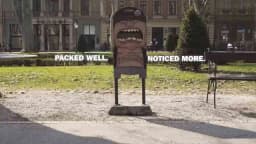
Fox Channel Brazil and BETC/Havas created The Vampire Poster in 2019, a São Paulo OOH campaign where chemically treated posters combusted at sunrise to promote

Fox Brazil Burned Its Own Posters to Promote The Passage
The Vampire Poster is a 2019 out-of-home campaign created by BETC/Havas São Paulo for Fox Channel Brazil, in which chemically treated posters installed across São Paulo combusted spontaneously at sunrise to promote the television series The Passage, directly dramatising the show's central vampire mythology in physical, public space.
Fox Channel Brazil launched The Passage on its Brazilian broadcast schedule in April 2019. The following month, BETC/Havas debuted the campaign on May 17, 2019, as reported by adsoftheworld.com and confirmed by musebyclios.com. Rather than communicate the premise of the series through conventional print or digital media, the agency engineered a single, visceral demonstration: posters treated with potassium permanganate and sulfuric acid that would ignite and reduce to ash the moment morning sunlight reached them, mirroring the fate of vampires in the show's fiction.
The execution was deliberately modest in physical scale and radical in conceptual ambition. According to adsoftheworld.com, four poster locations were selected across São Paulo, and each poster was replaced twice after combustion, producing approximately twelve individual burn events in total. The campaign contained one media asset and operated entirely within the out-of-home medium. In Brazil, where outdoor advertising remains a primary vehicle for entertainment marketing in dense urban environments, the choice to stage the campaign on São Paulo streets gave it immediate geographic specificity and cultural legibility. The Vampire Poster earned a Clapboard Score of 82 out of 100, reflecting strong marks for conceptual originality, medium-specific thinking, and craft integration.
BETC/Havas São Paulo grounded the strategy in a single, irreversible physical truth: sunlight destroys vampires.
The creative brief for The Passage promotion required communicating a genre premise — vampires as the central threat — in a media environment where supernatural fiction competes intensely for viewer attention. In Brazil, the pay-television and streaming landscape had grown markedly competitive by 2019. Globally, OTT revenue had risen from a reported twelve and a half billion US dollars in 2014 to thirty-eight point two billion US dollars in 2018, according to strategy-business.com, with the Brazilian market absorbing a meaningful share of that expansion as services including Netflix and Amazon Prime Video accelerated local content investment. Fox Channel operated within that pressure, competing directly with those streaming platforms for the attention of Brazilian genre-television audiences.
The strategic answer BETC/Havas developed was not to outspend competitors on media volume but to engineer an advertising format that competitors could not replicate without access to the same intellectual property. A poster that burns in sunlight is not merely a media buy; it is a product demonstration. The physical behaviour of the poster and the behaviour of the vampires in The Passage are identical. In São Paulo, where high foot traffic and dense urban infrastructure make out-of-home advertising a principal touchpoint for entertainment promotion, the location of the burn events amplified their word-of-mouth potential. As musebyclios.com noted in its coverage published on May 24, 2019, the campaign was characterised as genuinely incendiary out-of-home advertising, signalling that the stunt registered as authentic rather than manufactured spectacle.
BETC/Havas São Paulo applied potassium permanganate and sulfuric acid treatments directly to poster materials, engineering a reaction that sunlight would trigger without any digital or mechanical assistance.
The creative direction for The Vampire Poster was led by Chief Creative Officer Erh Ray and Executive Creative Director Andrea Siqueira, with Creative Directors Laura Azevedo, Alexandre Kazuo, and Lucas Ribeiro overseeing concept development, as documented by musebyclios.com and Propmark Com Br. Creatives Chico Lucas and Gustavo Guives Leal contributed to the execution, with typography handled by Lígia Fava and Gustavo Guives Leal. Integrated production was directed by Mariane Goebel and Anna Luisa Ferraz, with film production responsibilities shared between Anna Luisa Ferraz and Stela Viola. Production company Damasco Filmes handled the filmed documentation of the burn events, according to adsoftheworld.com and Siqueira Work.
The craft challenge was precise. The chemical mixture had to be stable enough to survive nighttime installation — posters were placed after dark specifically to prevent premature ignition — yet reactive enough to combust reliably and visibly as the São Paulo sun reached the poster surface at dawn. The resulting burn did not simply fade or discolour the poster; it consumed it entirely and left ash, the identical visual and material fate the show's vampire characters suffer on screen. According to horizont.net, which published coverage on May 22, 2019, the campaign was noted internationally for the specificity of its material execution. The decision to replace each of the four posters twice, yielding twelve documented combustion events, also meant that the creative spectacle could be filmed and distributed as a content asset extending the campaign's reach well beyond the immediate São Paulo out-of-home placements.

The Vampire Poster received documented international trade press coverage across multiple outlets within days of its May 2019 launch in São Paulo.
Muse by Clio published coverage on May 24, 2019, as confirmed by musebyclios.com, characterising the campaign as incendiary out-of-home advertising — an assessment that reflects both the literal mechanism and the trade press's recognition of its conceptual clarity. HORIZONT, the German advertising industry publication, published coverage on May 22, 2019, per horizont.net, indicating that the campaign crossed language and market boundaries within a week of launch. Adsoftheworld.com archived the campaign as a featured creative work, and cresta-awards.com documented the work in the context of awards consideration. Coverage also appeared on adruby.com and guives.com among practitioner portfolios.
No verified box-office or broadcast ratings uplift data for The Passage in Brazil is publicly attributed to The Vampire Poster campaign specifically, and Clapboard does not fabricate performance metrics. What the available evidence demonstrates is structural effectiveness: a campaign executed at a physically limited scale — four poster sites, twelve burn events — that generated international editorial coverage disproportionate to its production footprint. The campaign's design ensured that each combustion event was filmable and shareable, converting a hyper-local São Paulo OOH placement into a global creative-industry story. The Clapboard Score of 82 out of 100 reflects precisely this quality: a high ratio of strategic and creative impact to media spend, achieved through a mechanism that was conceptually inseparable from the product it advertised.
The Vampire Poster is a 2019 out-of-home campaign by BETC/Havas São Paulo for Fox Channel Brazil promoting the television series The Passage. Posters treated with potassium permanganate and sulfuric acid were installed across São Paulo at night and combusted at sunrise, mirroring how vampires in the series are destroyed by sunlight.
BETC/Havas applied a chemical treatment of potassium permanganate and sulfuric acid to the poster materials. The mixture remained stable in darkness, allowing overnight installation across São Paulo, then ignited upon exposure to direct sunlight at dawn, reducing each poster to ash as documented by musebyclios.com and adsoftheworld.com.
Four poster locations were used across São Paulo, Brazil. Each poster was replaced twice after combustion, producing approximately twelve individual burn events in total, according to adsoftheworld.com. The campaign launched on May 17, 2019, following Fox Channel Brazil's April 2019 premiere of The Passage.
Chief Creative Officer Erh Ray and Executive Creative Director Andrea Siqueira led the creative team at BETC/Havas São Paulo. Creative Directors Laura Azevedo, Alexandre Kazuo, and Lucas Ribeiro oversaw concept development, with creatives Chico Lucas and Gustavo Guives Leal contributing to execution, as documented by musebyclios.com and propmark.com.br.
The Vampire Poster received international trade press coverage from musebyclios.com, horizont.net, adsoftheworld.com, and cresta-awards.com within days of its May 2019 São Paulo launch. The campaign is archived on adsoftheworld.com as a featured creative work and is documented in awards records at cresta-awards.com. It holds a Clapboard Score of 82 out of 100.
In Brazil, out-of-home advertising is a principal medium for entertainment marketing in dense urban environments like São Paulo. BETC/Havas selected the OOH format because the physical behaviour of a poster combusting in sunlight was conceptually inseparable from the show's vampire premise, creating a demonstration no competing platform could replicate.
.webp)
Creative Collaboration Platform: The Backbone of Modern Creative WorkWhat is a creative collaboration platform?Clapboard defines a creative collaboration platform as the operational core for today’s distributed creative teams. This is not a collection of digital collaboration tools stitched together; Clapboard’s system


Understanding the Creative Production MarketplaceWhat is a Creative Production Marketplace?Clapboard defines a creative production marketplace as a structured ecosystem where brands, agencies, and production talent converge to execute video, advertising, and branded content at scale. Unlike the legacy agency or freelanREAD FULL ARTICLE

The Urgent Need for a Creative Production Operating SystemWhy Traditional Creative Production Models Break DownClapboard sees the creative production landscape shifting under pressure. Content velocity is no longer a buzzword—it’s a mandate. Modern advertising demands relentless output across dozens of channels, each wREAD FULL ARTICLE