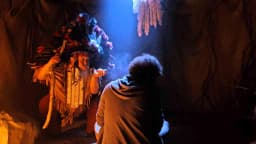
Flying Horse's Breaking Bat, created by Ogilvy & Mather Brazil in May 2014, staged a VFX-powered dance-off between a man and a bat to energise a crowded drinks

Flying Horse Breaking Bat Brought a VFX Dance Battle to Brazil
Breaking Bat is a 2014 Brazilian film campaign created by Ogilvy & Mather Brazil for Flying Horse, a non-alcoholic energy drink brand, in which a man and a VFX-rendered bat engage in a comedic, escalating dance-off staged as a spectacle of energy and absurd humour.
The campaign launched in May 2014 in Brazil, entering a domestic market where international giants commanded formidable shelf presence and share of voice. Flying Horse's brief to Ogilvy & Mather Brazil was not to outspend the competition but to outmanoeuvre it creatively. The answer was a single film asset built around a premise so specific and strange that it resists easy categorisation: a man, a bat, and a dance battle decided by sheer stamina and energy. The concept belongs to a broader strand of surreal, scientifically implausible storytelling that had become a house style for Flying Horse's relationship with Ogilvy, as documented in Clapboard's editorial archive.
In Brazil, the energy drink category was growing rapidly during this period, with global market dynamics placing the sector's estimated value at approximately fifty billion US dollars by 2014, according to data cited across sources including slideshare.net and prnewswire.com. That global momentum was mirrored locally, making Brazil a fiercely competitive battleground for energy and non-alcoholic stimulant drinks. Breaking Bat did not attempt to claim functional superiority. Instead, it positioned Flying Horse as the brand with enough creative voltage to make a bat dance — and to make audiences in Brazil remember it. The Clapboard Score for Breaking Bat stands at 63 out of 100, reflecting a campaign that executes its concept with craft and personality, while remaining a market-specific work without documented international reach or trade-press recognition.
Flying Horse built its creative strategy around humour and spectacle rather than performance claims. This positioning was deliberate in the context of a Brazilian market where category leaders communicated through aspiration, extreme sport, and athletic achievement. Red Bull held approximately forty-three percent market share in a major market estimate for 2013 to 2014, according to data referenced on energydrinkmania.net, while Monster Energy held approximately thirty-nine percent in comparable 2013 estimates cited by the same source. Against that duopoly, a challenger brand operating in Brazil's non-alcoholic drinks segment had limited room to compete on reach or media weight alone.
Ogilvy & Mather Brazil's response was to make Flying Horse synonymous with a particular comedic register — one rooted in absurd, implausible premises delivered with straight-faced production values. As documented in Clapboard's lineage records, the agency had established this creative territory as early as 2012, when it produced Catoast, a television spot featuring a scientist combining a cat and buttered toast as an energy source for Flying Horse. That same year, Ogilvy São Paulo created the Dubious Yawn Ads, a three-print campaign that questioned whether observed behaviour reflected fatigue or surreal activity, including what the campaign described as an epic falcon dance. Breaking Bat in 2014 extended and escalated this lineage, moving from print absurdism and laboratory comedy into full VFX-driven film production. The through-line across all three campaigns is a brand willing to lean into the irrational as a proxy for the energy it sells — a strategically coherent position even if it operates entirely within the register of entertainment.
Breaking Bat was directed by Javier Lourenço and Jorge Alaniz for production company Fulano Filmes, under the creative direction of Rafael Donato at Ogilvy & Mather Brazil. The film's central creative challenge was technical as much as conceptual: making a bat a credible, expressive, and comedically compelling dance partner required visual effects work capable of sustaining the joke across the full length of the film without the illusion collapsing into obvious artifice.
The decision to render the bat digitally rather than use a trained or composited real animal was not merely practical. It gave the directors and creative team precise control over timing, expression, and movement — qualities on which the comedy entirely depends. A dance-off lives or dies on rhythm, and the VFX bat had to feel physically present in the frame and emotionally legible as a competitor. Directors Lourenço and Alaniz, working with Fulano Filmes, constructed the film so that the bat's movements escalate in ambition alongside the human dancer's, building the comic tension through choreographic one-upmanship rather than dialogue or narration.
Rafael Donato's creative direction maintained the tone that had characterised Flying Horse's Ogilvy-produced work since 2012, as documented in Clapboard's archive. The humour is deadpan rather than broad, allowing the spectacle to carry the energy of the brand without the film tipping into self-parody. Fernando Passos is credited in the production record associated with this campaign, contributing to a creative team that understood the discipline required to make absurdist work feel grounded. The single film asset that constitutes Breaking Bat is a compact demonstration of how VFX production in Brazil's advertising industry had matured by 2014 — capable of delivering Hollywood-adjacent visual effects within the constraints of a challenger brand's production budget.
No verified performance data for Breaking Bat is publicly available. No trade-press coverage has been identified in Campaign, Ad Age, Adweek, The Drum, or Contagious. No social media reaction data has been located on Twitter, Reddit, LinkedIn, or YouTube, and no Brazilian press commentary has been found, as confirmed in Clapboard's research record. The absence of documented metrics is not unusual for a mid-tier challenger brand campaign from Brazil in 2014, a period when digital attribution for locally distributed film content was inconsistently tracked and rarely published.
Structural analysis offers a more durable basis for evaluation. Breaking Bat possesses two qualities that correlate with audience retention in the non-alcoholic drinks category: a genuinely original central premise and production execution sufficient to make that premise believable. The VFX work from Fulano Filmes under directors Javier Lourenço and Jorge Alaniz sustains the illusion across the film's duration, and Rafael Donato's creative direction keeps the brand's energy proposition embedded in the action rather than bolted on through end-frame messaging. The campaign's primary structural risk is one of reach: a single film asset, however well-made, generates limited frequency in the Brazilian market without significant paid media support behind it, and no media investment data has been documented. The Clapboard Score of 63 out of 100 reflects a campaign that achieves creative distinction within the parameters of its format and budget, falling short of the sustained cultural conversation that would push the score into higher territory. As a piece of craft filmmaking in service of a challenging creative brief, Breaking Bat represents a competent and occasionally inventive contribution to Flying Horse's body of work in Brazil.
Breaking Bat is a 2014 Brazilian film campaign for Flying Horse created by Ogilvy & Mather Brazil. It features a VFX-rendered bat engaging in a comedic dance-off against a human competitor. The campaign launched in May 2014 as a single film asset, using absurdist humour to position Flying Horse as a distinctive voice in Brazil's non-alcoholic drinks category.
Breaking Bat was directed by Javier Lourenço and Jorge Alaniz at production company Fulano Filmes. Creative direction was handled by Rafael Donato at Ogilvy & Mather Brazil. The film relied on VFX production to render the bat as a convincing, choreographically expressive dance partner throughout the spot, which was produced and released in Brazil in May 2014.
Flying Horse chose a bat as the central character to extend its established creative strategy of absurdist, implausible premises. Ogilvy & Mather Brazil had built this territory since 2012 with campaigns including Catoast. A man-versus-bat dance battle communicates the brand's energy proposition through spectacle and comedy rather than functional performance claims, differentiating Flying Horse from category leaders in Brazil.
Ogilvy & Mather Brazil consistently positioned Flying Horse through surreal, scientifically implausible humour. Beginning with the 2012 Catoast television spot and the Dubious Yawn print campaign, the agency built a creative identity rooted in absurdist comedy. Breaking Bat in 2014 escalated this approach into full VFX-driven film, making Rafael Donato's creative direction the throughline across the brand's campaign history.
Breaking Bat received a Clapboard Score of 63 out of 100. The score reflects strong creative originality and competent VFX execution by Fulano Filmes, balanced against the campaign's limited documented reach and the absence of verified performance data or trade-press recognition following its May 2014 launch in Brazil.
Breaking Bat launched in a Brazilian market shaped by dominant international brands. Red Bull held approximately forty-three percent market share in major market estimates for 2013 to 2014, according to energydrinkmania.net, with Monster Energy close behind. Flying Horse used comedic spectacle and VFX craft rather than media spend to carve a distinctive position for its non-alcoholic drinks in that competitive environment.
.webp)
Creative Collaboration Platform: The Backbone of Modern Creative WorkWhat is a creative collaboration platform?Clapboard defines a creative collaboration platform as the operational core for today’s distributed creative teams. This is not a collection of digital collaboration tools stitched together; Clapboard’s system


Understanding the Creative Production MarketplaceWhat is a Creative Production Marketplace?Clapboard defines a creative production marketplace as a structured ecosystem where brands, agencies, and production talent converge to execute video, advertising, and branded content at scale. Unlike the legacy agency or freelanREAD FULL ARTICLE

The Urgent Need for a Creative Production Operating SystemWhy Traditional Creative Production Models Break DownClapboard sees the creative production landscape shifting under pressure. Content velocity is no longer a buzzword—it’s a mandate. Modern advertising demands relentless output across dozens of channels, each wREAD FULL ARTICLE