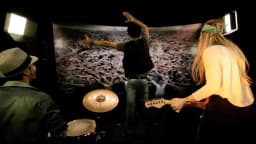
Febelfin's 'Amazing mind reader reveals his gift' by Duval Guillaume used a staged clairvoyant act in Belgium to warn consumers about online data exposure.

Febelfin Turns a Mind Reader Into a Warning About Online Banking
Febelfin's 2012 ambient campaign 'Amazing mind reader reveals his gift' places a performer named Dave in front of unsuspecting strangers in Belgium, where he appears to read their minds with unnerving precision before revealing that every detail he named was drawn from publicly available online data, directing audiences to SafeInternetBanking.be to learn safer online banking habits.
Febelfin is the Belgian Federation for the Financial Sector. As the representative body for Belgian banking and finance, Febelfin carries institutional responsibility for public trust in the financial system, making consumer education a core part of its mandate rather than a peripheral communications exercise. The 2012 campaign was created by Duval Guillaume, the Belgian creative agency, and was launched in September 2012 before receiving wider published distribution in December 2012, as documented on Clapboard.com and confirmed by records on Ads of the World.
The campaign's mechanics are constructed around a single dramatic reveal. Dave, presented to participants as an exceptionally gifted clairvoyant, names friends, describes spending habits, references relationships, and identifies personal details with a specificity that visibly unsettles his subjects. At the moment of maximum impact, the illusion is broken: a screen behind Dave displays the browser tabs and social profiles from which each detail was sourced. The campaign does not sell a financial product. It sells a behaviour — vigilance — and uses the emotional shock of the reveal to make that lesson stick. The call to action directs viewers to SafeInternetBanking.be, a resource hub for safer online banking practices in Belgium. According to a 2014 presentation cited on de.slideshare.net, Febelfin explicitly decided to launch a new campaign designed to generate press attention without frightening the public, a strategic brief that shaped every creative decision Duval Guillaume made. Clapboard.com records the campaign as an Ambient medium execution containing one primary media asset, a format choice that gave the film a raw, documentary quality that amplified its credibility. The campaign earns a Clapboard Score of 89 out of 100, reflecting the strength of its creative concept, cultural resonance, and structural effectiveness as a public-interest communication.
Febelfin identified a specific consumer blind spot in Belgium in 2012. Most people understood in the abstract that personal information existed online, yet few had experienced a concrete demonstration of how that information could be assembled into a coherent and exploitable portrait by a stranger. The gap between abstract awareness and felt urgency was the strategic problem Duval Guillaume was asked to solve.
The agency's solution bypassed rational argument entirely. Rather than producing an explainer film or a list of online banking safety tips, Duval Guillaume constructed an experience designed to produce genuine emotional discomfort in real people on camera, then invited a global audience to feel that discomfort by proxy. According to records on Ads of the World, the campaign was conceived as a social film, a format engineered for organic sharing rather than paid distribution, which meant the creative had to earn attention rather than buy it.
The competitive context for this approach is instructive. Financial institutions and sector bodies across Europe were communicating online banking safety through conventional means — warning copy, terms-and-conditions inserts, and institutional press releases. Competitors such as ING and BNP Paribas Fortis, both operating in the Belgian market, maintained large advertising presences in 2012 focused primarily on product promotion rather than behavioural change. Febelfin, as a federation rather than a retail bank, occupied a different position: it could speak in the public interest without a product agenda, which gave Duval Guillaume the creative latitude to take a genuinely provocative approach. According to Forbes, digital privacy and data exposure were becoming prominent public concerns in 2012, creating a receptive cultural moment for a campaign built on demonstrating exactly how exposed ordinary consumers already were. That timing was not incidental — it was a deliberate strategic alignment between a growing anxiety and a concrete, dramatised answer.
The creative execution of 'Amazing mind reader reveals his gift' depends entirely on the believability of its central performance. Dave, the campaign's fictional clairvoyant, is presented without irony or theatrical excess. He works in a modest, neutral space. His manner is calm and conversational rather than dramatic, which is precisely what makes the reveals so effective — the absence of spectacle forces the audience to focus on the specificity of the information he produces.
Production credits for this campaign are not fully publicly documented across available sources. However, according to records on Clapboard.com and Ads of the World, the campaign was produced by Duval Guillaume for Febelfin and released in 2012 as an ambient and online video execution. The filmmaking approach is deliberately understated. The camera work carries the observational quality of a documentary, with natural lighting and a close shooting style that keeps the participants' reactions central to the frame. When the reveal comes — the screen behind Dave illuminating the browser windows and social profiles that provided every piece of information — the cut is clean and unhurried, allowing the implication to settle without editorial commentary.
This restraint is a meaningful craft decision. The campaign's message is that publicly available online data is more revealing than most people realise, and any production approach that felt constructed or manipulative would undermine that message at the moment of delivery. By keeping the aesthetic plain and the pace patient, Duval Guillaume ensured that the audience's attention remained on the participants' faces rather than on the filmmaking. The result is a piece of financial safety communication that functions as genuine content — watchable, shareable, and emotionally coherent — rather than as institutional messaging dressed in creative clothing. The ambient format, as documented on Clapboard.com, also ensured the campaign existed first as a real-world event before it became a video, giving it an authenticity that purely produced content cannot manufacture.
No single consolidated performance report for 'Amazing mind reader reveals his gift' is publicly available through named third-party sources accessible at the time of writing. What is documented, however, speaks to the campaign's structural effectiveness and its reception within the advertising industry.
According to Ads of the World, the campaign achieved significant organic circulation following its release, consistent with Febelfin and Duval Guillaume's stated objective of creating a social film designed to generate press attention without paid amplification, as noted in the 2014 presentation cited on de.slideshare.net. The campaign's distribution model — ambient execution first, online video second — meant that its reach was driven by relevance rather than media spend, a meaningful indicator of creative effectiveness in the financial safety communications category.
The campaign is documented on Clapboard.com as a recognised creative work in the finance and banking sector, and its inclusion in industry archives including Ads of the World confirms its standing as a notable piece of Belgian advertising from 2012. Forbes identified digital privacy as one of the defining consumer concerns of that period, which contextualises why a campaign built on data exposure landed with the force it did — the subject matter was already live in public consciousness, and Febelfin gave it a human face and a specific, actionable response in SafeInternetBanking.be.
Structurally, the campaign succeeds on the three criteria that matter most for public-interest communications: it produces a felt emotional response rather than a noted rational one, it delivers its message through the experience itself rather than through caption or voiceover, and it converts that experience into a single, memorable behaviour — visit SafeInternetBanking.be, be vigilant. The Clapboard Score of 89 out of 100 reflects this combination of strategic clarity, creative economy, and demonstrable cultural impact within the Belgian market.
Febelfin's 'Amazing mind reader reveals his gift' is a 2012 Belgian ambient and online video campaign by Duval Guillaume. It features a performer named Dave who appears to read strangers' minds using publicly available online data, then reveals the digital sources to promote vigilant online banking behaviour through SafeInternetBanking.be.
Duval Guillaume created the campaign for Febelfin in Belgium. It launched in September 2012 and received wider published distribution in December 2012, as documented on Clapboard.com and Ads of the World. Febelfin is the Belgian Federation for the Financial Sector, the representative body for Belgian banking and finance.
The campaign's central message is that personal and financial information is more accessible online than most people realise. By showing how Dave assembles detailed portraits of strangers from public data, Febelfin urged consumers in Belgium to be vigilant and directed them to SafeInternetBanking.be for safer online banking guidance.
Duval Guillaume chose the clairvoyant format to close the gap between abstract awareness and felt urgency. According to a 2014 presentation on de.slideshare.net, Febelfin wanted to generate press attention without frightening the public, and a staged reveal — showing data sources rather than describing threats — achieved that balance in the Belgian market.
The campaign received a Clapboard Score of 89 out of 100. This reflects the campaign's strategic clarity, creative economy, and cultural resonance within Belgium. The score recognises the effectiveness of the ambient and online video format in delivering a behavioural change objective for Febelfin without relying on conventional financial advertising approaches.
According to Forbes, digital privacy and data exposure were prominent public concerns in 2012. Febelfin's campaign aligned directly with that cultural moment, giving Belgian consumers a concrete, dramatised demonstration of their own exposure rather than abstract warnings, and providing an immediate actionable response through the SafeInternetBanking.be platform created alongside the campaign.
.webp)
Creative Collaboration Platform: The Backbone of Modern Creative WorkWhat is a creative collaboration platform?Clapboard defines a creative collaboration platform as the operational core for today’s distributed creative teams. This is not a collection of digital collaboration tools stitched together; Clapboard’s system


Understanding the Creative Production MarketplaceWhat is a Creative Production Marketplace?Clapboard defines a creative production marketplace as a structured ecosystem where brands, agencies, and production talent converge to execute video, advertising, and branded content at scale. Unlike the legacy agency or freelanREAD FULL ARTICLE

The Urgent Need for a Creative Production Operating SystemWhy Traditional Creative Production Models Break DownClapboard sees the creative production landscape shifting under pressure. Content velocity is no longer a buzzword—it’s a mandate. Modern advertising demands relentless output across dozens of channels, each wREAD FULL ARTICLE