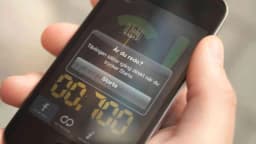
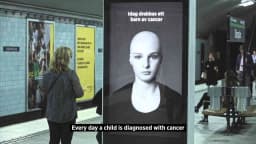
The 'Screen Donor' campaign by Doctors of the World leverages mobile technology to amplify public awareness of healthcare issues through a unique, interactive medium. Its core proposition hinges on transforming individuals’ smartphone screens into dynamic ad spaces that communicate vital information related to the organization’s mission. By inviting users to “donate” their phone display time, the campaign reframes passive screen time as an active channel for social impact, fostering a sense of personal contribution without financial cost.
The campaign’s market strategy hinges on the insight that smartphone users are increasingly connected but often disengaged from traditional public service messaging. By integrating advertising directly into a routinely viewed and private screen, it breaks through advertising fatigue and generates continuous exposure in an unobtrusive, ambient format. Targeting digitally savvy individuals likely receptive to social causes, the campaign employs a technological, user-empowered approach that also aligns with contemporary mobile consumption behaviors. The creative angle of temporarily disabling screen saver mode to deliver messaging situates public interest advertising within everyday habits, making social awareness both habitual and participatory. The choice of Sweden as a launch market, with its high smartphone penetration and social consciousness, further supports effective audience engagement. Overall, the campaign innovatively bridges technology and social advocacy, encouraging micro-level activism through a low-barrier, ambient advertising solution.
FORMAT#1 DEMONSTRATION — Directly shows how a product works and highlights its benefits.
This campaign is best classified as a Demonstration because the core concept revolves around actively showing the audience how the Screen Donor app functions on a smartphone. The campaign’s description emphasizes the app turning users’ phone displays into ad spaces for Doctors of the World, and explicitly details what happens when the app is enabled—bypassing sleep mode to display charitable content. There’s no persona, story arc, celebrity, parody, or symbolic problem-solving. Instead, the spotlight is on illustrating the app’s distinct utility in real-time, fulfilling the Demonstration format.
ADVERTISING FORMATS EXPLAINED: https://www.clapboard.com/blog/branding-and-advertising/brand-strategy/12-advertising-creative-formats
1. Médecins Sans Frontières (Doctors Without Borders) – Positioned as an independent, global medical humanitarian organization, they focus on providing emergency aid in conflict zones and epidemics, emphasizing neutrality and rapid response in crises where health systems collapse.
2. International Committee of the Red Cross (ICRC) – Known for its work in conflict-affected areas, the ICRC leverages its neutrality and strong international mandate to deliver medical and humanitarian assistance, emphasizing protection of victims and adherence to international humanitarian law.
3. Amnesty International – This organization focuses on human rights advocacy with healthcare as part of broader social justice issues, differentiating through global campaigning against medical neglect and raising awareness on health-related human rights violations.
4. UNICEF – Concentrates on child health and welfare, particularly in developing countries, using a blend of advocacy, vaccination campaigns, and support for vulnerable populations, positioning itself as a champion for children’s rights and health worldwide.
5. Save the Children – Specializes in improving child health and survival rates through community-based health programs and emergency response, differentiating by integrating education and protection services into their health initiatives to foster long-term wellbeing.
Q: What is Screen Donor about?
A: Screen Donor is a professional campaign launched in Sweden in 2015 for Doctors of the World, developed by the agency JMW. The campaign centers on a unique ambient idea: a mobile app that allows users to donate their smartphone display space to the organization. By keeping the phone screen active instead of entering sleep mode, the app displays curated messages about global health issues, transforming passive screen time into an opportunity for social impact. This initiative leverages everyday mobile behavior to raise awareness for public interest causes, positioning technology as a conduit for humanitarian engagement.
Q: What creative device does Screen Donor use?
A: According to Clapboard's 12-format taxonomy, Screen Donor is classified under FORMAT#1 DEMONSTRATION. The campaign’s creative approach is rooted in directly showing how the Screen Donor app functions, highlighting its utility by turning users’ smartphone screens into live ad spaces for Doctors of the World. Rather than relying on narrative, celebrity, or symbolic storytelling, the campaign’s communication is anchored in a real-time demonstration of the app’s core feature, making the technology’s social benefit immediately tangible to the audience.
Q: What is the campaign proposition for Screen Donor?
A: The campaign proposition for Screen Donor is to reimagine smartphone usage as a channel for social contribution by inviting users to donate their screen time to Doctors of the World. Targeting digitally engaged individuals, the campaign leverages the ubiquity of mobile devices and habitual screen interaction to deliver focused, uninterrupted public service messaging. By transforming a personal device into a platform for humanitarian communication, Screen Donor positions itself at the intersection of technology and social advocacy, offering a low-barrier, participatory way for users to support global health awareness without financial commitment.
Q: How does Screen Donor rank in Clapboard's archive?
A: Screen Donor holds a Clapboard Campaign Score of 73/100 in Clapboard's global ad archive. This score reflects the campaign’s creative ambition, the quality of its execution, and its relevance within the cultural and technological context of public interest advertising.
Q: Who are the competitors in Doctors of the World's category?
A: In the public service and humanitarian health sector, Doctors of the World competes with organizations such as Médecins Sans Frontières, which is recognized for its rapid emergency medical aid in crisis zones; the International Committee of the Red Cross, known for its neutral humanitarian assistance in conflict areas; Amnesty International, which integrates healthcare into broader human rights advocacy; UNICEF, focusing on child health and welfare through global campaigns; and Save the Children, which combines child health initiatives with education and protection services to support long-term wellbeing.


 ARCHIVE
.webp)