 ARCHIVE
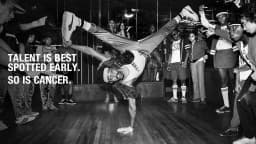
How Montefiore Turned Breakdancing's Olympic Debut Into a Cancer Awareness Moment
How Montefiore Einstein Connected Breakdancing's Olympic Debut to Early Cancer Detection Montefiore...
Cologuard and FCB Health Make Colon Cancer Screening Unmissable
Cologuard's 'Catch That Truck' is an integrated healthcare campaign created by FCB Health, launched in the United States in January 2025, that uses a truck-catching metaphor drawn from popular film and television tropes to communicate the urgency of timely colorectal cancer screening and early detection.
The campaign made its debut on January 11, 2025, during the NFL Playoffs, placing its message in front of one of the largest live television audiences in the United States calendar. That placement was not incidental. For a health intervention aimed at encouraging adults to act before symptoms appear, the NFL Playoffs offered both scale and a culturally tuned audience primed for dramatic, high-stakes storytelling. Cologuard, owned by Exact Sciences, is a non-invasive, at-home stool DNA test for colorectal cancer screening, and the brand has built its communications strategy around removing the perceived barriers — clinical anxiety, procedural fear, and simple inertia — that prevent eligible adults from screening on schedule.
'Catch That Truck' operates as an integrated campaign with one primary media asset, as documented by Clapboard and classified by Ads of the World as a health-industry campaign. The creative idea is categorised by Clapboard as 'Symbolize the Problem', a strategic framing that translates an abstract medical imperative into a visceral, kinetic image: the urgency of catching something before it is permanently out of reach. In the United States, where colorectal cancer remains among the most preventable cancers when detected early, that symbolic logic carries genuine clinical weight. The campaign sits within a broader brand lineage that includes Cologuard's 2022 'Mission to Screen' effort featuring journalist and colorectal cancer advocate Katie Couric, which introduced national television, broadcast, digital distribution, and social content promoting screening from age 45 onward, as documented by Ads of the World. 'Catch That Truck' extends that public health mandate through a sharper, more culturally specific creative lens. Clapboard awards the campaign a score of 56 out of 100.
FCB Health identified cultural avoidance — not lack of awareness — as the primary barrier to colorectal cancer screening uptake in the United States. Kathleen Nanda, Chief Creative Officer at FCB Health New York, stated as reported by Roastbrief US on January 31, 2025: 'To tap into culture in a way we hadn't before, we decided to reference what people are watching on TV and in movies. It's about meeting people where they are, and using humor to disarm the anxiety surrounding screening for colon cancer.' That diagnosis of the problem — anxiety mediated through cultural distance — shaped every strategic and creative decision behind 'Catch That Truck.'
The strategic context in the United States is significant. Stool-based tests represent a substantial share of the colorectal cancer screening market, according to Grand View Research, and at-home stool DNA tests account for a commanding portion of colorectal cancer diagnostics revenue, according to Market Research Future. Cologuard competes in a market that includes colonoscopy referral pathways supported by major hospital systems, as well as rival at-home testing products backed by laboratory and diagnostics companies. Against that competitive field, Cologuard's long-standing advantage has been patient accessibility and its direct-to-patient communication model — and 'Catch That Truck' leans into that model by meeting consumers inside the entertainment experiences they already inhabit rather than inside a clinical frame.
Jeremy Truxal, whose statement was reported by Roastbrief US, articulated the tonal ambition directly: 'The cultural zeitgeist is filled with drama, but we wanted to show that colon cancer screening doesn't have to be part of that narrative.' Placing the campaign during the NFL Playoffs reinforced that ambition, embedding a healthcare call to action inside a moment defined by collective national attention rather than individual medical anxiety. In the United States, that distinction between a shared cultural moment and a private health decision is strategically meaningful, particularly for a screening behaviour that adults routinely defer.
Kathleen Nanda serves as Chief Creative Officer at FCB Health New York and is the senior creative authority credited to 'Catch That Truck.' Her stated creative rationale, published by Roastbrief US, frames the campaign's core mechanism: borrowing the visual and narrative grammar of drama — the chasing, the urgency, the near-miss — from the films and television programmes that already occupy the audience's imagination, and redirecting that grammar toward a public health message. The result is a campaign that does not ask viewers to enter a medical headspace but instead meets them inside a cinematic one.
The truck-catching metaphor functions as a compression device. It collapses the abstract, slow-moving risk of undetected colorectal cancer into a single, legible image of something valuable disappearing unless action is taken immediately. That compression is characteristic of healthcare advertising that must convert emotional distance into behavioural intent within the compressed window of a broadcast placement. For a brand like Cologuard, where the product itself is designed to remove procedural friction, the creative logic is structurally consistent: the ad removes the emotional friction that the product removes the physical friction.
The campaign is classified as an integrated execution, with one media asset documented in the Clapboard archive and on Ads of the World. Its NFL Playoffs placement indicates a broadcast-first production approach, prioritising the clarity and immediate legibility demanded by live-sports environments, where viewer attention is high but advertising tolerance is compressed. The use of humour as a disarming mechanism — explicitly described by Nanda in her Roastbrief US remarks — is a deliberate departure from the earnest, testimony-driven register that characterises much pharmaceutical and diagnostics advertising in the United States. Production credits beyond Nanda's creative leadership are not publicly documented for this campaign.
No verified performance data for 'Catch That Truck' is publicly available. No published figures covering sales lift, prescription volume change, revenue impact, or market-share movement have been released by Cologuard, Exact Sciences, or FCB Health. No media spend, budget, or impressions data has been disclosed. The campaign has not been recognised across Cannes Lions, the Effie Awards, the One Show, D&AD, Clio Health, AdvertisingHealth World, the Webby Awards, or WARC as of the time of this analysis, per Clapboard's awards tracking.
Structural analysis in the absence of disclosed metrics points to several sources of probable effectiveness. The NFL Playoffs placement on January 11, 2025 ensured mass simultaneous exposure in the United States at a moment of high collective attention — a distribution condition that healthcare brands rarely purchase and that amplifies message encoding beyond what comparable digital or programmatic placements can achieve. The Clapboard creative score of 56 out of 100 reflects a campaign that executes its 'Symbolize the Problem' strategy competently without reaching the creative differentiation threshold that defines category-leading healthcare work.
The campaign's tonal strategy — humour deployed against clinical anxiety — is structurally well-matched to a brand whose primary challenge is behavioural activation rather than awareness building. Cologuard's prior 'Mission to Screen' campaign, as documented by Ads of the World, established brand recognition and clinical legitimacy through advocacy-led storytelling. 'Catch That Truck' attempts to convert that existing brand equity into action by lowering the emotional cost of engagement. Whether that conversion succeeded at scale remains undocumented and unverifiable from publicly available sources.
'Catch That Truck' is an integrated healthcare campaign created by FCB Health for Cologuard, launched in the United States in January 2025. It uses a truck-catching metaphor drawn from film and television tropes to communicate the urgency of colorectal cancer screening, debuting during the NFL Playoffs on January 11, 2025, as documented by Clapboard.
FCB Health created 'Catch That Truck' for Cologuard. Kathleen Nanda, Chief Creative Officer at FCB Health New York, led the campaign's creative direction. Her creative rationale — using pop-culture references and humour to reduce anxiety around colon cancer screening — was published by Roastbrief US in January 2025, as part of the campaign's public launch coverage.
Cologuard launched 'Catch That Truck' during the NFL Playoffs on January 11, 2025, to reach a large simultaneous US audience. The placement reflects FCB Health's strategy of meeting consumers inside shared cultural moments rather than clinical contexts, using entertainment-adjacent humour to disarm the anxiety that typically prevents adults from pursuing colorectal cancer screening.
FCB Health built 'Catch That Truck' around a 'Symbolize the Problem' approach, as categorised by Clapboard. The truck-catching metaphor translates the abstract urgency of early colorectal cancer detection into a kinetic, cinematic image. Chief Creative Officer Kathleen Nanda described the intent as using pop-culture references and humour to disarm screening anxiety, per Roastbrief US.
No awards have been verified for 'Catch That Truck.' Per Clapboard's tracking, the campaign has not received recognition from Cannes Lions, the Effie Awards, Clio Health, AdvertisingHealth World, the One Show, D&AD, the Webby Awards, or WARC as of this analysis. Clapboard assigns the campaign an archive score of 56 out of 100.
Cologuard's prior major campaign, 'Mission to Screen,' launched in March 2022 featuring colorectal cancer advocate Katie Couric, as documented by Ads of the World. That campaign established brand credibility through advocacy storytelling across television, digital, and social channels. 'Catch That Truck' builds on that foundation by shifting toward cultural humour to drive behavioural activation among US adults.
.webp)
Creative Collaboration Platform: The Backbone of Modern Creative WorkWhat is a creative collaboration platform?Clapboard defines a creative collaboration platform as the operational core for today’s distributed creative teams. This is not a collection of digital collaboration tools stitched together; Clapboard’s system


Understanding the Creative Production MarketplaceWhat is a Creative Production Marketplace?Clapboard defines a creative production marketplace as a structured ecosystem where brands, agencies, and production talent converge to execute video, advertising, and branded content at scale. Unlike the legacy agency or freelanREAD FULL ARTICLE

The Urgent Need for a Creative Production Operating SystemWhy Traditional Creative Production Models Break DownClapboard sees the creative production landscape shifting under pressure. Content velocity is no longer a buzzword—it’s a mandate. Modern advertising demands relentless output across dozens of channels, each wREAD FULL ARTICLE