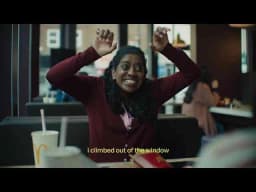
Capri Sun Hold My Pouch Brings Anti-Bullying to the Cafeteria
Capri Sun's Hold My Pouch is a 2019 film-led campaign created by Leo Burnett for the United States market, designed to position the brand's iconic juice pouch as a symbol of childhood solidarity, friendship, and active resistance to exclusion among school-age children.
Launched in April 2019, Hold My Pouch extended Capri Sun's ongoing relationship with No Bully, the non-profit organisation dedicated to eliminating bullying in American schools. As reported by MediaPost, the campaign was conceived explicitly as an extension of that anti-bullying work, giving the brand a prosocial mission that moved well beyond product attributes. The central creative idea anchored the pouch itself as a gesture of belonging — a prop children could use to signal acceptance and solidarity in everyday social situations.
The campaign ran across film and television placements, over-the-top streaming platforms, and social media channels in the United States, reflecting a distribution strategy built to reach both children and their parents. A flagship spot depicted two girls at a school cafeteria pushing tables together to create what the narrative framed as a together table, welcoming a new boy who might otherwise have sat alone. The scene was simple, recognisable, and deliberately low-stakes — the kind of moment that resonates with parents anxious about their children's social wellbeing and with children navigating the social hierarchies of school life.
Capri Sun is a brand owned by Kraft Heinz and holds longstanding recognition in the United States children's beverage category. The Hold My Pouch campaign carries a Clapboard Score of 63 out of 100, reflecting competent execution of a values-led brief within a competitive and increasingly scrutinised drinks segment.
Capri Sun faced measurable commercial headwinds in the children's beverage category as it entered 2019. Parental concern about sugar content and artificial ingredients was reshaping purchasing decisions across the segment. According to The Grocer, Capri Sun's sales in the United Kingdom declined by approximately £10.8 million, representing a 14.5 percent fall, to around £63.9 million in 2019 — a decline the publication attributed partly to growing parental anxiety about sugar. While that figure reflects the UK market specifically, the same attitudinal shift was present among American consumers. In the United States, consumers spent approximately $1.4 billion on children's fruit drinks and flavored waters in 2018, according to available market research, representing a category large enough to reward differentiation but mature enough to punish stagnation.
Against this backdrop, Capri Sun and Leo Burnett made a deliberate strategic choice to compete on values rather than reformulation alone. The brand had already repositioned around healthier credentials with its 2017 No Added Sugar campaign, which featured John Legend and targeted millennial parents seeking cleaner ingredient lists, as reported by The Drum. Hold My Pouch shifted the frame again — this time toward emotional and social meaning, addressing parents' broader concern for their children's wellbeing rather than their nutritional calculus.
In the United States children's juice drink segment, Capri Sun competes directly with Kool-Aid Jammers, which targets a similar age demographic with comparable flavour profiles and pouch or bottle formats. Minute Maid juice products represent a further competitive pressure point, particularly as retail shelf space for children's drinks contracts under health-driven category reviews. By aligning with No Bully and placing inclusion at the centre of its storytelling, Capri Sun sought to occupy emotional territory that neither Kool-Aid Jammers nor Minute Maid had claimed at the time of the campaign's launch.
Leo Burnett constructed Hold My Pouch around a single, legible human moment. The primary film spot showed two girls at a school cafeteria recognising that a new boy was sitting alone and responding not with words but with a physical act — pushing their table toward his to create a unified space. The Capri Sun pouch appeared not as a product to be sold but as an object present within a world where children choose kindness. That distinction — product as context rather than product as hero — required creative confidence and a willingness to subordinate brand visibility to emotional authenticity.
The execution drew on the visual and tonal conventions of slice-of-life children's advertising, favouring naturalistic performance, school-corridor settings, and warm but unsentimental cinematography. The creative team at Leo Burnett calibrated the tone carefully: sentimental enough to connect with parents, grounded enough to avoid condescension toward children who are sophisticated consumers of media and can detect artificiality quickly. The cafeteria scenario was chosen precisely because it is universally legible — a social space that virtually every American viewer has navigated and remembers.
Production credits for Hold My Pouch are not publicly documented in available sources. The campaign comprised a single media asset, indicating a focused production effort rather than a multi-execution platform launch. Distribution across film, OTT, and social placements suggests the creative was designed to function as a single cohesive piece rather than a modular system of adaptations. As reported by MediaPost, the campaign's connection to No Bully gave the creative a factual foundation — the partnership is real, documented, and independently verifiable — which insulated the prosocial messaging from accusations of cause-washing that often attach to brand purpose campaigns in the United States market.
No verified performance data for Hold My Pouch is publicly available. No campaign-specific sales lift, market-share change, or brand-tracking results have been identified in accessible sources. The campaign did not appear in Leo Burnett's 2019 Cannes Lions listings, which according to available records included other agency work such as Legal-Ade, The Time We Have Left, and Kraft Now Pay Later. No awards recognition for Hold My Pouch has been confirmed across Cannes Lions, the Effies, The One Show, D&AD, the Clios, the Webby Awards, or WARC Awards.
Structurally, the campaign presents a coherent strategic architecture. The decision to route emotional meaning through an existing, credentialed non-profit partnership with No Bully reduced the reputational risk inherent in purpose-led advertising and gave the creative a defensible factual anchor. The single-film format concentrated production investment and avoided the dilution of message that can occur when a campaign attempts too many executions simultaneously. The choice of the cafeteria as a setting maximised cultural reach within the United States: it is a space that resonates across age groups, school types, and geographies.
The campaign's limitation, and likely the factor most constraining its Clapboard Score of 63 out of 100, is the absence of a distinctive creative device that would make Hold My Pouch immediately retrievable in competitive memory. The prosocial territory it occupies is strategically sound but increasingly crowded, and the execution, while accomplished, does not introduce a formal innovation or tonal surprise that would elevate it above competent delivery of the brief.
Hold My Pouch is a film-led campaign created by Leo Burnett for Capri Sun, launched in the United States in April 2019. The campaign positioned the Capri Sun pouch as a symbol of childhood inclusion and extended the brand's anti-bullying partnership with No Bully, running across television, OTT platforms, and social media channels.
Leo Burnett created Hold My Pouch for Capri Sun in 2019. Leo Burnett had also created Capri Sun's earlier 2017 No Added Sugar campaign featuring John Legend, as reported by The Drum, establishing a sustained creative relationship between the agency and the Kraft Heinz-owned brand in the United States market.
The campaign's central idea linked the Capri Sun pouch to acts of everyday solidarity among children. The flagship spot depicted two girls pushing cafeteria tables together to include a new boy, framing the pouch as a prop present in moments of active kindness rather than as a product to be promoted directly.
Hold My Pouch has no confirmed awards recognition. No record of the campaign appears across Cannes Lions, the Effies, The One Show, D&AD, the Clios, the Webby Awards, or WARC Awards. Leo Burnett's 2019 Cannes Lions listings, per available records, do not include Hold My Pouch among the agency's submitted work.
Hold My Pouch extended Capri Sun's existing partnership with No Bully, the United States non-profit focused on eliminating school bullying. As reported by MediaPost, the campaign was conceived as a direct continuation of that anti-bullying work, giving the creative a credentialed factual foundation and reducing the reputational risk associated with purpose-led brand advertising.
Growing parental concern about sugar and artificial ingredients was contracting the children's drinks category in 2019. According to The Grocer, Capri Sun's UK sales fell 14.5 percent that year, reflecting pressures also present in the United States market. Leo Burnett responded by competing on emotional values rather than product reformulation alone.
.webp)
Creative Collaboration Platform: The Backbone of Modern Creative WorkWhat is a creative collaboration platform?Clapboard defines a creative collaboration platform as the operational core for today’s distributed creative teams. This is not a collection of digital collaboration tools stitched together; Clapboard’s system


Understanding the Creative Production MarketplaceWhat is a Creative Production Marketplace?Clapboard defines a creative production marketplace as a structured ecosystem where brands, agencies, and production talent converge to execute video, advertising, and branded content at scale. Unlike the legacy agency or freelanREAD FULL ARTICLE

The Urgent Need for a Creative Production Operating SystemWhy Traditional Creative Production Models Break DownClapboard sees the creative production landscape shifting under pressure. Content velocity is no longer a buzzword—it’s a mandate. Modern advertising demands relentless output across dozens of channels, each wREAD FULL ARTICLE