Burger King's Dogpper campaign, created by La Despensa in 2018, offered a flame-grilled dog bone free with delivery orders to solve pets begging at mealtimes.

Burger King Dogpper Turns Pet Owners Into Loyal Delivery Customers
Burger King's Dogpper is a branded dog treat designed to replicate the flame-grilled taste of the Whopper, created by agency La Despensa and launched in 2018, offering the bone free with qualifying delivery or app orders to keep pets calm while their owners eat at home.
The campaign debuted in Spain, with a public launch window running from August 31 through September 7, 2018, as reported by IPMARK, before reaching the United States market through publication in September 2018. The promotional period extended throughout September 2018, according to LBBOnline, giving the campaign a sustained run across television, outdoor, digital, and social media channels. The strategic premise was disarmingly simple: dogs beg when owners eat at home, and Burger King delivery orders eaten at home create exactly that situation. Rather than ignoring the problem, Burger King and La Despensa built a product to solve it.
In the United States, where Burger King operates as one of the dominant quick-service restaurant chains, the Dogpper positioned the brand at the intersection of two powerful consumer passions — fast food and pet ownership. The campaign's film medium anchored the creative, with a single media asset carrying the narrative weight of the entire effort. The Clapboard Score for the Dogpper campaign is 70 out of 100, reflecting strong conceptual originality and cultural resonance tempered by the inherent limitations of a single-asset, promotional-product execution. The Dogpper campaign demonstrates how a tactically narrow idea — a dog treat tied to a delivery mechanic — can generate disproportionate brand attention when the insight behind it is both genuine and universally relatable.
Burger King grounded the Dogpper campaign in proprietary consumer research before a single frame of film was shot. According to LBBOnline, Burger King surveyed more than 500 Spanish dog owners and found that 65% reported their dogs always begged when food was served at home, with nearly half admitting they regularly shared their own food with their pets. That data gave La Despensa a concrete behavioral truth to build around, not a manufactured sentiment.
The strategic rationale connected directly to Burger King's growing investment in delivery and app-based ordering. By tying the free Dogpper to a qualifying delivery or app order, the campaign created a functional incentive for the very transaction it was designed to celebrate. In the United States, the quick-service restaurant sector was in active expansion during 2018. According to Restaurant Business Online, the ten largest US fast-food chains — including Burger King alongside McDonald's, Starbucks, Subway, Taco Bell, Chick-fil-A, Wendy's, Dunkin', Domino's, and Pizza Hut — accounted for 90% of sector growth that year. Per Restaurant Business Online, US quick-service chains tracked by Technomic grew 3.1% in 2018. This was the competitive environment into which the Dogpper entered: a market growing rapidly, driven by delivery adoption and loyalty mechanics.
McDonald's was also investing heavily in creative campaigns during this period. In 2018, McDonald's launched both its "Follow the Arches" outdoor campaign, developed by Cossette, and its Dollar Menu value platform, each designed to reinforce habitual purchase. Burger King's counter-move with La Despensa was to pursue emotional differentiation rather than price competition, using a genuinely unexpected product to generate earned media and deepen the brand's personality around the flame-grilled Whopper identity across the US market and beyond.
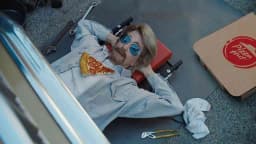
La Despensa produced a film campaign for the Dogpper that relied on observation rather than spectacle. The creative approach placed the everyday domestic scene — an owner eating a delivery meal at home, a dog watching intently — at its center, letting the behavioral truth identified in research drive the narrative forward without embellishment.
The film was directed by Martín Kalina and produced by Primo, according to both IPMARK and LBBOnline. Kalina's direction prioritised naturalistic performance and timing, allowing the comedic and emotional logic of the dog-begging scenario to land without overstatement. The single film asset carried the full conceptual argument: dogs beg, Burger King delivery creates the occasion for begging, and the Dogpper resolves the tension for both owner and pet. Campaign photography was credited to Ale Burset, according to LBBOnline, whose work extended the visual language of the campaign across outdoor and digital placements throughout Spain and, subsequently, the United States market.
The distribution strategy was deliberately broad. As reported by IPMARK, the campaign ran across television, outdoor, digital, and social media channels during September 2018, ensuring the Dogpper reached both existing Burger King customers and the wider pet-owning audience who might not be regular delivery users. The product itself functioned as creative collateral: a dog bone engineered to evoke the flame-grilled flavour of the Whopper gave journalists, social media users, and pet owners a tangible, shareable object to respond to, extending the film campaign's reach through organic conversation. In the United States, where pet ownership rates are among the highest in the world, the creative premise had particular resonance, even though the product originated in Spain. The Dogpper's visual identity stayed tightly connected to Burger King's established flame-grilled brand codes, ensuring the campaign read as authentically Burger King regardless of the market receiving it.
No independently verified sales or delivery-volume performance data for the Dogpper campaign is publicly available for the United States market. What the public record does confirm, through reporting by IPMARK and LBBOnline, is that the campaign attracted substantial press and trade attention following its launch on August 31, 2018, with IPMARK publishing a dedicated campaign report on the day of launch — an indicator of the level of industry interest the Dogpper generated at release.
Structurally, the campaign's effectiveness rests on a mechanic that aligned brand storytelling with a measurable commercial outcome. The free Dogpper was contingent on a qualifying delivery or app order, meaning every redeemed dog bone represented a completed Burger King transaction. This is a well-constructed performance architecture: the creative idea and the commercial trigger are the same object. In the context of the United States quick-service market, where Burger King operated 7,617 North American locations compared with 15,377 for its largest competitor McDonald's, according to data reported by Restaurantify, differentiation through emotional and cultural relevance carried real strategic value beyond any single campaign's direct return.
The Dogpper also demonstrated the brand's willingness, in partnership with La Despensa, to pursue product-level innovation as a creative vehicle — a direction that would become increasingly central to Burger King's global creative reputation following its D&AD recognition as Most Awarded Client in 2016, as reported by LBBOnline. The campaign's Clapboard Score of 70 out of 100 reflects a genuinely original consumer insight and a clean film execution, with room to score higher had wider verified performance data entered the public record.
The Dogpper is a branded dog bone Burger King offered free with qualifying delivery or app orders in 2018. Created by La Despensa, the treat was designed to replicate the flame-grilled taste of the Whopper and stop dogs from begging while their owners ate a Burger King delivery meal at home.
La Despensa created the Dogpper campaign for Burger King. The Spanish agency developed the concept, grounded it in consumer research surveying more than 500 dog owners, and produced the film with director Martín Kalina at production company Primo, according to reporting by IPMARK and LBBOnline.
The Dogpper campaign launched in Spain on August 31, 2018, with a promotional window running through September 7, as reported by IPMARK. The campaign was subsequently published in the United States in September 2018, extending its reach across television, outdoor, digital, and social media channels throughout that month.
La Despensa built the Dogpper around research showing that 65% of dog owners surveyed said their dogs always begged when food was served at home, according to LBBOnline. Burger King surveyed more than 500 Spanish dog owners, with nearly half admitting they regularly shared their own meals with their pets.
Martín Kalina directed the Dogpper film, produced by Primo, according to IPMARK and LBBOnline. Campaign photography was credited to Ale Burset, per LBBOnline, whose imagery supported the outdoor and digital placements running alongside the television film throughout the campaign's promotional period in September 2018.
The Dogpper campaign receives a Clapboard Score of 70 out of 100. The score reflects a genuinely original consumer insight, clean film craft from director Martín Kalina, and a well-structured delivery mechanic, with the rating limited by the absence of publicly verified performance data for the United States market.
.webp)
Creative Collaboration Platform: The Backbone of Modern Creative WorkWhat is a creative collaboration platform?Clapboard defines a creative collaboration platform as the operational core for today’s distributed creative teams. This is not a collection of digital collaboration tools stitched together; Clapboard’s system


Understanding the Creative Production MarketplaceWhat is a Creative Production Marketplace?Clapboard defines a creative production marketplace as a structured ecosystem where brands, agencies, and production talent converge to execute video, advertising, and branded content at scale. Unlike the legacy agency or freelanREAD FULL ARTICLE

The Urgent Need for a Creative Production Operating SystemWhy Traditional Creative Production Models Break DownClapboard sees the creative production landscape shifting under pressure. Content velocity is no longer a buzzword—it’s a mandate. Modern advertising demands relentless output across dozens of channels, each wREAD FULL ARTICLE