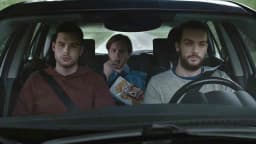
Bolt School of Unviolators Brings Scooter Safety to Ukraine
Bolt's School of Unviolators is a 360-degree road safety campaign created by Ukrainian agency idealers in 2025, designed to educate electric scooter riders on responsible riding through a fully operational public training event where participants completed theory lessons, practical tests, and received symbolic scooter licenses, according to Bolt Eu.
Electric scooters have moved from novelty to norm on Ukrainian roads. Yet their integration into everyday traffic has not been matched by a corresponding shift in rider behaviour. Bolt, the global ride-hailing and micromobility platform, identified a persistent gap: people mount scooters without ever having been formally taught how to ride them responsibly. The campaign, also referenced in archive records as the School for Law-Abiding Citizens and the Unoffenders School, set out to close that gap by borrowing the most trusted mechanism in road safety education — the driving school — and rebuilding it around the scooter. In Ukraine, where Bolt operates as a significant player in shared micromobility, the initiative carried both cultural relevance and operational urgency.
The campaign's mechanics centred on a physical, fully dressed location in Ukraine divided into zones that mirrored the stages of a conventional driving school curriculum. Attendees moved through master-class areas, a practical riding section, an examination zone, a rest area, a designated parking bay, and — in a detail that signalled both seriousness and showmanship — a crash-test demonstration area. Participants who completed the process received a plastic scooter licence, a tangible, shareable artefact that extended the campaign's reach beyond the event itself. The film and digital executions documented and amplified the experience, giving the School of Unviolators presence across screens as well as streets.
Bolt's strategists identified a fundamental credibility deficit at the heart of scooter safety in Ukraine, according to Komersant Ua. In-depth interviews conducted by the idealers team revealed that electric scooters, despite their growing presence in Ukrainian road traffic, are still not widely perceived as serious vehicles demanding serious conduct. The consequence is predictable: traffic rules are ignored, not out of defiance, but out of ignorance reinforced by a cultural blind spot. No institution had ever required scooter riders to learn, to be tested, or to be held accountable in the way that car drivers are held accountable through the driver's licence system.
That insight — that formal education creates formal responsibility — became the strategic engine of the School of Unviolators. By replicating the structure of a driving school, Bolt reframed the scooter as a vehicle deserving the same respect as a car. The symbolic scooter licence issued at the event was not a gimmick; it was a direct response to the insight that the driver's licence process instils a sense of consequence that casual scooter use has never generated. The approach is grounded in behavioural logic: people who invest time, attention, and effort in learning a skill take that skill more seriously.
The competitive context sharpens the strategic rationale. In the global shared micromobility market, Bolt competes directly with operators including Lime, which according to available estimates holds a significant share of global shared scooter usage, and Tier Mobility, which has built safety positioning as a brand pillar across European markets, according to En Wikipedia. In Ukraine specifically, differentiating on safety rather than price or coverage represents a defensible brand territory. According to Mordor Intelligence, the global shared micromobility sector is experiencing compound annual growth, making safety credibility an increasingly important lever for platforms seeking long-term user trust in emerging markets like Ukraine.
The creative team at idealers built the School of Unviolators around a single governing idea: if the absence of formal education is the problem, then formal education — rendered with wit and spectacle — is the solution. The execution did not lecture; it enrolled. Every physical element of the event location was designed to reproduce the grammar of a real driving school, from zoned training areas to an examination sequence, while the tone remained accessible enough to draw in participants who might otherwise dismiss a road safety message as bureaucratic noise.
Creative direction was led by Oleh Svyshch as creative director, with Vadym Kozedub serving as creative CEO, according to records documented at Creative-Stories Com Ua. Strategy was headed by Roman Zotov, with Arthur Boshyan as strategist. Copywriting was handled by Vitalii Katan and Liza Kulbachko, per the same source. The production extended across film and digital formats, with three campaign assets recorded in archive documentation, ensuring the physical event generated media-ready content that could travel independently of attendance.
The crash-test demonstration area deserves specific attention as a creative decision. In a conventional road safety campaign, crash statistics are cited. Here, the consequence of unsafe riding was made visible and visceral within a controlled, theatrical setting, converting an abstract risk into an immediate, memorable experience. The plastic scooter licence issued to graduates functioned as designed merchandise — a physical takeaway that participants could photograph, share, and keep, extending the campaign's organic reach beyond the event footprint. The integration of safety merchandise alongside the licence reinforced the school metaphor at the material level. The campaign's 360-degree classification reflects a deliberate layering of live experience, film documentation, and digital distribution, each channel reinforcing the others rather than operating independently.
The School of Unviolators earned a Bronze award at the Kyiv International Advertising Festival, known as KIAF, in the Film, Radio and Audio, Automotive category in 2025, according to records cited by creative-stories.com.ua. That recognition from one of Ukraine's most established creative industry juries confirms the campaign's standing within the regional advertising community and places it on the record as a formally validated piece of work in a year when Ukrainian creative output faced significant operational constraints.
No independently verified audience reach figures, scooter licence issue counts, post-event behaviour change data, or paid media performance metrics for the School of Unviolators are publicly available at the time of writing. No verified recognition from Cannes Lions, the Effie Awards, The One Show, D&AD, or the Clio Awards has been identified for this campaign, per searches of those organisations' public records. The KIAF Bronze represents the sole confirmed award.
Structurally, the campaign demonstrates strong strategic coherence. The insight is specific and testable, the mechanic directly addresses the identified behaviour gap, and the symbolic licence creates a measurable participation moment that doubles as earned media. The crash-test element introduces sensory memorability that purely digital safety campaigns rarely achieve. The Clapboard Score for this campaign is 63 out of 100, reflecting a well-constructed strategic foundation and credible creative execution offset by limited documented scale and the absence of verified performance data. In the context of Ukrainian market conditions in 2025, the ambition and completion of the event itself represent a meaningful creative achievement.
The School of Unviolators is a road safety campaign by Bolt and Ukrainian agency idealers, launched in Ukraine in 2025. It used a real-world scooter school format — with theory, practical tests, crash demonstrations, and symbolic licences — to teach riders responsible riding and traffic rules through direct participation rather than passive messaging.
Ukrainian agency idealers created the campaign for Bolt. The creative team included creative CEO Vadym Kozedub, creative director Oleh Svyshch, head of strategy Roman Zotov, strategist Arthur Boshyan, and copywriters Vitalii Katan and Liza Kulbachko, according to records documented by creative-stories.com.ua.
The campaign won a Bronze award at the Kyiv International Advertising Festival in the Film, Radio and Audio, Automotive category in 2025, according to creative-stories.com.ua. No verified recognition from Cannes Lions, D&AD, the Effies, The One Show, or the Clio Awards has been publicly confirmed for this campaign.
Bolt's strategists found through in-depth interviews that scooter riders in Ukraine are never formally taught traffic rules, unlike car drivers who undergo structured driver's licence training. The school format replicated that credibility-building process, making responsible riding feel earned and consequential rather than advisory, per the campaign brief as documented by idealers.
Participants moved through a fully zoned location in Ukraine that included master-class areas, a practical riding section, an exam zone, a parking area, a rest space, and a crash-test demonstration. Graduates received a plastic symbolic scooter licence. The event was documented across film and digital formats as part of a 360-degree campaign.
The Clapboard Score for the School of Unviolators is 63 out of 100. The score reflects a well-defined strategic insight and coherent event-based execution, balanced against the absence of publicly verified performance metrics and limited documented audience scale for the Ukraine campaign.
.webp)
Creative Collaboration Platform: The Backbone of Modern Creative WorkWhat is a creative collaboration platform?Clapboard defines a creative collaboration platform as the operational core for today’s distributed creative teams. This is not a collection of digital collaboration tools stitched together; Clapboard’s system


Understanding the Creative Production MarketplaceWhat is a Creative Production Marketplace?Clapboard defines a creative production marketplace as a structured ecosystem where brands, agencies, and production talent converge to execute video, advertising, and branded content at scale. Unlike the legacy agency or freelanREAD FULL ARTICLE

The Urgent Need for a Creative Production Operating SystemWhy Traditional Creative Production Models Break DownClapboard sees the creative production landscape shifting under pressure. Content velocity is no longer a buzzword—it’s a mandate. Modern advertising demands relentless output across dozens of channels, each wREAD FULL ARTICLE