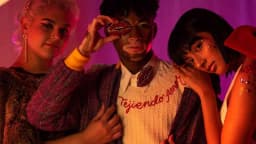
Balenciaga's Summer 21 Pre-collection, directed by Walter Stern in 2020, replaced the runway with a 10-minute fashion film shot on the nocturnal streets of

Balenciaga Summer 21 Pre-Collection Turns a Darkened Paris Into a Runway
Balenciaga's Summer 21 Pre-collection campaign is a approximately 10-minute fashion presentation film, published in the United Kingdom in October 2020, directed by Walter Stern and scored by BFRND's electronic cover of Corey Hart's 'Sunglasses at Night', replacing a conventional runway show with a cinematic night-time journey through the streets of Paris.
The campaign arrived at a moment of acute disruption for the fashion calendar. With the global personal luxury goods market contracting sharply in 2020 according to Bain, and live runway formats made impossible by the pandemic, Balenciaga chose to treat constraint as creative opportunity. The Summer 21 Pre-collection was not positioned as a stopgap replacement for a cancelled show but as a fully realised artistic statement in its own right, published on Balenciaga's own channels and amplified through YouTube, where the film accumulated over 1.2 million views and 14,353 likes.
In the United Kingdom, the campaign was released as a content-medium activation targeting a digitally native, fashion-forward audience. The pre-collection timing, ahead of the main summer line, was deliberate: by establishing the visual and sonic identity of the collection in October 2020, Balenciaga created sustained anticipation for pieces expected to enter stores in early 2021, as reported by Hypebeast. The campaign earned a Clapboard Score of 71 out of 100, reflecting its strong creative ambition and cultural resonance against the constraints of its production window.
Balenciaga structured the Summer 21 Pre-collection campaign around a single strategic insight: in a year when physical presence was impossible and audience attention was migrating to long-form digital content, a fashion film of genuine cinematic quality could outperform a conventional runway moment. The brand did not simply adapt its existing format to digital delivery. It discarded the format entirely and commissioned an original work.
The strategic context was severe. According to Bain, the global personal luxury goods market contracted by approximately 23 percent year-over-year in 2020, falling to around €217 billion as COVID-19 disrupted both retail and the experiential pillars of luxury marketing. McKinsey similarly identified a forecast contraction of between 27 and 30 percent across the global fashion and apparel industry for 2020. In the United Kingdom specifically, physical retail closures and event cancellations compounded pressure on brands dependent on seasonal show cycles to generate press coverage and consumer desire.
Against this backdrop, Balenciaga's choice to invest in a high-production film directed by Walter Stern was a direct competitive differentiator. Competing luxury houses including Gucci and Saint Laurent also pivoted to digital formats during the same period, but Balenciaga's approach was distinguished by its rejection of the lookbook aesthetic in favour of narrative immersion. The nocturnal Paris setting, the music-video grammar of the film, and the deliberate length of approximately 10 minutes all signalled a brand willing to demand audience time rather than compete for diminishing attention spans. Creative director Demna Gvasalia, who joined Balenciaga in 2015 according to The Impression, had already established the house's appetite for subverting fashion convention, and the Summer 21 Pre-collection campaign extended that lineage directly into the digital content space.
Walter Stern directed the Summer 21 Pre-collection film. Stern's visual language has long operated at the intersection of music video and fashion, a lineage that LBBOnline noted connects to his earlier work on The Verve's 'Bitter Sweet Symphony', and it is precisely that grammar he applied to Balenciaga's darkened Paris streets.
The film's visual foundation was built on the cinematography of director of photography Mauro Chiarello, who, as noted by Matthieu Toullet, colourist at MPC, made distinctive use of what Toullet described as 'tungsten Paris lights by night.' That practical light source — the amber sodium glow of Parisian street lighting — gives the film its characteristic warmth against an otherwise cold, nocturnal palette, a choice that situates Balenciaga's sharp tailoring and layered silhouettes in an environment that feels simultaneously real and heightened.
Post-production was handled by MPC, whose VFX Supervisor Dan Lorenzini designed the film's transitional morph effects and camera shake sequences. Lorenzini stated publicly that the approximately 10-minute film was delivered 'in record time', characterising the achievement as 'a testament to the team spirit and dedication of the people at MPC'. That compressed delivery timeline is significant: the campaign was produced during active pandemic restrictions, making the logistical and creative accomplishment of the finished film materially more demanding than under normal circumstances.
The sonic identity of the campaign rests on BFRND's electronic cover of Corey Hart's 1984 song 'Sunglasses at Night.' The choice is tonally precise. Hart's original track carries associations of nocturnal cool and studied detachment that map directly onto Balenciaga's visual register under Demna Gvasalia. BFRND's reworking strips the original of its pop production and replaces it with a textural electronic arrangement that sits closer to the fashion film tradition than to commercial advertising music. Academy Films contributed to the production, as reported by LBBOnline. Production credits beyond those named above are not fully documented in public records.
The Summer 21 Pre-collection campaign generated 1,202,964 views, 14,353 likes, and 112 comments on YouTube. These figures, drawn from Balenciaga's own channel data, represent a substantial organic audience for a fashion film of approximately 10 minutes in length — a format that commands significantly more viewer commitment than a standard commercial spot.
No verified third-party performance data for the campaign, including paid reach, earned media value, or retail attribution, is publicly available. What the raw engagement metrics do indicate is audience willingness to invest time in the work. A view-to-like ratio that reflects genuine appreciation rather than passive consumption, combined with the film's reception as reported by LBBOnline as 'a 10-minute fashion epic', suggests the campaign succeeded in its primary structural ambition: to establish Balenciaga's Summer 21 Pre-collection as a cultural event rather than a product catalogue.
The campaign's downstream influence is also traceable. Balenciaga described its Fall 21 collection, which first appeared off-season in December 2020 according to publicly available brand communications, as an evolution of the Summer 21 Pre-collection, confirming that the film functioned not only as a marketing activation but as a creative brief for subsequent work. In the United Kingdom and across the broader English-language digital landscape, the film demonstrated that pre-collection presentations can sustain audience attention and generate lasting brand equity without a single physical event. The campaign's Clapboard Score of 71 out of 100 reflects that structural effectiveness alongside the recognised constraints of its production context.
Balenciaga's Summer 21 Pre-collection campaign is an approximately 10-minute fashion film published in October 2020. Directed by Walter Stern and scored by BFRND's cover of Corey Hart's 'Sunglasses at Night', it replaced a conventional runway show with a cinematic journey through the nocturnal streets of Paris, targeting a fashion-forward audience in the United Kingdom and globally.
Walter Stern directed the Balenciaga Summer 21 Pre-collection film. Stern is known for work at the intersection of music video and fashion filmmaking. LBBOnline connected his visual approach on this project to his earlier direction of The Verve's 'Bitter Sweet Symphony', a lineage that informed the film's nocturnal, music-video grammar throughout.
The campaign uses BFRND's electronic cover of 'Sunglasses at Night', originally recorded by Corey Hart in 1984. BFRND's reworking replaces the original's pop production with a textural electronic arrangement. The track was chosen to reinforce the film's nocturnal aesthetic and Balenciaga's detached, culturally attuned visual identity under creative director Demna Gvasalia.
COVID-19 made live runway shows impossible in 2020. Balenciaga responded by commissioning a fully cinematic fashion film shot on the darkened streets of Paris instead. According to Bain, the global personal luxury goods market contracted approximately 23 percent that year, making digital content a strategic necessity across the United Kingdom and international luxury fashion markets.
The Balenciaga Summer 21 Pre-collection film received 1,202,964 views, 14,353 likes, and 112 comments on YouTube, according to Balenciaga's channel data. For a fashion film running approximately 10 minutes — a format demanding significant viewer commitment — these figures represent a meaningful organic audience and indicate genuine engagement rather than passive consumption.
MPC handled post-production on the Balenciaga Summer 21 Pre-collection film. VFX Supervisor Dan Lorenzini designed transitional morph effects and camera shake sequences, while colourist Matthieu Toullet graded the footage. Lorenzini noted the film was delivered in record time, describing the result as a testament to the team's dedication during a challenging pandemic production period.
.webp)
Creative Collaboration Platform: The Backbone of Modern Creative WorkWhat is a creative collaboration platform?Clapboard defines a creative collaboration platform as the operational core for today’s distributed creative teams. This is not a collection of digital collaboration tools stitched together; Clapboard’s system


Understanding the Creative Production MarketplaceWhat is a Creative Production Marketplace?Clapboard defines a creative production marketplace as a structured ecosystem where brands, agencies, and production talent converge to execute video, advertising, and branded content at scale. Unlike the legacy agency or freelanREAD FULL ARTICLE

The Urgent Need for a Creative Production Operating SystemWhy Traditional Creative Production Models Break DownClapboard sees the creative production landscape shifting under pressure. Content velocity is no longer a buzzword—it’s a mandate. Modern advertising demands relentless output across dozens of channels, each wREAD FULL ARTICLE