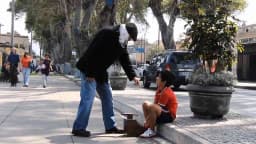
The Firecracker Project campaign by Aniquem, developed by McCann in Peru, leverages the ambient media format to address a public interest issue through a documentary-style social experiment. While specific content details are limited, the campaign’s underlying brand proposition likely centers on raising awareness about a social cause related to safety, inclusion, or community impact, aligning with Aniquem’s positioning as a socially responsible organization. The value conveyed focuses on fostering empathy, understanding, or behavioral change, encouraging the audience to reconsider their perceptions or actions concerning the identified issue.
Strategically, the campaign employs a experiential and observational approach typical of documentary and social experiment genres to engage viewers emotionally and cognitively. By situating the message within everyday environments (ambient media), it maximizes real-world relevance and immediacy, increasing the likelihood of genuine audience connection. The use of ambient media in Peru targets a broad, possibly urban demographic exposed to public spaces where the message can organically resonate. This creative angle taps into social proof and participatory observation, drawing viewers into authentic scenarios that implicitly invite reflection on societal attitudes or challenges. The campaign’s modest digital footprint—reflected in its views and interaction metrics—suggests a focused deployment rather than mass-scale exposure, potentially aiming for depth of impact over wide reach in the Peruvian public service sector.
FORMAT#3 SYMBOLIZE THE PROBLEM — Uses symbols or analogies to represent the problem instead of showing it literally.
This campaign, titled "The Firecracker Project" for Aniquem—a public service initiative in Peru—leverages a documentary/social experiment genre, signaling a real-world context with constructed or symbolic scenarios. Since it’s for a public interest cause (likely injury prevention or awareness related to firecrackers) and placed in the "Ambient" medium, the campaign most likely uses a symbolic act or experiment involving firecrackers to represent the broader issue (e.g., dangers to children). There is no explicit problem-solution arc, product demonstration, celebrity, or testimonial cue. The reliance on a project name and experimental approach makes symbolism the campaign’s core creative strategy: using a physical metaphor or staged event to highlight the seriousness of preventable injuries without literally showing actual harm. This aligns best with the "Symbolize the Problem" format, as the campaign translates abstract societal risk into a compelling, tangible, and symbolic representation to provoke public reflection and action.
1. TECHO Perú – Market Positioning
TECHO Perú focuses on eradicating poverty through building transitional housing and fostering community development. They position themselves as a youth-driven grassroots movement emphasizing empowerment and direct social action, differentiating through volunteer engagement and sustainable local impact.
2. CARE Perú – Market Positioning
CARE Perú targets poverty alleviation with a focus on women's empowerment and economic development. Their strategic angle revolves around gender equality and social inclusion, leveraging international resources to create scalable, community-based programs.
3. Aldeas Infantiles SOS Perú – Market Positioning
Aldeas Infantiles SOS provides long-term care for vulnerable children without parental care. They differentiate through personalized, family-like environments and holistic child development programs, promoting social integration and stability.
4. Asociación Paralímpica Peruana – Market Positioning
This organization champions inclusion and empowerment of people with disabilities through sports. Their distinctive positioning lies in promoting visibility, equal opportunities, and social integration using Paralympic sports as a catalyst for societal change.
5. SOS Children’s Villages Perú – Market Positioning
SOS Children’s Villages Perú positions itself as a provider of family-based alternative care and protective services for at-risk children. Their strategic focus is on creating nurturing environments, safeguarding children’s rights, and supporting family strengthening initiatives.
Q: What is The Firecracker Project about?
A: The Firecracker Project is a professional ambient advertising campaign launched in Peru in 2013 for the brand Aniquem, created by the agency McCann. Developed within the public interest sector, the campaign centers on raising awareness of critical social issues—most likely the dangers associated with firecrackers—through a documentary-style social experiment. By leveraging a single media asset and communicating in Spanish, The Firecracker Project aims to provoke thought and stimulate dialogue within the community. Its immersive approach in public spaces underscores Aniquem’s commitment to social responsibility and highlights the potential of creative advertising to inspire collective reflection on important societal concerns.
Q: What creative device does The Firecracker Project use?
A: The Firecracker Project employs the Symbolize the Problem format, as classified by Clapboard’s 12-format taxonomy (FORMAT#3). Rather than depicting the issue literally, the campaign uses symbols or analogies—in this case, a firecracker as a metaphor—to represent the broader societal risk. This approach is executed through a documentary/social experiment genre, constructing scenarios that translate abstract dangers into tangible, relatable experiences. By relying on symbolism, the campaign invites the audience to reflect on the seriousness of preventable injuries, making the message accessible and emotionally resonant without resorting to graphic depictions.
Q: What is the campaign proposition for The Firecracker Project?
A: The campaign proposition for The Firecracker Project centers on Aniquem’s mission to raise awareness about a pressing public interest issue, likely related to safety or injury prevention, using an experiential and observational approach. Targeting a broad Peruvian audience in public spaces, the campaign seeks to foster empathy and encourage behavioral change by prompting viewers to reconsider their perceptions and actions. This aligns with Aniquem’s positioning as a socially responsible organization, leveraging the ambient media format to deliver real-world relevance and emotional impact, ultimately aiming to drive community reflection and inspire positive societal shifts.
Q: How does The Firecracker Project rank in Clapboard's archive?
A: The Firecracker Project holds a Clapboard Campaign Score of 57/100 in Clapboard’s global ad archive. This score reflects the campaign’s creative ambition, execution quality, and cultural relevance within the public interest sector, as assessed by Clapboard’s curatorial standards.
Q: Who are the competitors in Aniquem's category?
A: In the Peruvian public service landscape, Aniquem competes with organizations such as TECHO Perú, which positions itself as a youth-driven movement focused on eradicating poverty through community development and transitional housing; CARE Perú, which emphasizes women’s empowerment and economic development with a focus on gender equality; Aldeas Infantiles SOS Perú, known for providing long-term, family-like care for vulnerable children; Asociación Paralímpica Peruana, which champions inclusion and empowerment for people with disabilities through Paralympic sports; and SOS Children’s Villages Perú, which offers family-based alternative care and protective services for at-risk children, prioritizing nurturing environments and child rights.


 ARCHIVE
.webp)