The Clapboard Ad Archive features top ecommerce advertising campaigns showcasing iconic brand marketing and digital ads for strategic campaign reference.
eCommerce
Green Toaster
eCommerce
Green Toaster
The Green Toaster campaign, launched in South Korea in August 2015 for the brand Gmarket by the ad agency INNORED, presents a creative and impactful approach within the Retail Services industry using Ambient media. This innovative campaign, named the Green Toaster Project, focused on promoting hygienic mobile phone use by introducing a unique concept: sterilizing smartphones in a specially designed "Green Toaster." This clever twist not only captured public attention but also aligned with growing consumer concerns about cleanliness and health in everyday life. With a single media asset, the campaign effectively communicated its core message through engaging visual storytelling that encouraged users to rethink their habits and provided a tangible solution for mobile hygiene. The campaign's language was English, enabling broader accessibility and understanding beyond the domestic market. Garnering over 20,000 views, 26 likes, and sparking conversation with comments, the Green Toaster project leveraged the power of ambient advertising to create meaningful brand engagement and awareness in an often-overlooked aspect of personal care. This campaign creatively positioned Gmarket as an innovative and socially conscious brand that prioritizes consumers' well-being, reinforcing its presence as a forward-thinking leader in retail services. By combining a practical idea with environmental and health-conscious messaging, the Green Toaster campaign successfully bridged product promotion with public service, demonstrating the effectiveness of ambient media to deliver memorable and socially relevant advertising experiences.
Own the Night
In December 2014, Zalora launched the dynamic digital campaign Own the Night in Singapore, aimed at empowering consumers to embrace confidence and style after sunset. Positioned within the Retail Services industry, this campaign capitalized on the festive holiday season to inspire shoppers to revel in nightlife with fashion that catches every eye. Central to the campaign was a compelling video featuring the unreleased track Flowing, crafted by Phil Cook, which set a vibrant and celebratory tone. The messaging encouraged audiences to transition seamlessly from daytime achievements to nighttime glamour, positioning Zalora as Asia’s premier online fashion destination for head-turning apparel. With hashtags like #OWNTHEMOMENT, #OWNTHEEVENING, #OWNTHEPARTY, and #OWNTHENIGHT, the campaign leveraged social media to foster engagement and community participation. Garnering over 1.95 million views, 965 likes, and 182 comments, the campaign demonstrated strong audience resonance. By inviting consumers to take the spotlight and own their celebrations, Zalora effectively connected emotional appeal with product offering, enhancing brand visibility during one of the most competitive retail periods of the year. This approach underscored Zalora’s commitment to making fashion accessible, relevant, and aspirational for the modern consumer navigating the vibrant urban nightlife.
The joy of giving - ebay | Clapboard Ad Archive
The joy of giving campaign from eBay, created in partnership with Exposure for the United Kingdom market in 2014, marks a pivotal turn for the eCommerce category as it leverages the emotive peak of the December holidays to reposition the brand beyond its traditional role as an online marketplace and into the realm of meaningful social connection. By foregrounding generosity and the emotional resonance of gift-giving, the campaign appeals directly to both the professional services sector and broader consumer mindset, highlighting the ease and joy facilitated by eBay’s platform as intrinsic to the act of giving. Anchored by a digital-first approach, the narrative avoids clichés of competitive self-comparison or celebrity presence, instead building its emotional arc around authentic stories of gifting and the tangible happiness sparked between givers and recipients. This is a textbook example of what Clapboard’s taxonomy would classify as FORMAT#6—Benefit Causes Story: the actions and emotional peak of generosity are catalyzed by the unique benefit eBay offers—namely, accessible and thoughtful gifting at scale. The creative restraint of deploying a single standout media asset serves to amplify impact rather than dilute it, ensuring that the campaign’s message lands with clarity and relevance at a moment when consumer attention is saturated and traditional brands scramble for differentiation. Exposure’s work elevates eBay’s brand perception, drawing on the heightened emotional charge of the season to reinforce eBay as an enabler of personal connection, rather than simply a transactional utility. Importantly, the campaign eschews heavy retail messaging in favor of stories that bridge digital experiences with real-world emotions, signaling a sophisticated understanding of what moves holiday audiences and what elevates a platform from service provider to social facilitator. Clapboard rates this 48/100. In foregrounding the emotional dividend of connection over the hard sell, eBay’s joy of giving signals a shift in how eCommerce brands can own cultural moments by amplifying the human stories their platforms make possible.
Student sports - Geocell | Clapboard Ad Archive
Geocell’s VICI campaign, developed in partnership with Windfor’s, reimagines the student journey as a full-contact sport, threading together themes of stamina, creativity, and personal endurance through a sharply conceived film that speaks directly to the realities of young Georgians balancing academic ambition with internal competition. Launched in the Georgian market in the Year 2017 and grounded in the eCommerce category, this campaign sidesteps literal depictions of student stress or straightforward product messaging; instead, it leans on the universal language of sports to symbolize the rigors and relentless self-measurement that define student life. The narrative’s core — pushing oneself against personal limits, competing not just with classmates but fundamentally with oneself — is visually expressed through cinematic techniques that elevate everyday student experiences to the dramatic intensity of athletic pursuit. This approach, which Clapboard’s taxonomy places squarely in FORMAT#3 Symbolize the Problem, transforms student struggles into a metaphorical athletic arena, using analogy as a strategic lens to engage and motivate its audience without resorting to overt exposition or direct product demonstration. The creative strategy underscores Geocell’s commitment to supporting youth aspirations, framing the telecom brand as a partner cheering students onward in their pursuit of growth and self-discovery. Every touchpoint — from casting and production design to the campaign’s carefully orchestrated narrative tempo — is calibrated to ensure the spot lands with emotional authenticity while remaining true to Geocell’s brand promise of empowerment. The campaign earns a score of 63/100 in Clapboard’s global creative archive. By rescripting the educational ordeal into a near-mythic contest of mind and spirit, Student sports signals to the industry that youth marketing succeeds when it trades literal problem-solving for powerful cultural analogy as connective tissue with its audience.
#RamadanBersamaGojek - Go-Jek | Clapboard Ad Archive
#RamadanBersamaGOJEK stands as a benchmark for market-responsive digital storytelling in Indonesia’s professional services sector, leveraging the emotional resonance of Ramadan to drive both customer engagement and brand equity for Go-Jek. Launched in Year 2016, the campaign zeroes in on the pivotal insight that even modest acts of recognition—like expressing thanks or offering a gratuity—carry amplified meaning during the holy month’s focus on generosity. By embedding intuitive Thank You and Tipping features directly into the Go-Jek app for key service touchpoints across GO-RIDE, GO-CAR, GO-FOOD, and GO-MART, the work transforms ordinary transactional moments into authentic opportunities for gratitude, all within a user experience designed to minimize friction and maximize impact. The campaign narrative eschews overt drama, instead illustrating how the new product features themselves become catalysts for real-world kindness, an approach that sits squarely in Clapboard’s FORMAT#6—Benefit Causes Story taxonomy: the mechanic is the message, and the product benefit directly enables a higher-order behavior. With over 120,000 views racked up on the principal digital asset, the creative signals strong digital traction and a cultural fit within the market’s Ramadan rituals. The campaign architecture extends beyond the app with activations that encourage broader participation, constructing a flexible framework that scales from private, in-app actions to collective, public displays of appreciation. This positions Go-Jek as a platform by and for community, not simply a service provider, further blurring the line between utility and social purpose—a highly salient strategy in the increasingly competitive eCommerce category. The agency’s execution leverages local language, iconography, and context to disarm resistance to digital tipping, reframing what might otherwise be a transactional add-on as a meaningful gesture deeply embedded in Indonesian values. At its core, #RamadanBersamaGOJEK demonstrates that platform enhancements—when contextually programmed and emotionally loaded—can serve as both functional improvement and brand storytelling device, yielding measurable uplift in both engagement and favorability. Clapboard rates this 68/100. For brands navigating categories where product benefits are often dismissed as mere hygiene, this campaign signals that when rooted in cultural moment and emotional utility, feature-led stories can unlock powerful new value equations.
#EmpowerChange - Hijup.com | Clapboard Ad Archive
Hijup.com’s #EmpowerChange digital campaign, launched in Indonesia in Year 2016, demonstrates how a retail services brand can transform both cultural conversation and commercial engagement by turning the lens on its community’s most resonant narratives. Centered around the moving accounts of five women who rise above entrenched stereotypes to pursue their ambitions, #EmpowerChange tactically aligns the Hijup.com brand — a leading e-commerce destination for modest fashion — with the aspirational pulse of modern Muslim women. More than a showcase for its apparel, hijabs, and accessories, the campaign crafts an emotionally-charged mosaic that invites its target audience to see facets of their own aspirations, challenges, and resilience reflected onscreen. The storytelling here is unmistakably digital in confidence, yet its intent is unmistakably human: to forge a social dialogue around empowerment and individuality, and to recast modest fashion not as constraint, but as a canvas for creative strength and personal agency. What Clapboard’s taxonomy would classify as FORMAT#10—Associated User Imagery—the campaign’s creative device is to spotlight relatable and aspirational user stories, deftly embedding the Hijup.com proposition within the lived experiences of role models who feel both familiar and inspiring to the brand’s core demographic. With over 1.7 million views, the initiative exemplifies the reach possible when an e-commerce platform abandons product-centric storytelling in favor of emotionally intelligent content that speaks directly to its audience’s values and lived realities. The campaign’s performance is reinforced by a groundswell of substantive engagement, as viewers gravitate to the narrative’s authentic tone and Hijup.com’s positioning as both a commercial and cultural ally for women who reject limiting definitions of what it means to be modern and modest. In an industry where retail services can often lean on surface-level transactional appeals, Hijup.com’s strategic focus on community empowerment serves to deepen brand affinity, catalyze conversation around social progress, and turn the act of shopping for modest fashion into a contribution to a wider movement for positive change. The campaign earns 73/100 in Clapboard’s global creative archive. As modest fashion continues its push into digital retail and social storytelling, #EmpowerChange signals that brand leadership in this category now depends on bridging emotional storytelling with authentic user representation.
Santa’s big break - Takealot | Clapboard Ad Archive
Santa’s big break for Takealot, conceived by M&C Saatchi and launched in South Africa’s fiercely competitive retail services market in 2016, pivots on a bold reinterpretation of holiday advertising convention: casting Santa Claus not as the tireless deliverer but as a suddenly redundant figure enjoying unexpected downtime thanks to the seamless convenience of online shopping. This creative execution harnesses a powerful mechanism identified in Clapboard’s taxonomy as FORMAT#12—Parody or Borrowed Format, leveraging the instantly recognizable iconography of Santa and the underlying holiday mythology to draw viewers in with humor and a culturally resonant twist. By subverting the traditional festive narrative and placing Takealot at the center of gift-giving efficiency, the campaign deftly spotlights ecommerce strengths—a frictionless buying journey and reliable delivery—qualities that become even more attractive when set against the comedic spectacle of an out-of-work Santa. The film’s tightly constructed narrative uses visual storytelling to universalize the message, reinforcing Takealot’s positioning as the default solution for end-of-year gifting anxiety and raising the brand’s profile across both digital and traditional broadcast platforms at a moment when consumer attention peaks. Crucially, Santa’s big break resists product demonstration in favor of a lifestyle-driven, emotionally loaded narrative, maximizing the psychological imprint by speaking directly to the stress points and aspirations of holiday shoppers. With only a single media asset, the campaign demonstrates how strong core insight and focused creative can stretch impact, providing Takealot with not only tactical sales momentum but also a branding halo that extends into long-term recall and preference. In a year when South African shoppers were rapidly embracing ecommerce, this campaign plays both educator and entertainer, making the case for online retail as a smart, joyful alternative to the season’s logistical headaches. The campaign earns 63/100 in Clapboard’s global creative archive. For an industry in which festive tradition often dominates creative choices, Santa’s big break signals how parody and cultural borrowing, executed with wit and strategic precision, can help ecommerce brands reframe category expectations while making the digital transition truly feel like a holiday.
Happiness is, The Aviator - ebay | Clapboard Ad Archive
Happiness is, The Aviator repositions eBay in the eCommerce landscape with a film campaign released in the United States in 2016, a collaboration between the retail giant and Pereira & O’Dell aimed squarely at restoring emotional resonance to online shopping. At the heart of the narrative lies the symbolic pursuit of happiness, presented through the unmistakable lens of desire and fulfillment wrapped within the motif of The Aviator—a storytelling device that transcends literal purchase journeys and instead anchors the campaign in the universal thrill of discovery. Rather than demonstrate or list product features, the film leans into evocative visuals and a gently paced, emotionally attentive storyline, staking out territory where eBay’s promise is less about inventory breadth and more about the joy sparked when a shopper uncovers that singular, meaningful object. This strategy distinguishes eBay from pure-play transactional platforms by asserting the brand’s cultural role: not just a retailer but a conduit for aspiration and sentiment, as every item carries the potential for personal story and transformation. Pereira & O’Dell’s creative execution is deliberately warm, using atmosphere, sound, and crafted visuals to cultivate authenticity, all while sidestepping overt transactional messaging to bring consumers into an intimate emotional space. What Clapboard’s taxonomy would classify as FORMAT#9—Symbolize the Benefit—this approach sets aside didactic demonstrations in favor of amplifying the payoff itself, inviting viewers to recognize themselves in the quest for unexpected delight that eBay facilitates. With just two media assets, the campaign achieves a lean but potent presence, reflecting current communications discipline: fewer, bigger, better. The film’s ability to bridge aspiration and emotional payback directly addresses the challenge facing eCommerce brands in 2016—to establish lasting, human connections when so much retail messaging remains rational and commoditized. eBay’s choice to invest in storytelling that privileges empathy and joy positions the brand as both destination and companion, reinforcing its market identity where happiness is something shoppable but also deeply personal. The campaign earns 63/100 in Clapboard’s global creative archive. In a sector often dominated by functional messaging, this work signals eBay’s recognition that the deepest brand value emerges when commerce and emotion meet.
Shop a Song - Only the Good Die Young Collection, Shop a ... - ebay | Clapboard Ad Archive
Shop a Song – Only the Good Die Young Collection marks a bold, culturally attuned move from eBay and Goodby Silverstein & Partners, embracing music’s iconic relevance as the backbone of digital retail engagement in the eCommerce space in 2015. By harnessing the enduring emotional pull of Billy Joel’s Only the Good Die Young, the campaign transforms shopping from a transactional activity into an immersive pop culture experience, curating product recommendations around the mood, era, and motifs embedded in the song. This alliance of music and commerce situates eBay as a conduit for nostalgia and discovery, using the song’s evocative storytelling to reframe product browsing as an act of cultural participation rather than mere consumption. The creative approach roots itself in what Clapboard’s taxonomy recognizes as FORMAT#12—Parody or Borrowed Format, strategically borrowing the structure and emotional valence of existing pop cultural content to generate resonance and instant recognizability. On digital channels, bespoke media assets invite users to traverse the Only the Good Die Young Collection in a way that feels both interactive and deeply personalized, tying the act of shopping to the sensibilities of music fandom and lifestyle aspiration that defined the era and genre. This deliberate cross-pollination signals an advanced understanding of how consumers’ passions and digital behaviors intersect, collapsing the boundaries between entertainment and retail in a manner that elevates brand salience and forges stronger emotional loyalty. The intended effect is to shift eBay’s perception from a utilitarian online marketplace to a culture-forward curator, with agency craft evident in the campaign’s ability to stage each product as part of a lived, storied world. Beyond mere song reference, the campaign exploits the rich semiotics of music nostalgia, presenting collections as connective tissue between decades, identities, and consumer desire. Its success lies not in bombast or novelty, but in the studied calibration of audience insight with creative discipline, allowing participants to see themselves not only as eBay buyers but as members of a discerning, culturally literate community. The campaign earns 63/100 in Clapboard’s global creative archive. For brands operating in crowded digital marketplaces, Shop a Song – Only the Good Die Young Collection demonstrates that commerce rooted in cultural memory is more than a tactic—it is a powerful strategy for relevance and differentiation when algorithmic shopping threatens to flatten the emotional dimension of retail.
The Refugee Résumé - Social Bee | Clapboard Ad Archive
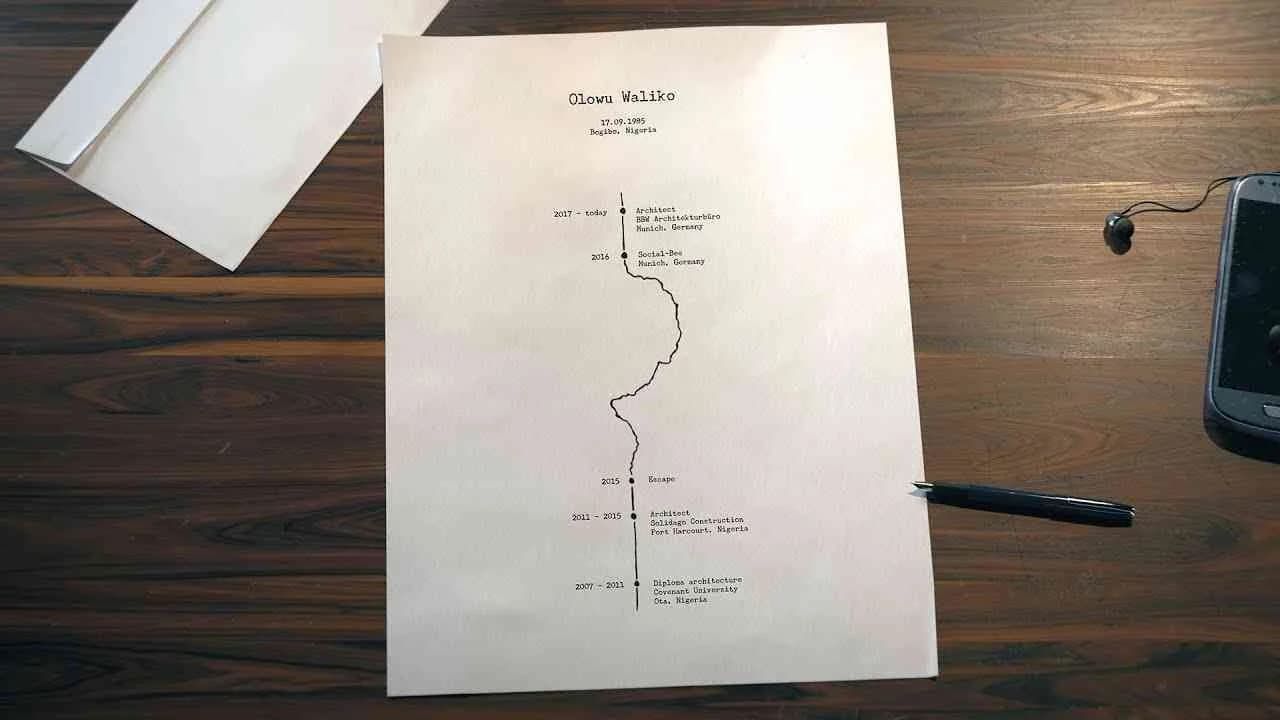
Social Bee’s The Refugee Résumé, released in Germany in 2018 by Jung von Matt, reframes one of the central challenges of refugee employment — the perceived black mark of a CV gap caused by forced migration — as a distinctive marker of resilience and determination, using design to change not just the look of a job application, but its fundamental narrative. Addressing the eCommerce market category with sharp clarity, the campaign turns the often-overlooked details of an applicant’s escape route into the very visual structure of their résumé, embedding the geography of individual hardship into the language of professional achievement. Rather than relying on standard narratives or product-based solutions, Jung von Matt’s work for Social Bee operationalizes the problem itself, transforming an invisible obstacle into a deeply human symbol and making every application sent across Germany both unforgettable and authentic. What Clapboard’s taxonomy would classify as FORMAT#3—Symbolize the Problem, The Refugee Résumé does not attempt to handhold its audience through exposition or redemption arcs; instead, the creative power sits in the literal mapping of adversity, inviting hiring managers to see the gap as evidence not of deficiency but of extraordinary journey and perseverance. This approach does more than disrupt the recruiter’s visual pattern-matching — it demands empathy by asking gatekeepers to acknowledge the lived experience behind the documents they review, neatly sidestepping pity in favor of agency. With individualized routes powering each CV’s core design, Social Bee’s campaign deploys bespoke storytelling at scale, multiplying both its memorability and capacity to reshape employer perceptions nationwide. Jung von Matt avoids the tropes or testimonials that typically dominate cause-based employment drives, placing faith in the audience’s ability to recognize strength reframed as uniqueness. The campaign’s simplicity belies its sophistication: by refusing to edit out or euphemize adversity, it enlists powerful symbolism to communicate deep context and unspoken characteristics in immediate, visual terms. This direct intervention in hiring process mechanics illuminates a path for social enterprise brands seeking to reposition entrenched biases in the workplace, demonstrating how category-leading creative can solve communications challenges endemic to structurally marginalized groups. The campaign earns 77/100 in Clapboard’s global creative archive. The Refugee Résumé matters because it proves that with the right creative device, even the least visible hurdles can become standout assets when reframed for the right audience.
The postcard - Vistaprint | Clapboard Ad Archive
Vistaprint’s 2015 campaign The postcard stands as a strategically poised statement within the professional services and eCommerce category, leveraging a narrative film to reclaim the tactile, human impact of personalized marketing in an era dominated by ephemeral digital outreach. Developed for the United States market and using a singular, sharply crafted film asset, the campaign constructs an emotional arc around the seemingly simple act of sending a postcard, underscoring how small gestures of personalized communication can foster trust, spark connection, and drive business growth for small businesses and professionals. Without relying on overt demonstrations or testimonials, the piece exemplifies an exemplary story technique—the very definition of what Clapboard’s 12-format taxonomy designates as FORMAT#5—Exemplary Story, in which the product is not a mere embellishment but the driving force of the narrative’s resolution. Here, the Vistaprint postcard is not just a marketing artifact; it is elevated to a linchpin in a story about building relationships and leaving lasting impressions. The film walks a fine line between nostalgia and relevance, deftly exploiting the emotional resonance of physical mail to remind audiences that in a marketplace saturated with digital messaging, a thoughtfully designed, high-quality print piece from Vistaprint has the potential to cut through noise and deliver genuine, memorable engagement. The campaign’s creative confidence is matched by its strategic clarity: it positions Vistaprint not merely as another online print provider, but as an essential partner in a small business owner’s arsenal—an enabler of meaningful contact in customer relationship building, and a champion of tangible communications that persist beyond the swipe of a screen. With strong production values and a clear marketing proposition, The postcard succeeds in making the case for print as both an economic and emotional differentiator—sentiment reinforced by targeted distribution and storytelling discipline. Clapboard rates this 63/100. For practitioners and strategists, this campaign signals an enduring truth in professional services marketing that authentic, tactile experiences remain powerful tools for differentiation when elevated with narrative craft.
Shuffle sells - Letgo | Clapboard Ad Archive
Letgo’s Shuffle sells campaign, devised by Saatchi & Saatchi for the Ukrainian market in the Professional Services sector, exemplifies the streamlined selling proposition at the heart of modern eCommerce. Anchored in a single, sharply executed film asset, the campaign leverages a brisk visual vocabulary to demonstrate how Letgo’s platform reimagines the process of selling personal goods — not through metaphor or narrative overlay, but via a direct, action-centric concept that trades on the sense of immediacy suggested by the term shuffle. The creative choice to strip away extraneous storytelling and foreground the product in motion reflects a purposeful alignment with what Clapboard’s taxonomy would classify as FORMAT#1—Demonstration, highlighting Letgo’s core value: transforming a traditionally cumbersome exchange into a fluid, almost effortless act of connection between seller and buyer. By working in Russian and meeting the audience on their own ground, Saatchi & Saatchi tailor the communication for resonance, harnessing the tone and pace of daily transactions to make the Letgo proposition immediately relatable. The focus on clarity and efficiency speaks to a professional audience that values function over flourish and regards ease of use as non-negotiable in digital service platforms. This approach sidesteps the trappings of celebrity, parody, or social proof, asserting instead that the best endorsement is the platform’s own visible performance — a confidence born of product integrity rather than borrowed equity. Say less, show more: Shuffle sells is emblematic of a philosophy where simplicity and utility are indistinguishable from creativity, inviting the audience to imagine their own participation in the Letgo ecosystem. The agency’s restraint is strategic, emphasizing speed, transparency, and trust in a market where frictionless commerce is both cultural aspiration and industry imperative. The campaign earns 52/100 in Clapboard’s global creative archive. In setting a benchmark for demonstration-based messaging in eCommerce, this work signals that brands positioning for trust and efficiency in professional services must articulate value through the visceral clarity of product experience.
FAQs for the Playlist: eCommerce■
Top questions to this curated campaign playlist
Professionals analyze ecommerce campaigns to understand effective storytelling, user experience integration, and conversion-driven messaging. These references reveal how brands balance product focus with emotional engagement, optimize calls to action, and leverage platform-specific formats to drive sales and loyalty in competitive online environments.
Examining ecommerce advertising history highlights shifts in consumer behavior, technology adoption, and media channels. This context helps strategists anticipate market trends, avoid past pitfalls, and craft campaigns that resonate with evolving digital audiences, ensuring brand relevance and competitive advantage over time.
Ecommerce advertising adapts to local cultural nuances, purchasing habits, and platform ecosystems. For example, social commerce dominates in Asia with influencer-driven content, while Western markets emphasize seamless omnichannel experiences. Format choices and messaging styles reflect these distinctions, shaping campaign effectiveness regionally and by device.
A frequent misconception is that ecommerce ads must focus solely on product features or discounts. In reality, successful campaigns blend brand storytelling with transactional clarity, creating emotional connections that drive both immediate sales and long-term loyalty, rather than relying purely on price-driven tactics.
Analyzing landmark ecommerce campaigns sharpens one's ability to identify innovative techniques in user engagement, data-driven personalization, and integrated storytelling. This deep understanding informs more nuanced, effective campaign development, supporting creative leadership and strategic decision-making—archived in Clapboard's global ad archive.
Creative Collaboration Platform: The Backbone of Modern Creative WorkWhat is a creative collaboration platform?Clapboard defines a creative collaboration platform as the operational core for today’s distributed creative teams. This is not a collection of digital collaboration tools stitched together; Clapboard’s system

Understanding the Creative Production MarketplaceWhat is a Creative Production Marketplace?Clapboard defines a creative production marketplace as a structured ecosystem where brands, agencies, and production talent converge to execute video, advertising, and branded content at scale. Unlike the legacy agency or freelanREAD FULL ARTICLE
The Urgent Need for a Creative Production Operating SystemWhy Traditional Creative Production Models Break DownClapboard sees the creative production landscape shifting under pressure. Content velocity is no longer a buzzword—it’s a mandate. Modern advertising demands relentless output across dozens of channels, each wREAD FULL ARTICLE

.webp)