


Varun Katyal | Founder, Clapboard
Varun Katyal is the Founder & CEO of Clapboard and a former Creative Director at Ogilvy, with 15+ years of experience across advertising, branded content, and film production. He built Clapboard after seeing firsthand that the industry’s traditional ways of sourcing talent, structuring teams, and delivering creative work were no longer built for the volume, velocity, and complexity of modern content. Clapboard is his answer — a video-first creative operating system that brings together a curated talent marketplace, managed production services, and an AI- and automation-powered layer into a single ecosystem for advertising, branded content, and film. It is designed for a market where brands need content at a scale, speed, and level of specialization that legacy agencies and generic freelance platforms were never built to deliver. The thinking, frameworks, and editorial perspective behind this blog are shaped by Varun’s experience across both the agency world and the emerging platform-led future of creative production. LinkedIn: https://www.linkedin.com/in/varun-katyal-clapboard/
Decoding the Core Elements of a Startup Branding Guide
The startup branding guide is not a vanity project — it’s a commercial tool. Its job is to codify how your company shows up in the world, both visually and verbally. When done right, it eliminates ambiguity, accelerates decision-making, and protects brand equity as you scale. The best guides are concise, actionable, and built for real-world use, not just internal show-and-tell. Here’s what matters most.
Key sections in a startup branding guide
Every effective startup branding guide starts with the fundamentals: mission, vision, and values. These aren’t just statements for the About page. They’re the north star for every creative and commercial decision. Next comes the unique value proposition — a clear articulation of what sets the business apart in a crowded market. This isn’t theoretical; it’s the filter through which all messaging and design choices should be run.
From there, the guide must define the core branding components: visual identity, verbal identity, and usage rules. Each section should be built to scale — concise enough for quick onboarding, robust enough to handle growth pains. Consistency is the only shortcut to trust and recognition, especially in the early stages.
Visual identity elements every startup needs
Visual identity for startups is about more than logos and colors. The guide should specify the logo lockup, minimum clear space, and misuse examples. Color palette must be tight: a primary set for recognition, a secondary set for flexibility. Typography guidelines should cover web, print, and motion — not just font names, but hierarchy, weight, and application. Every element should be shown in context, not just as isolated assets. This is where many guides fail: they forget that branding lives in feeds, decks, and ads, not just on a mood board.
Visual brand identity is only as strong as its weakest execution. The guide should include real-world mockups: social posts, landing pages, video frames. If you’re serious about video, specify lower-third treatments, intro/outro animations, and overlay standards. These details keep production teams aligned, no matter how fast you’re moving.
Crafting your brand voice and messaging
Brand messaging framework is the unsung hero of startup branding. It’s not enough to define what you say — you need to define how you say it. Tone of voice guidelines should be explicit: formal or conversational, optimistic or pragmatic, concise or explanatory. Provide dos and don’ts, sample headlines, and boilerplate copy. This isn’t about policing creativity; it’s about giving teams the tools to communicate with precision and consistency.
Brand messaging should ladder directly from the value proposition. If your positioning is challenger, your language should be sharp and direct. If you’re selling trust, your tone should be measured and authoritative. The style guide must also cover naming conventions, taglines, and key phrases to use or avoid. Every word choice is a signal to your market — get lazy here, and you dilute your brand before it even gets traction.
Style guide essentials for consistency
No startup branding guide is complete without rules of engagement. Set clear usage protocols: how to handle co-branding, what to do in edge cases, who owns final sign-off. Include a checklist for asset handoff, a quick-reference for core branding components, and escalation paths for exceptions. This is operational hygiene, not bureaucracy. It’s what keeps your brand coherent as you add new markets, channels, and collaborators.
In the end, a startup branding guide is only as valuable as its adoption. Make it accessible, keep it updated, and treat it as a living document. The payoff isn’t just a prettier brand
Why Every Startup Needs a Startup Branding Guide
What is a startup branding guide?
A startup branding guide is not a vanity document. It is a tactical blueprint that codifies the core elements of your brand identity for startups: voice, visual language, tone, messaging, and application rules. Unlike the sprawling brand bibles of legacy corporations, a startup branding guide is lean, actionable, and built for speed. Its purpose is to ensure that every touchpoint — from pitch decks to paid ads — speaks with one clear, consistent voice. This is the foundation for building your brand with intent, not improvisation.
Why startups can’t afford inconsistent branding
Startups operate in a pressure cooker: limited resources, compressed timelines, and a market that rarely gives second chances. Inconsistent branding is a silent killer. It confuses investors, erodes customer trust, and dilutes any early traction. When every asset looks and sounds different, you’re not building a brand — you’re broadcasting chaos. The cost isn’t just aesthetic; it’s commercial. Without a startup branding guide, founders risk burning through budget on creative that doesn’t compound, or worse, undermines credibility.
How a branding guide supports business growth
Structured branding for new businesses is a growth lever, not a cost center. A clear startup brand strategy accelerates go-to-market by eliminating ambiguity. Teams move faster because decisions are already made: colors, logos, tone, messaging hierarchy. This clarity is especially critical as you scale — new hires, agencies, and partners can align instantly, reducing friction and rework. The result is market presence that feels intentional, not accidental, and earns early trust from both customers and investors.
What should a startup branding guide include?
A functional branding guide for startups covers more than just a logo and color palette. It should define your value proposition, tone of voice, elevator pitch, key messaging pillars, visual system, and usage examples. The best guides are practical — they show, not just tell, how to apply the brand across channels. This is where branding best practices meet operational reality: the guide must be easy to use, easy to share, and adaptable as the business evolves.
A startup branding guide is not optional for founders who want to build a durable, trusted business. It’s the difference between noise and signal, between wasted spend and compounding brand equity. In the early stage, clarity is your most valuable asset — and the guide is how you operationalize it.
Mapping Your Startup’s Brand DNA: Mission, Values, and Positioning
Brand positioning for startups is not a theoretical exercise—it’s a commercial imperative. In a market where every founder claims to “disrupt,” clarity and differentiation are the only currencies that matter. Your brand DNA—mission, values, and positioning—must be engineered for impact, not aesthetics. This section breaks down how to articulate these fundamentals so every dollar and minute spent on branding is anchored in real strategic value.
Writing an effective mission statement for startups
The startup mission statement is your north star. It’s not a tagline or a vague aspiration. It’s the concise articulation of what your business stands for, why it exists, and the impact it intends to make. A mission statement should be clear, specific, and actionable—memorable enough to guide internal decisions and inspire external stakeholders. If your mission doesn’t clarify what you do and why it matters, it’s noise. The best statements align with your core values in branding and act as a filter for every strategic move (Bolder Agency, 2025).
Defining brand values that resonate
Core values in branding are not window dressing—they drive decisions, culture, and, ultimately, market perception. Identify values that are authentic to your team and relevant to your customers. Avoid generic platitudes. Instead, codify principles that directly influence how you build, sell, and support. Purpose-driven brands outperform: companies built on clear, actionable purpose grow three times faster than their peers, as seen in brands like Patagonia where values dictate everything from product to marketing (Kedraco, 2026). The test: if a value doesn’t shape a real-world business choice, it doesn’t belong in your DNA.
Positioning your startup against competitors
Effective brand positioning for startups is about staking a claim in the market that no one else can credibly own. This starts with a positioning statement that is brutally specific: Who are you targeting? What pain point do you solve? What outcome do you promise? And—critically—what proof do you offer? A robust positioning statement isn’t just an internal memo; it’s the foundation for messaging, creative direction, and product priorities. If your positioning can be swapped with a competitor’s without raising eyebrows, it’s not positioning—it’s camouflage. The goal is to make your unique selling proposition obvious and defensible from day one.
Building a foundation for scale
Brand DNA isn’t static. As your startup grows, revisit your mission, values, and positioning to ensure they remain sharp and relevant. But resist the temptation to dilute for broader appeal—clarity scales, vagueness doesn’t. Every successful brand refresh or evolution is rooted in a disciplined understanding of its original DNA. Use these foundational elements to filter opportunities, shape your culture, and fuel creative decisions that drive commercial outcomes.
For further guidance on defining your brand mission or exploring brand positioning strategies, ensure your leadership team is aligned on these fundamentals before you brief the creative team or commission your next campaign. Decisions made at this stage will echo throughout every touchpoint, from pitch decks to product launches. Get it right, and your brand becomes a strategic asset—not just a logo or a tagline, but a lever for outsized growth.

Designing Visual Brand Identity That Resonates
Visual brand identity is not window dressing—it’s the frontline of startup recognition and the anchor for emotional connection. For founders and marketers, translating brand DNA into visuals is about more than taste. It’s about building a system that signals intent, creates recall, and scales with ambition. The process is strategic, not decorative. Every visual decision should express positioning and personality, working systematically as a unified whole and documented for consistency (MetaBrand Digital, 2026).
How to design a startup logo that stands out
Memorable startup logo design hinges on clarity, adaptability, and meaning. Strip away the superfluous. A strong logo distills the brand’s core idea into a mark that’s instantly recognisable, legible in any context, and flexible enough for digital, print, or motion. Variations—primary, secondary, and icon—aren’t optional; they’re critical for real-world application. The mark must be unique in the category but never so abstract it loses relevance. Avoid trends. A logo built on strategy, not style, endures and compounds brand equity.
Choosing brand colors that connect with your audience
A brand color palette isn’t a mood board exercise. Color must align with your brand’s values, market position, and audience psychology. Primary and secondary colors should work in concert, with functional tones for accessibility and clarity. The right palette distinguishes, signals intent, and drives recognition—think of it as shorthand for your brand’s personality. Document every color specification and usage rule. For a deeper dive on how to approach this with discipline, see our brand design tips and choosing brand colors resources.
Typography and its impact on perception
Typography is a lever, not an afterthought. The choice of typeface, hierarchy, and spacing shapes how audiences perceive your brand’s credibility and tone. A tech startup might opt for geometric sans-serifs to signal innovation, while a fintech challenger could use sharp serifs for authority. Consistency is non-negotiable. Lock in primary and secondary typefaces, set clear rules for headlines, subheads, and body copy, and document every detail. The aim: instant recognition, not just legibility.
Ensuring visual consistency across platforms
Brand recognition strategies fall apart without rigorous consistency. A complete visual identity system includes logo variations, color palettes, typography, iconography, illustration, photography direction, and graphic patterns—all codified in brand guidelines (MetaBrand Digital, 2026). These guidelines aren’t bureaucratic—they’re operational, ensuring every touchpoint, from website to packaging to social content, feels unmistakably yours. Inconsistency erodes trust and recognition. Cohesion, on the other hand, accelerates familiarity and builds perceived scale from day one.
Startups that treat visual brand identity as a strategic asset—not a creative afterthought—win faster and endure longer. Design every element to work as a system, document it ruthlessly, and enforce it relentlessly. That’s how brand visuals move beyond aesthetics and become a lever for growth.
Crafting a Brand Voice and Messaging Framework
Defining your startup’s brand voice
Brand voice for startups isn’t a moodboard or a list of adjectives. It’s the translation of your business DNA into language that lands with precision. Start by distilling your brand’s personality into a set of core traits—three at most. Are you direct or playful? Authoritative or approachable? This isn’t about picking what sounds good; it’s about what’s true to your founding team, your product, and your market position. If your team can’t articulate the voice in one sentence, you haven’t gone deep enough.
Every word—on your website, in your pitch decks, across your socials—should echo this identity. Consistency is non-negotiable. It’s not just about how you sound, but what you choose to say and what you deliberately leave out. This is the foundation for every startup communication strategy that cuts through noise and builds trust.
Building a messaging framework for consistency
A robust messaging framework gives your team guardrails, not a script. Start with three to five messaging pillars: the core themes you want your audience to remember. These should be rooted in your value proposition and differentiated from competitors. For each pillar, develop proof points—evidence, data, or stories that validate your claims. This isn’t about making everything sound the same; it’s about ensuring every touchpoint reinforces your strategic narrative.
Map these pillars to your audience segments and buyer journeys. What matters to an investor won’t match what matters to a first-time user. The framework should flex, but the underlying truths remain unchanged. This is the backbone of brand messaging development that scales with growth and complexity.
Tips for maintaining tone across channels
The best tone of voice guidelines go beyond “friendly” or “bold.” They provide actionable do’s and don’ts for every channel. Social posts might call for brevity and wit; investor updates demand clarity and gravitas. Emails, product copy, and customer support all require nuance, but the core voice should never fracture.
Train your team with real examples—good and bad. Audit your comms regularly. If your Slack banter and your press releases sound like they’re from different companies, you have a problem. The solution isn’t rigid templates, but a shared understanding of what your brand voice for startups means in practice.
Consistency is a competitive advantage. Internal alignment is just as critical as public-facing clarity. Build your messaging framework into onboarding, creative briefs, and review cycles. When everyone—from founders to freelancers—operates from the same playbook, your startup’s voice becomes an asset, not an afterthought. For deeper guidance, see our approach to brand messaging development and strategies for communicating brand values.
Startup Branding Guide in Action: From Theory to Execution
Implementing a startup branding guide is where theory collides with operational reality. The document isn’t a trophy for the pitch deck; it’s a set of levers for every team to pull, every day. Effective branding execution means the guide becomes muscle memory across the organisation, not just a PDF gathering digital dust. The challenge isn’t in crafting the guidelines—it’s in embedding them into the bloodstream of the business, ensuring brand consistency for startups under pressure to move fast and scale faster.
How to roll out your startup branding guide
Start with a hard launch, not a soft suggestion. Schedule a focused session—virtual or in-person—where leadership walks through the branding guide, framing it as a decision-making tool, not a rulebook. Contextualise the “why” behind each guideline, showing how these choices ladder up to commercial goals. This isn’t about fonts and colours; it’s about how the brand will compete, differentiate, and be remembered. Make it clear: this is non-negotiable infrastructure, not optional aesthetics.
Follow up with a tactical rollout plan. Assign clear ownership for brand implementation across business units. Marketing, sales, and product teams should each have a “brand champion” responsible for applying brand guidelines in their vertical—whether that’s campaign messaging, pitch decks, or UI elements. This decentralises accountability while keeping execution tight.
Training teams on brand standards
Onboarding isn’t a one-off. Build brand training into every new hire’s first week, and run quarterly refreshers for existing teams. Use real-world examples from your own campaigns—what nailed the brand, what missed the mark, and why. Make the branding guide interactive: run scenario drills where teams must apply guidelines to live projects. This moves brand consistency for startups from theory to reflex.
Don’t overlook non-marketing functions. Sales scripts, customer support templates, and even internal memos should reflect the brand. Equip every department with practical checklists that map their day-to-day outputs to the branding guide. The goal is to reduce interpretation and eliminate drift.
Keeping your branding guide up to date
No startup brand is static. As you pivot, iterate, or expand, the branding guide must evolve. Set a review cadence—quarterly for early-stage, biannually for scale-ups—where leadership and key stakeholders audit the guide against market realities and company direction. Document every change, and communicate updates with the same rigour as the original rollout. Treat the guide as a living document, not a relic.
Use version control tools or dedicated brand management platforms to track updates and ensure everyone is working from the latest playbook. This is especially critical for distributed or fast-growing teams, where outdated assets can slip through the cracks and erode brand equity.
Tools and processes for brand management
Operationalising the branding guide requires more than shared drives. Invest in systems that embed brand assets, templates, and guidelines directly into team workflows. Digital asset management (DAM) platforms can enforce asset usage, while approval workflows catch deviations before they reach the market. For smaller teams, even a locked-down template library and naming conventions can go a long way.
Finally, measure the impact. Track brand consistency in market-facing materials, and solicit feedback from teams on where the guide helps—or hinders—execution. The goal isn’t just compliance; it’s building a brand that scales, flexes, and endures under real-world conditions. That’s the true test of implementing a startup branding guide.
Measuring Branding Success: Metrics and KPIs for Startups
Branding success metrics are the difference between guesswork and growth. For startups, tracking the right data isn’t just about vanity—it’s about proving that every dollar spent on brand delivers commercial impact. Effective measurement requires a blend of quantitative and qualitative KPIs, set against clear benchmarks, and interrogated with commercial discipline.
Top KPIs for measuring startup branding
Brand awareness KPIs are the first layer. Impressions, reach, and share of voice are baseline metrics—useful, but not enough. Layer in unaided and aided brand recall, tracking how often your brand is top-of-mind versus competitors. For digital-first startups, direct traffic, branded search volume, and social mentions provide sharper signals of market penetration. Conversion rates from branded content, not just click-throughs, reveal if brand is driving action, not just attention.
Measuring brand equity is tougher, but essential. Track net promoter score (NPS) and customer lifetime value (CLV) as leading indicators of brand health. Brand sentiment analysis—using structured customer feedback and social listening—uncovers shifts in perception that raw numbers miss. For early-stage teams, even qualitative interviews with high-value customers can surface critical insights about emotional resonance and differentiation.
How to track brand awareness growth
Set benchmarks early—before a major campaign or rebrand, capture baseline metrics for awareness, recall, and perception. Use consistent survey methods and sampling to compare over time. Don’t just look at the numbers; interrogate the context. A spike in brand mentions means nothing if sentiment is negative. Map awareness growth against market share and acquisition costs to see if increased recognition is translating to commercial outcomes.
Startup branding analytics should go beyond surface-level dashboards. Integrate data from CRM, web analytics, and customer support to triangulate the true impact of brand activity. For example, track the correlation between brand campaign periods and changes in average deal size or inbound lead quality. If awareness rises but pipeline quality drops, your message isn’t landing with the right audience.
Leveraging analytics for brand improvement
Brand measurement tools are only as useful as the decisions they inform. Use analytics to identify which channels and creative assets actually move the needle on your core KPIs. Double down on what works; cut what doesn’t. Set up rapid feedback loops—weekly or monthly reviews of branding success metrics—to refine messaging, creative, and spend allocation in real time.
Don’t underestimate the value of qualitative data. Customer interviews, open-ended survey responses, and even frontline sales feedback often reveal blind spots in brand perception that quantitative dashboards can’t catch. Combine these insights with hard metrics for a complete view of brand performance.
For startups, measuring branding success isn’t about chasing every available metric. It’s about picking the handful that tie directly to business outcomes, tracking them relentlessly, and using the results to drive smarter creative and commercial decisions. The startups that win are those that treat branding analytics as a board-level discipline, not a marketing afterthought.
Common Startup Branding Mistakes and How to Avoid Them
Most common startup branding mistakes
Startup branding mistakes are rarely about a bad logo or an amateur color palette. The critical errors are strategic. The first—and most damaging—is a lack of brand differentiation. Too many founders chase category conventions, resulting in a brand indistinguishable from the competition. When your proposition is generic, you’re inviting a race to the bottom on price or features. Another frequent misstep is inconsistency, both visually and verbally. Startups often dilute their own message by shifting tone, look, or even logo usage across touchpoints. This creates confusion and undermines trust, especially when you’re still earning credibility.
Ignoring audience feedback is another classic pitfall. Early-stage companies sometimes operate in an echo chamber, mistaking internal enthusiasm for market validation. When real users signal confusion or disengagement, it’s a red flag that the brand isn’t resonating. Finally, startups often fail to update their branding as they evolve. What worked for a seed-stage disruptor can quickly become a liability as the business scales or pivots. Stagnant branding signals stagnation—never a good look in a growth market.
How to avoid brand inconsistency
Brand inconsistency issues stem from a lack of clear, documented guidelines and a failure to enforce them. It’s not enough to have a brand book gathering dust. Every stakeholder—internal or external—must understand and apply core visual and verbal rules. This means precise guidance on logo spacing, tone of voice, and messaging hierarchy. Consistency is a discipline, not a one-off design sprint. For startups moving fast, this discipline creates efficiency: assets are easier to produce, campaigns are more cohesive, and the brand builds equity with every touchpoint.
To go deeper, integrate regular brand audits into your operational rhythm. Don’t wait for a crisis or a customer complaint. Use tools and processes that flag deviations early—whether it’s a rogue color in a social post or a sales deck that strays off-message. For more on this, see our guide to branding troubleshooting and practical steps for improving brand consistency.
Fixing branding errors before they hurt growth
Correcting common branding errors starts with objectivity. Strip sentiment from the process and interrogate your brand assets as a skeptical outsider would. Is your value proposition unique, or does it echo every other player in your space? Does your visual identity flex for different channels without losing coherence? Are you actually listening to customer feedback—or just scanning for compliments?
When updating branding, don’t just refresh for the sake of novelty. Align every change to a clear business objective: new audience, new market, new product. Audit the full ecosystem—website, pitch decks, ads, even internal docs—for alignment. Treat branding as a living asset, not a historical artifact. The startups that win are those that treat every touchpoint as a brand-building opportunity and course-correct before small errors calcify into growth barriers.
Real-World Startup Branding Guide Success Stories
Startup branding guide case studies: From chaos to clarity
Startup branding guide success isn’t a theory—it’s a pattern seen in the field. Take a fintech disruptor struggling with fragmented messaging across three continents. Their initial brand presence was a patchwork: inconsistent logos, conflicting tone, and a colour palette that morphed by market. After deploying a unified branding guide, the shift was immediate. Internal teams finally had a single source of truth. The result: a 30% increase in unaided brand recall within six months, and a measurable lift in inbound partnership inquiries. The lesson? Consistency scales faster than cleverness.
Contrast that with a SaaS startup entering a saturated vertical. Their leadership viewed branding as a “nice to have” until a failed product launch exposed fatal weaknesses—no one knew what they stood for. The branding guide they built wasn’t ornate; it was functional. Voice, visual identity, and messaging pillars were codified in a way that could be executed by any agency or freelancer. Six months post-implementation, churn dropped by 18%, and NPS rose by double digits. The guide didn’t just align marketing; it recalibrated product and customer success teams around a shared promise.
Branding transformations that drove growth
Branding transformation stories rarely hinge on aesthetics alone. One direct-to-consumer startup, for example, used their branding guide as a lever to unify packaging, digital, and retail touchpoints. Pre-guide, every channel felt like a different company. Post-guide, the brand experience became seamless. The impact: a 22% uptick in repeat purchases and a 40% reduction in customer service queries related to order confusion. This is what effective branding outcomes look like—measurable, not just memorable.
Another case: a B2B marketplace struggling to attract enterprise clients. Their branding guide didn’t just clarify visuals—it set out a new tone for sales collateral and pitch decks. The transformation wasn’t flashy, but it was commercial: average deal size increased by 25% within a year, attributed directly to improved credibility and trust. The startup’s founder called it “the cheapest operational upgrade we ever made.”
Key takeaways from real startup branding journeys
What do these startup branding case studies have in common? First, the branding guide was never a static PDF—it was a living operational tool. Second, success required top-down commitment: founders and leadership treated the guide as non-negotiable, not optional. Third, the impact was always measured in business terms, not subjective creative wins.
Branding transformation stories from the field show that well-executed guides drive alignment, accelerate growth, and reduce friction at scale. For senior marketers and founders, the message is clear: investing in a startup branding guide success isn’t about vanity—it’s about building a platform for sustainable, repeatable business outcomes.
- For more startup branding examples, see our deep-dive on sector-specific playbooks.
- Explore additional branding impact stories to benchmark your own transformation.
Conclusion
A startup branding guide is not a nice-to-have. It is the foundation for how a business presents itself, communicates its values, and builds credibility in the market. In the earliest stages, when every impression counts, a branding guide acts as the operational playbook—defining visual language, voice, and tone with precision. This isn’t about chasing trends or aesthetics for their own sake; it’s about establishing a brand identity for startups that can cut through noise and signal intent from day one.
Branding for new businesses is never static. Markets shift, competitors emerge, and customer expectations evolve. But the discipline of consistent brand execution, anchored by a clear guide, compounds over time. It builds recognition, accelerates trust, and reduces the friction of every touchpoint—from pitch decks to product launches. Customers don’t just buy products; they buy into narratives and signals. When those signals are cohesive and deliberate, trust scales with the business.
Growth is not just a function of product-market fit or clever distribution. It’s also the result of a startup brand strategy that aligns teams, sharpens messaging, and delivers a unified experience across every channel. The branding guide is what ensures that creative ambition translates into commercial impact—no matter how fast the business moves or how many markets it enters.
For senior marketers and founders, the takeaway is blunt: consistent branding is not a box to tick, but a growth lever. The brands that win are the ones that treat their guide as a living asset—one that informs every decision and interaction. For those building your brand, the path to trust and scale starts with clarity, discipline, and a guide that everyone follows.
FAQs
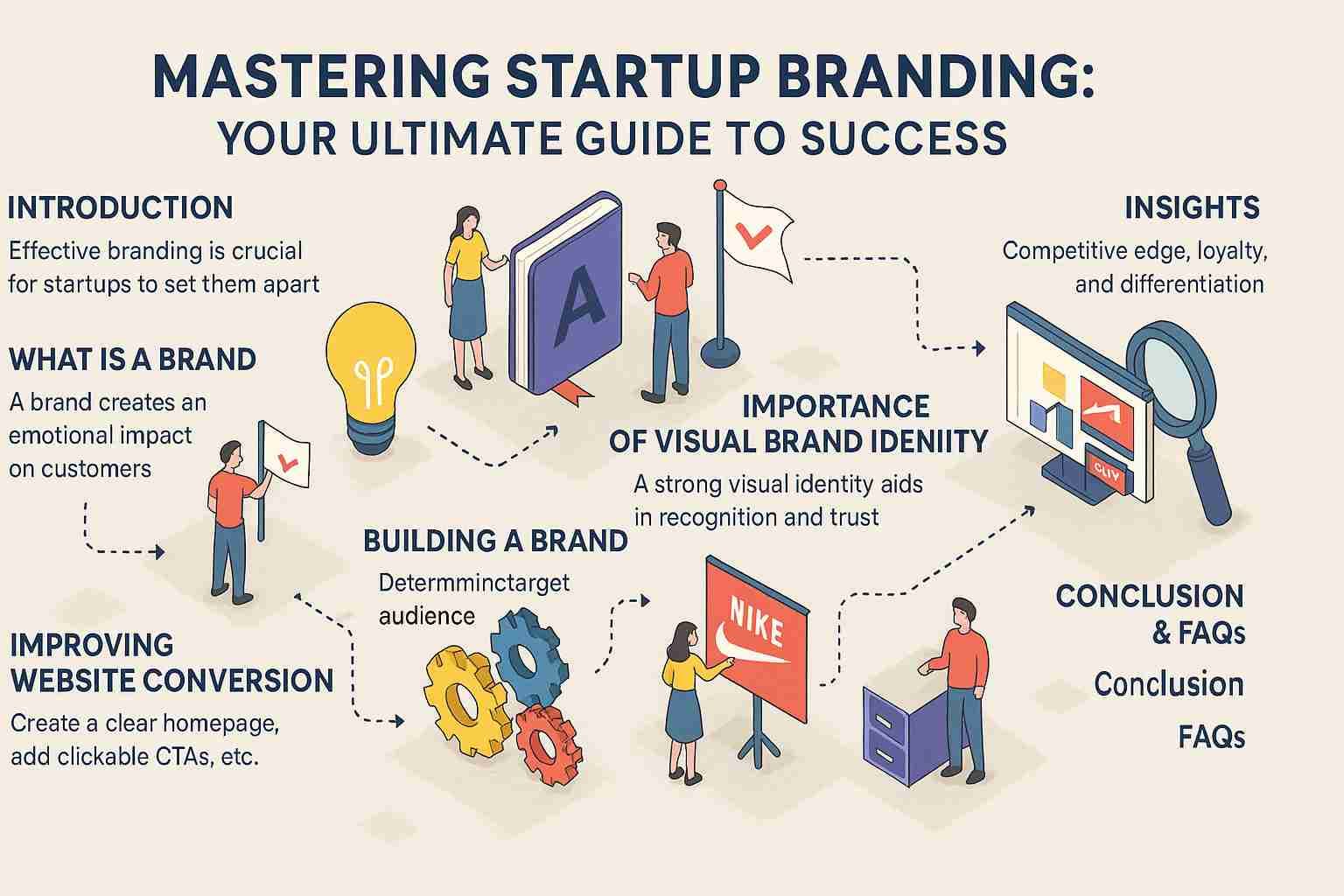
What is a brand?
A brand is more than a logo or tagline. It’s the sum of perceptions, associations, and experiences that define how your business is recognized and remembered. A strong brand signals your value proposition, builds trust, and creates differentiation in a crowded market. In short, it’s your commercial identity—externally and internally.
Why is branding important for startups?
Branding gives startups a competitive edge from day one. It accelerates trust-building with customers, investors, and partners. A clear brand helps cut through noise, attract talent, and command pricing power. Without it, you’re just another commodity—easy to overlook, harder to remember, and vulnerable to copycats.
How do I build a brand?
Start with clarity: define your core values, positioning, and audience. Develop a distinct visual and verbal identity—name, logo, tone, and messaging. Ensure consistency across every touchpoint, from product to pitch deck. Finally, activate your brand in-market and iterate based on real feedback, not internal preference.
What are the key elements of visual brand identity?
Core elements include your logo, color palette, typography, and imagery style. These work together to create recognition and signal your brand’s personality. Consistency is critical—fragmented visuals dilute impact. Build a system, not just assets, so every execution reinforces your brand’s distinctiveness and credibility.
How can I improve website conversion rates?
First, clarify your offer and remove friction in the user journey. Use strong calls to action, fast loading times, and mobile-optimized design. Social proof—testimonials, case studies—builds trust. Test relentlessly: small changes in copy, layout, or visuals can yield outsized improvements in conversion.
What are common startup branding mistakes?
Generic positioning, inconsistent messaging, and overcomplicated visuals top the list. Many startups chase trends instead of building foundations. Others neglect internal alignment, causing confusion. Avoid shortcuts—branding is a long game. Invest in clarity and consistency early to avoid expensive fixes later.
How do I measure branding success?
Track both quantitative and qualitative signals. Key metrics include brand recall, share of voice, and direct traffic. Monitor sentiment through surveys and social listening. Ultimately, branding should drive commercial outcomes: higher conversion rates, pricing power, and customer loyalty. If those aren’t moving, your brand isn’t working.
.webp)
Creative Collaboration Platform: The Backbone of Modern Creative WorkWhat is a creative collaboration platform?Clapboard defines a creative collaboration platform as the operational core for today’s distributed creative teams. This is not a collection of digital collaboration tools stitched together; Clapboard’s system

Understanding the Creative Production MarketplaceWhat is a Creative Production Marketplace?Clapboard defines a creative production marketplace as a structured ecosystem where brands, agencies, and production talent converge to execute video, advertising, and branded content at scale. Unlike the legacy agency or freelanREAD FULL ARTICLE

The Urgent Need for a Creative Production Operating SystemWhy Traditional Creative Production Models Break DownClapboard sees the creative production landscape shifting under pressure. Content velocity is no longer a buzzword—it’s a mandate. Modern advertising demands relentless output across dozens of channels, each wREAD FULL ARTICLE

JOIN THE NEWSLETTER.
Content Production insights, videos, books, and freebies, delivered to your inbox weekly


LEAVE A COMMENT
Your email address will not be published.