



Varun Katyal | Founder, Clapboard
Varun Katyal is the Founder & CEO of Clapboard and a former Creative Director at Ogilvy, with 15+ years of experience across advertising, branded content, and film production. He built Clapboard after seeing firsthand that the industry’s traditional ways of sourcing talent, structuring teams, and delivering creative work were no longer built for the volume, velocity, and complexity of modern content. Clapboard is his answer — a video-first creative operating system that brings together a curated talent marketplace, managed production services, and an AI- and automation-powered layer into a single ecosystem for advertising, branded content, and film. It is designed for a market where brands need content at a scale, speed, and level of specialization that legacy agencies and generic freelance platforms were never built to deliver. The thinking, frameworks, and editorial perspective behind this blog are shaped by Varun’s experience across both the agency world and the emerging platform-led future of creative production. LinkedIn: https://www.linkedin.com/in/varun-katyal-clapboard/
Mapping Buyer Intent: Decoding Customer Journeys in the Funnel
How buyer intent changes through the content marketing funnel
The classic content marketing funnel—awareness, consideration, decision—remains a useful framework. But it’s naive to assume buyers move through it in a straight line. Today’s buyer’s journey is fragmented. Prospects loop, stall, revisit, and skip stages based on context, urgency, and external triggers. The only constant is change in intent. Senior marketers must recognize that intent is dynamic: top-of-funnel curiosity can become mid-funnel evaluation in a single session, or regress if the experience disappoints. The content marketing funnel still matters, but only if you treat it as a map, not a conveyor belt.
Mapping customer journeys to funnel stages
Effective customer journey mapping starts by accepting that no two paths are identical. At the awareness stage, buyers signal intent through broad research—searching for solutions, asking open-ended questions, or engaging with trend content. In consideration, signals sharpen: prospects compare options, download guides, attend webinars, and probe for proof. Decision-stage intent is unmistakable: direct product queries, pricing page visits, demo requests, or high-intent retargeting engagement. The challenge is not just to identify these stages, but to recognize the jumps and loops. Content must address the reality that a prospect may read a case study before ever seeing your explainer, or bounce between solution overviews and customer stories as their needs evolve. Mapping buyer intent means tracking these behaviors, not just their declared interests.
Identifying intent signals for targeted content
Intent-based marketing relies on precise behavioral cues. Awareness-stage signals include social follows, top-funnel blog reads, or video views with high drop-off rates—signs of curiosity, not commitment. Consideration intent surfaces as repeat visits, tool comparisons, or engagement with technical content. Decision-stage signals are concrete: high dwell time on pricing, direct contact, or cart activity. The key is to build a taxonomy of signals tailored to your business, then align content output accordingly. Don’t waste product demos on the merely curious; don’t serve generic thought leadership to prospects hovering over the buy button. Recognizing these intent signals is not about guessing—it’s about rigorous pattern recognition, informed by analytics and direct feedback loops.
Empathy as a competitive advantage in journey mapping
Too many marketers treat customer journey mapping as a box-ticking exercise. The real differentiator is empathy—seeing the funnel through the buyer’s lens, not your own. This means interrogating not just what prospects do, but why. What’s the friction that stalls progression? What information gaps force buyers to backtrack? Where are signals being misread or ignored? Empathy is not soft; it’s commercial. It enables sharper targeting, higher conversion, and less wasted spend. Mapping buyer intent with empathy turns the funnel from a theoretical model into a practical, revenue-driving tool.
In sum, the content marketing funnel is only as effective as your ability to decode intent and map journeys in real time. Treat each stage as a dynamic environment, not a fixed checkpoint. The winners are those who spot intent shifts early and respond with precision, not those who cling to the myth of linear progression.
Understanding the Content Marketing Funnel: Foundations and Purpose
What is a content marketing funnel and how does it work?
The content marketing funnel is the backbone of any high-functioning digital strategy. At its core, it’s a framework that maps the stages a prospect moves through—from first encounter to final conversion—using content as the lever at every step. This isn’t just a theoretical model; it’s a practical tool for turning audience attention into measurable business outcomes. When senior marketers ask, “what is a content marketing funnel?” the answer is simple: it’s the disciplined approach to guiding prospects through a structured journey, using tailored content to move them from awareness, to consideration, to decision. The funnel is not a relic—it’s the architecture that underpins all effective content planning.
Why the content marketing funnel is essential for modern marketers
Generic marketing funnels are blunt instruments. They outline a sequence but ignore the nuances of content’s role in shifting perception, building trust, and triggering action. The content marketing funnel evolved because the old models failed to account for how people actually engage with brands today. Modern audiences don’t move linearly—they zigzag, revisit, and demand relevance at every touchpoint. The content funnel addresses this by aligning messaging, format, and channel with the customer’s current mindset. It’s not about flooding the pipeline with content. It’s about deploying the right asset, at the right stage, for the right commercial objective. This is why any content strategy that neglects the funnel is flying blind. The funnel is the difference between random acts of content and a system that consistently drives pipeline and revenue.
Overview of content funnel stages: awareness, consideration, decision
The traditional content funnel breaks down into three primary stages: awareness, consideration, and decision. Each stage has a distinct function and demands a different creative approach. At the awareness stage, content is designed to surface problems and spark curiosity—think short-form video, thought leadership, or high-reach social campaigns. In the consideration stage, the goal shifts to education and differentiation. Here, case studies, webinars, and in-depth explainers help prospects weigh options and see your value. The decision stage is about conversion—content here must eliminate friction and drive action, whether that’s a product demo, testimonial, or direct offer. Understanding these content funnel stages isn’t academic; it’s operational. It dictates what you make, how you distribute, and how you measure success.
Why every content strategy must address the funnel
Ignoring the content marketing funnel is a strategic misstep. Without it, content becomes disconnected from commercial goals and fails to move the needle. Senior marketers and creative leads who understand funnel mechanics can orchestrate content that not only attracts but also qualifies and converts. The funnel gives structure to creativity, ensuring every asset has a purpose and every campaign is accountable to business outcomes. Whether you’re building a global campaign or refining a niche B2B play, the funnel is the throughline that aligns teams, budgets, and metrics. For those serious about content effectiveness, the funnel isn’t optional—it’s foundational. For a deeper dive, see our guide on content funnel basics and get the marketing funnel explained in full context.
Creating Stage-Specific Content That Moves Prospects Forward
Best content types for each stage of the content marketing funnel
The content marketing funnel isn’t a theoretical construct—it’s the backbone of effective acquisition and conversion. Each stage demands a distinct content approach. At the top of funnel (TOFU), the mandate is simple: cast a wide net. Educational videos, industry explainers, and thought-leadership articles work because they answer broad questions and establish authority. The audience is unqualified, often unaware of your brand, so the content must deliver immediate value with no strings attached (Beehiiv, 2025).
Middle of funnel (MOFU) content shifts gears. Here, prospects are solution-aware but not yet convinced. This is where whitepapers, webinars, and case studies come into play. They provide depth, context, and evidence—addressing objections and demonstrating outcomes. A well-produced case study isn’t just a story; it’s a proof point, tailored to the buyer’s vertical and pain points. At the bottom of funnel (BOFU), content gets surgical. Product demos, pricing breakdowns, and customer testimonials remove doubt and accelerate decision. Ignore the post-purchase phase at your peril—onboarding guides and exclusive insights reinforce loyalty and drive retention (Usermaven, 2026).
How to map content to buyer questions and needs
Effective stage-specific content starts with one question: what’s the prospect trying to solve right now? At TOFU, they’re researching trends, not brands. Content here should answer “why does this problem matter?” without introducing your solution too early. MOFU buyers are comparing approaches. Content must now answer “how does this work in practice?” and “who has succeeded with it?” BOFU prospects are weighing risk. They want to know “why should I trust you?” and “what’s the real-world payoff?”
Mapping content types to these questions is not a checklist exercise. It’s a logic chain—each asset should anticipate the next question in the buyer’s mind and hand off seamlessly. The goal is progression, not just engagement. If a prospect encounters a case study before understanding the category, you’ve wasted both the asset and the opportunity. Content mapping demands ruthless clarity: every piece must have a defined role and a clear call to action aligned with buyer readiness. This is the core of a robust funnel content strategy.
Editorial planning for stage-specific content
Editorial planning is where most content strategies unravel. Too often, teams produce content in isolation—siloed by channel, format, or internal priorities. The result: mismatched assets that stall buyers or push them too aggressively. The remedy is progression logic. Start by auditing your funnel: identify the questions, objections, and motivations at each stage. Then, map content types and formats directly to these needs. For example, if MOFU buyers hesitate over implementation complexity, build a video walkthrough or a case study featuring a similar client overcoming that hurdle.
Calendar planning should reflect funnel velocity, not arbitrary cadence. If the majority of prospects stall at MOFU, double down on assets that bridge the gap to decision. Monitor performance ruthlessly. Content that doesn’t move buyers forward is dead weight—replace it. Editorial planning isn’t about volume; it’s about sequencing the right assets, at the right depth, at the right moment. That’s the only way to align content with buyer stages and drive commercial outcomes.
Avoiding common mismatches between content and funnel phase
The most common mistake? Serving content out of sequence. Pushing testimonials to an unaware audience, or bombarding ready-to-buy prospects with generic thought leadership, kills momentum. About 45% of buyers read reviews during the purchase process—testimonials

The Real ROI: How the Content Marketing Funnel Drives Conversions
The content marketing funnel is not a theoretical construct—it’s a commercial engine. Scattershot content may win impressions, but only a funnel-driven strategy consistently converts. When every asset is mapped to a stage, lead nurturing shifts from generic touchpoints to targeted momentum. The result: more qualified prospects, higher conversion rates, and a measurable impact on the bottom line.
Measuring the ROI of your content marketing funnel
ROI in content marketing is not about vanity metrics. The real story is in conversion optimization and cost-per-lead. Fully integrated funnel stacks—where CRM, automation, landing pages, and analytics talk to each other—deliver 2.9 times higher conversion rates and 41.7% lower cost-per-lead than standalone tools (G2 Martech Adoption Intelligence Report, 2026). This isn’t incremental; it’s transformative. The funnel’s structure is what enables this efficiency, not just the content itself.
How funnel alignment improves conversion rates
When content is aligned to the funnel, every interaction is engineered for progression. Top-of-funnel assets attract and educate. Mid-funnel pieces qualify and nurture leads, while bottom-funnel content removes friction and closes. This sequencing is not optional—organizations using content marketing funnels generate more qualified prospects and stronger client relationships than those operating without alignment (INFUSE, 2026). Funnel-driven approaches outperform scattergun tactics because they eliminate waste: every touchpoint is intentional, every follow-up is relevant.
Key metrics to track funnel-driven results
- Conversion rate by funnel stage: Tracks performance from awareness to sale, exposing drop-off points and optimization opportunities.
- Lead quality and velocity: Measures how efficiently leads move through the funnel and how well they match your ideal customer profile.
- Cost-per-lead (CPL) and cost-per-acquisition (CPA): Quantifies efficiency gains from integrated funnel systems.
- Sales cycle length: Shorter cycles indicate effective nurturing and readiness at each stage.
- Customer lifetime value (CLV): Demonstrates the downstream impact of nurturing leads with relevant content.
Why nurturing at each stage boosts sales readiness
Lead nurturing is not a checkbox—it’s a continuous process that compounds results. At the awareness stage, content builds trust and frames the problem. As prospects move through consideration and decision, tailored messaging answers objections and reinforces value. By the time a lead reaches sales, they’re informed, primed, and ready to convert. This is the difference between leads that stall and those that close. Funnel-driven nurturing doesn’t just increase conversions; it improves the quality of every conversion, lifting both immediate and long-term ROI.
The commercial case for a structured content marketing funnel is clear. Alignment, measurement, and targeted nurturing drive higher conversion rates and lower costs. In a world where every marketing dollar is scrutinized, funnel ROI is not a nice-to-have—it’s the baseline for competitive performance.
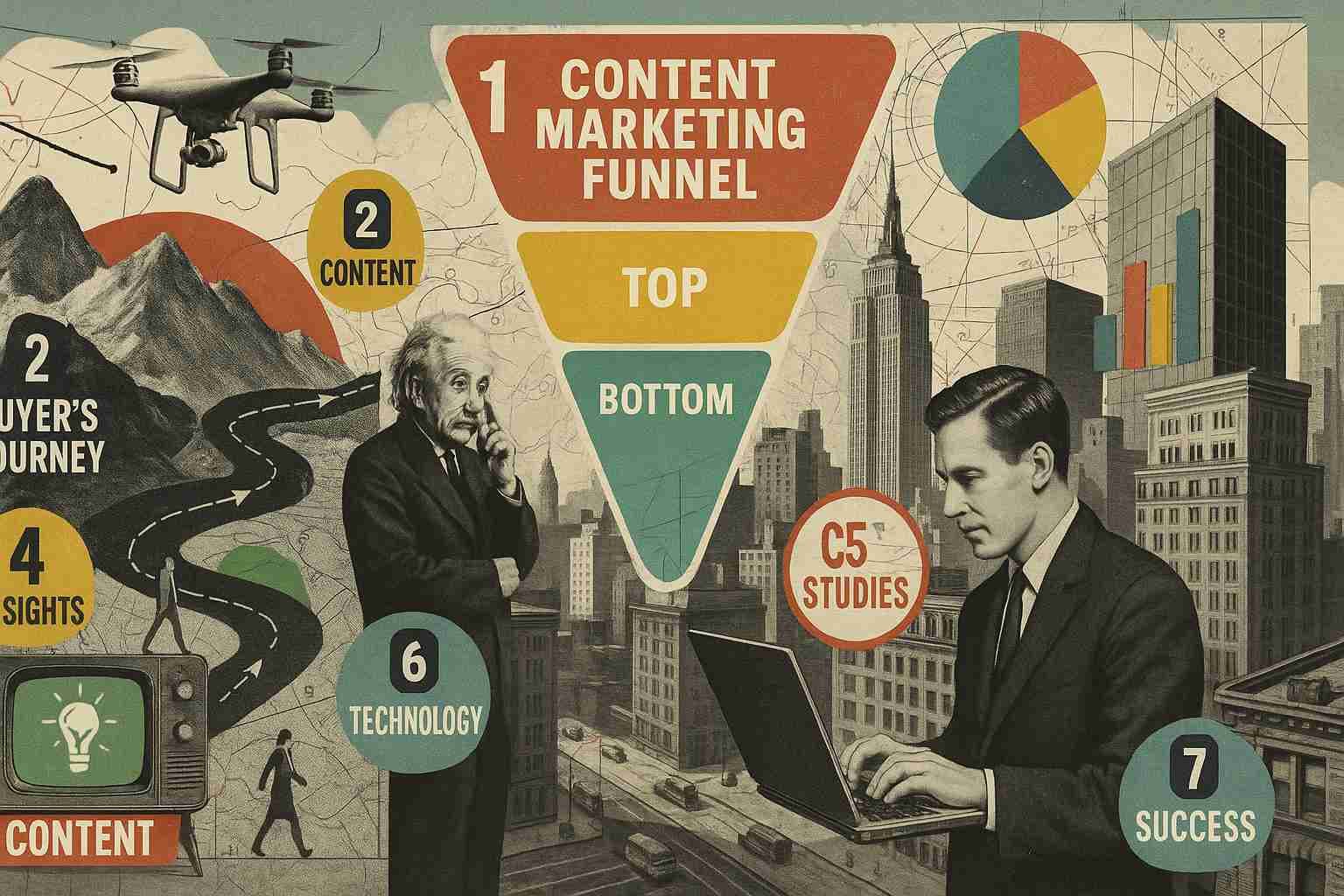
Channel Tactics: Distributing Content Across the Funnel
The content marketing funnel isn’t a theory exercise—it’s a blueprint for channel strategy. Distribution isn’t about blasting the same asset everywhere. Each stage of the funnel demands a different approach, both in channel selection and in how content is delivered. If you want effectiveness, not just reach, you need to map your distribution tactics to the funnel’s realities.
Best channels for each stage of the content marketing funnel
Top-of-funnel is about visibility and discovery. Here, broad-reach channels—organic social, YouTube, and programmatic display—win. They’re designed for scale, not precision. But as you move down the funnel, intent grows and so does the need for more controlled, targeted touchpoints. Mid-funnel thrives on email, retargeting, and in-feed paid social: channels that let you segment, sequence, and personalize. Bottom-of-funnel is where search, direct email, and even messaging platforms deliver—these are channels where users act with intent and conversion is the metric that matters.
How to tailor content distribution by funnel phase
It’s not just about where you show up, but what you deliver. Top-of-funnel content must be thumb-stopping and frictionless—short-form video, punchy carousels, or snackable explainers. This is the gateway, not the sales pitch. Mid-funnel requires depth: case studies, webinars, comparison videos—formats that build trust and answer objections. At the bottom, specificity wins. Product demos, testimonials, and sharp CTAs drive action. The same asset rarely works across all phases; adapt format, length, and messaging to the audience’s mindset and the channel’s native behavior.
Channel selection strategies for funnel optimization
Channel selection is a question of economics and intent. Multi-channel marketing only works if each channel’s role is clear and its costs justified. Owned channels (your website, email list) anchor mid- and bottom-funnel efforts—they’re high control, low incremental cost. Earned channels (PR, influencer mentions) are unpredictable but can spike top-funnel awareness. Paid channels fill the gaps but must be ruthlessly measured; overspending on paid at the wrong funnel stage is the fastest way to burn budget for little return. The multi-channel funnel is about orchestration: sequencing touchpoints so each channel builds on the last, nudging the audience closer to conversion.
Timing and sequencing for optimal engagement
Timing is leverage. A well-sequenced channel strategy moves prospects from awareness to action without wasted steps. Launch broad on high-reach platforms, then retarget engaged users with deeper content on channels where you control the narrative. Use data to trigger the next touch—don’t rely on static drip campaigns. The goal is to create a logical, momentum-building journey, not a scattergun presence. Pay attention to channel fatigue and diminishing returns; sometimes pulling back is as important as pushing forward.
Distribution channels are not interchangeable. The most effective content marketing funnel is engineered—each channel, format, and message chosen for its ability to move the audience, not just fill a calendar. In a market where attention is expensive, distribution is where strategy meets execution. That’s where campaigns are won or lost.
Technology’s Role: Automation, AI, and Analytics in Funnel Management
How automation enhances the content marketing funnel
Marketing automation is no longer a nice-to-have—it’s the backbone of any serious content marketing funnel. Automation platforms orchestrate content delivery with precision, ensuring the right message lands at the right stage. Automated workflows segment audiences, trigger communications based on behavioral signals, and scale personalization beyond what manual teams could ever achieve. This isn’t about saving time for its own sake; it’s about removing friction. When automation runs the plumbing, strategists can focus on creative and commercial levers that actually move the needle. For organizations operating across markets, automation is the only way to maintain relevance at scale, ensuring local nuance without sacrificing operational efficiency. The result: higher velocity through the funnel, lower drop-off, and a pipeline that doesn’t leak opportunity.
Using AI to personalize funnel content
AI in content is reshaping how marketers approach both creation and optimization. Machine learning models analyze user behavior, content consumption patterns, and contextual signals to predict what will resonate next. AI-generated content isn’t just about volume—it’s about relevance. Dynamic copy, adaptive visuals, and real-time recommendations turn static nurture streams into responsive, audience-aware journeys. The value isn’t theoretical; it’s commercial. AI-driven optimization tools A/B test variations at a scale humans can’t match, rapidly surfacing what converts. For high-value funnel stages—think consideration and decision—AI-powered personalization can mean the difference between a lead and a lost opportunity. The competitive edge comes from deploying AI not as a gimmick, but as a force multiplier for creative intent and business outcomes.
Analytics tools for funnel performance tracking
Without rigorous content analytics, funnel management is guesswork. Modern analytics platforms deliver granular visibility into every stage of the content marketing funnel—what’s working, what’s stalling, and, crucially, why. Marketers can pinpoint bottlenecks, attribute conversions to specific touchpoints, and identify which assets accelerate or impede progression. The best teams don’t just report on metrics; they interrogate them. Analytics insights drive iterative improvement, informing everything from creative direction to distribution strategy. When analytics are fully integrated with automation and AI, feedback loops become immediate. Underperforming content is flagged, optimized, or replaced before it drags down results. In a landscape where attention is scarce and budgets are scrutinized, analytics-powered decision-making is non-negotiable.
Iterative improvement: Technology as an enabler, not a crutch
Technology’s real value in funnel management is its ability to enable rapid iteration. Automation, AI, and analytics don’t replace strategic thinking; they amplify it. The most effective content marketing funnels are living systems—constantly tested, measured, and refined. Tech streamlines the process, but the sharpest results come from teams who treat these tools as instruments for creative and commercial experimentation. The future isn’t about chasing the next shiny feature; it’s about building adaptive, data-driven funnels that evolve ahead of audience expectations and market shifts.
- For a deeper dive on operationalizing automation, see our guide to marketing automation tools.
- To unlock actionable insights from your data, explore our analysis on content analytics insights.
Pitfalls and Misconceptions: What Breaks a Content Marketing Funnel?
Common mistakes that hurt your content marketing funnel
The most persistent funnel mistakes start with over-generalization. Too many teams treat funnel stages as static boxes: awareness, consideration, decision. In practice, audiences don’t move linearly and rarely fit into neat categories. When content is mapped to these stages without nuance, it fails to address the real questions and hesitations that drive action. Instead of mapping generic assets to “middle of funnel,” scrutinize what actually shifts intent at each point. If you haven’t recently stress-tested your funnel against actual buyer journeys, you’re guessing.
Another common misstep is ignoring feedback loops. Marketers obsess over top-of-funnel reach but rarely trace how those touchpoints influence conversion or retention. If you’re not closing the loop between content performance and next-step actions, you’re flying blind. Consistent funnel troubleshooting—reviewing drop-off points, attribution data, and qualitative feedback—should be standard, not an afterthought. Without it, you’ll keep investing in formats and channels that no longer move the needle.
Myths about the content funnel that cost you conversions
One enduring myth: that every audience follows the same funnel path. In reality, high-value prospects often bypass “awareness” entirely, landing mid-funnel from a referral or niche channel. Designing your content marketing funnel around a single, universal journey leaves gaps. Another misconception is that more content equals better results. Volume without precision dilutes impact and confuses measurement. Focus on relevance, not just reach.
Then there’s the belief that funnel models don’t age. Many teams cling to frameworks built for a different media environment—linear, desktop-first, low-noise. Today’s buyers are cross-device, self-directed, and quick to tune out. If your funnel still treats touchpoints as isolated events, you’re missing how influence compounds across channels and formats.
Troubleshooting a broken content marketing funnel
Diagnosing funnel breakdowns requires ruthless clarity. Start by mapping actual user flows, not theoretical ones. Where do people drop off? Which assets attract but fail to convert? Are you measuring only vanity metrics, or do you understand which content accelerates movement? If you see sharp fall-offs or repeated bottlenecks, revisit your content’s intent and alignment with audience needs. Misaligned messaging is often the root cause—content that speaks to what you want to say, not what your audience needs to hear.
To fix these issues, tighten your feedback loop. Set up regular funnel reviews with both data and qualitative input. Challenge assumptions about what works at each stage. Discard underperforming formats and double down on assets that demonstrably drive action. Update your funnel model to reflect how your audience actually behaves—not how you wish they did. For deeper analysis, explore our guide on content marketing mistakes and proven methods for troubleshooting funnel issues.
The bottom line: a content marketing funnel isn’t a static diagram, but a living system. It breaks when you stop interrogating it. The teams that win are those that keep pressure-testing their assumptions, closing feedback loops, and adapting to how real buyers move—not how marketers wish they would.
Measuring Success: KPIs and Iterative Funnel Optimization
Effective content marketing funnel management is a discipline of measurement and adjustment. It’s not about tracking every metric, but about identifying the KPIs that matter at each stage and using them to drive tangible improvements. Senior marketers know that vanity metrics distract; what counts is what moves the business.
Essential KPIs for your content marketing funnel
Each stage of the funnel demands its own success signals. At the top, focus on reach and qualified traffic—unique visitors, impressions, and click-through rates. In the middle, engagement metrics take over: average session duration, scroll depth, and content shares. Lower down, conversion rate, lead quality, and cost per acquisition become the non-negotiables. Funnel KPIs are not static; they shift as campaigns mature and as business priorities evolve.
Choosing the right KPIs is a strategic act. For a B2B SaaS campaign, for example, marketing qualified leads (MQLs) and demo requests may eclipse sheer traffic. For a DTC ecommerce brand, cart additions and repeat purchase rates are the real story. The point: align funnel KPIs with commercial objectives, not just with what’s easy to measure.
Using data to optimize funnel performance
Performance measurement is only valuable if it informs action. Dashboards must be built for clarity, not for show. Integrate analytics platforms—GA4, CRM, and attribution tools—so you can track the user journey end-to-end. But don’t drown in data. Set up automated alerts for KPI shifts that matter, and schedule regular reviews to interrogate what’s working and what’s not.
Actionable insight comes from pattern recognition, not isolated data points. If engagement drops at the consideration stage, scrutinize content sequencing, creative relevance, and friction in the user path. If conversion stalls, dig into offer clarity, CTA placement, and landing page performance. The best teams use data as a diagnostic tool, not a report card.
Iterative strategies for funnel improvement
Funnel optimization is a process, not a project. The most effective teams run A/B tests on headlines, visuals, and calls to action at every stage. They don’t just test for the sake of it—they design experiments with a hypothesis rooted in previous performance measurement. Each test should have a clear success metric and a plan for rapid implementation if it wins.
Continuous learning is the engine of funnel optimization. Post-mortems on failed tests are as valuable as celebrating wins. Feed learnings back into creative briefs, media planning, and even product development. Over time, this iterative approach compounds gains: higher engagement, lower acquisition costs, and more predictable revenue from your content marketing funnel.
For those serious about scale, connect your measurement framework to your team’s workflow. Make sure KPIs drive weekly priorities, not just quarterly reviews. Build a culture where optimization is expected, not exceptional. That’s how content marketing delivers commercial results, not just creative output.
For more depth on measuring content performance or actionable funnel optimization strategies, explore our dedicated guides.
Interactive and Personalized Content: Advanced Funnel Engagement Tactics
Most brands talk about the content marketing funnel. Few actually engineer it for velocity. Interactive content and content personalization aren’t just conversion hacks—they’re levers for moving prospects faster and deeper into your pipeline. When deployed with intent, these tactics transform passive consumption into active participation, compressing decision cycles and surfacing high-value leads with surgical precision.
How interactive content enhances the content marketing funnel
Static assets—whitepapers, case studies, even video—have a ceiling. Interactive content breaks through it. Calculators, quizzes, assessments, and interactive demos force attention, not just invite it. They collect zero-party data in real time, segmenting users by intent or need before sales ever lifts a finger. The result: prospects self-qualify, revealing urgency, budget, and pain points as they engage. This isn’t just engagement; it’s qualification at scale, feeding the top and middle of the funnel with context-rich signals that power sharper follow-up and nurture.
Personalization strategies for funnel acceleration
Personalization isn’t a token name-drop in an email. It’s dynamic sequencing—content that adapts to user behavior, firmographics, and psychographics across every stage. Sophisticated marketers deploy modular video, adaptive landing pages, and branching content journeys that respond to each action. A prospect who interacts with a pricing calculator gets routed to tailored case studies or ROI breakdowns. Someone who lingers on a technical demo is nudged toward deep-dive content or live consults. The funnel becomes less linear, more responsive—each touchpoint recalibrated in real time for relevance and momentum.
Tools for creating engaging funnel experiences
Execution is everything. Off-the-shelf quiz builders and calculator platforms have their place, but true differentiation comes from custom logic and seamless integration. Interactive video platforms enable viewers to choose their own path, surfacing the most relevant proof points or calls to action. CRM and MAP integrations mean every click, selection, or drop-off is tracked and scored—fuel for both automation and sales enablement. The best practitioners treat these tools not as gimmicks, but as core infrastructure for funnel intelligence and acceleration.
- Quizzes and Assessments: Segment audiences, diagnose needs, and tee up tailored nurture flows.
- Calculators and ROI Tools: Quantify value, address objections, and surface buying intent with hard numbers.
- Interactive Video and Guided Journeys: Let users self-direct, shortening the path to what matters most.
The impact? Funnel velocity increases as friction drops. Prospects move from awareness to action with fewer handoffs and less waste. Sales teams get leads warmed by relevance, not just volume. And marketing gains a feedback loop of behavioral data, informing creative and media decisions upstream. In a market where attention is scarce and cycles are short, interactive and personalized content isn’t a luxury—it’s the new baseline for funnel performance.
- Explore more interactive marketing ideas to sharpen your approach.
- Dive deeper into personalizing the funnel for next-level engagement.
Conclusion
The content marketing funnel is not just a framework—it’s the operational backbone of any serious marketing strategy. Understanding the marketing funnel definition and its distinct content funnel stages is fundamental for leaders who expect results, not just reach. The funnel is the architecture that shapes the buyer’s journey, from first touch to final conversion, and it demands more than generic content at arbitrary intervals.
What separates effective strategies from wasted spend is ruthless alignment between content and buyer intent at every stage. Top-of-funnel assets attract and educate, but without a clear path to mid- and bottom-funnel engagement, awareness is just noise. Each piece of content must serve a precise function in moving prospects forward. This is where mapping buyer intent and knowing the nuances between consideration and decision content become non-negotiable. The content funnel is not a linear path—it’s a dynamic system that requires constant attention to friction points and drop-offs.
Measurement is not an afterthought. Continuous optimization is the only way to ensure your funnel remains relevant as markets shift and audience behaviors evolve. Relying on last quarter’s playbook is an invitation to stagnation. Funnel optimization strategies must be built into the process, not tacked on after launch. Every stage, from awareness to advocacy, must be interrogated for performance and recalibrated as needed. This is where the intersection of creative, data, and commercial discipline delivers real value.
The content marketing funnel, when executed with discipline and clarity, is the engine that drives scalable, predictable growth. Its impact is measured not in vanity metrics, but in business outcomes—qualified leads, shortened sales cycles, and measurable brand lift. In a market where attention is scarce and competition is relentless, mastering the funnel is not optional. It’s the baseline for any marketer who intends to win.
FAQs
What is the content marketing funnel?
The content marketing funnel is a framework that maps the customer journey from initial awareness to final purchase. It structures content delivery by stage, guiding prospects with relevant information and touchpoints. The funnel’s purpose is to systematically nurture leads, moving them efficiently toward conversion rather than leaving engagement to chance.
How to align content with the buyer's journey?
Effective alignment means matching content type and message to the buyer’s readiness. Early-stage prospects need education and context; mid-funnel audiences need problem-solving and differentiation; late-stage buyers want proof and reassurance. Audit your content inventory, identify gaps by stage, and deploy assets where they have maximum influence on progression.
What are the stages of the content marketing funnel?
The funnel has three core stages: awareness, consideration, and decision. Awareness builds recognition and interest. Consideration develops understanding and trust, often through deeper content. Decision focuses on conversion, using case studies, demos, or testimonials to remove friction and close the deal. Each stage demands a distinct content approach.
Why is measuring content marketing success important?
Without robust measurement, content marketing is guesswork. Tracking KPIs—such as engagement rates, lead quality, and conversion metrics—reveals what drives actual business outcomes. Data-backed insights allow you to optimise spend, refine messaging, and justify investment. In short: measurement closes the loop between creative effort and commercial impact.
How can technology enhance content marketing efforts?
Technology raises the ceiling on both efficiency and scale. Automation streamlines distribution and reporting, freeing teams to focus on strategy. AI enables smarter personalisation, predictive analytics, and rapid content iteration. When deployed with intent, these tools sharpen targeting, speed up learning cycles, and drive better funnel performance.
What are common mistakes in content marketing funnels?
Typical errors include neglecting mid-funnel content, over-focusing on top-of-funnel reach, and failing to connect content to clear business goals. Many marketers also ignore data signals or rely on vanity metrics. These missteps stall momentum and waste resources—precision and discipline are non-negotiable for sustained funnel impact.
How to create engaging interactive content for the funnel?
Deploy interactive formats—quizzes, calculators, polls, or shoppable videos—at key funnel stages to boost engagement and gather zero-party data. The goal is to deepen participation, not just passive consumption. Test formats that encourage action, personalise follow-ups based on responses, and integrate seamlessly with your lead capture and nurture systems.
.webp)
Creative Collaboration Platform: The Backbone of Modern Creative WorkWhat is a creative collaboration platform?Clapboard defines a creative collaboration platform as the operational core for today’s distributed creative teams. This is not a collection of digital collaboration tools stitched together; Clapboard’s system

Understanding the Creative Production MarketplaceWhat is a Creative Production Marketplace?Clapboard defines a creative production marketplace as a structured ecosystem where brands, agencies, and production talent converge to execute video, advertising, and branded content at scale. Unlike the legacy agency or freelanREAD FULL ARTICLE

The Urgent Need for a Creative Production Operating SystemWhy Traditional Creative Production Models Break DownClapboard sees the creative production landscape shifting under pressure. Content velocity is no longer a buzzword—it’s a mandate. Modern advertising demands relentless output across dozens of channels, each wREAD FULL ARTICLE
JOIN THE NEWSLETTER.
Content Production insights, videos, books, and freebies, delivered to your inbox weekly


LEAVE A COMMENT
Your email address will not be published.