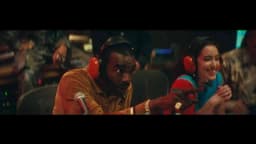
Squarespace's 'Whatever your dream, a website makes it real' campaign launched in the United States in October 2025 as a trilogy of cinematic films directed by

Squarespace Turns Personal Ambition Into a Website in 2025
Squarespace's 'Whatever your dream, a website makes it real' campaign launched in the United States in October 2025 as a trilogy of three cinematic short films — 'Goth,' 'Ohm,' and 'Skydive' — each pairing a distinct human aspiration with the brand's digital platform proposition that a website is not a tool but a permanent realisation of personal ambition.
The campaign was produced entirely by Squarespace's in-house creative team and directed by Walid Labri of Love Song. Its central argument is deceptively simple: fear and doubt are fleeting emotions, but a website endures. The tagline of the 'Skydive' film makes this explicit — 'Fear is temporary, websites are forever'. This framing elevates the act of building an online presence from a practical task into something closer to a declaration of identity, positioning Squarespace's all-in-one digital platform as the instrument through which that declaration becomes real.
In the United States, the campaign entered a highly competitive website-builder market where differentiation increasingly depends on emotional resonance rather than feature comparison. Squarespace has historically pursued this path aggressively — from its celebrated 2022 Super Bowl spot starring Zendaya and André 3000, directed by Edgar Wright, to this 2025 trilogy — and the 'Whatever your dream' work continues that tradition of treating the brand as a cultural object as much as a technology product. The three films were distributed across connected TV and digital channels, with 'Goth' and 'Ohm' releasing on October 18, 2025, and 'Skydive' following within the same week, according to Stash Media. Clapboard awarded the campaign a score of 63 out of 100.

Squarespace identifies aspiration as the primary emotional driver behind the decision to build a website. Rather than competing on price or feature sets, the 2025 campaign positions the brand's digital platform as the logical endpoint of any personal dream — a strategic choice that separates it from competitors who lead with utility messaging.
The US website-builder market is substantial and growing. The global website-builder market is estimated at between roughly three and four billion dollars in 2025, with compound annual growth rates projected in the low-to-mid double digits, though estimates vary considerably by market definition, according to GII Research and 6W Research. Within this broader landscape, the ecommerce website-builder segment is estimated at approximately seven billion dollars in 2025 and growing at around eleven percent annually through 2034, according to Dataintelo. These figures underscore why Squarespace's in-house team chose to anchor the campaign in emotional territory rather than functional claims — in a growing market, aspiration is a more durable differentiator than any single feature.
Two competitors define the competitive pressure Squarespace navigates in the United States. Wix occupies a similar all-in-one positioning and has invested heavily in AI-assisted website building, while WordPress — which, according to Colorlib, powers a commanding share of the internet — competes on openness and flexibility rather than brand warmth. Squarespace's answer to both is a consistently cinematic brand voice that treats website creation as a meaningful personal act rather than a technical one. The 'Whatever your dream' campaign extends that voice into 2025 by grounding each film in a specific, recognisable human scenario — extreme sport, creative identity, spiritual practice — and resolving each narrative with the same structural beat: the dream becomes real when it has a home online.
Walid Labri of Love Song directed all three films in the campaign. Creative direction was led by Mathieu Zarbatany and Ben Hodgin, with copywriting by Pepe Hernandez and art direction by Alex Thompson, according to News Designrush and Mediamarketing Ma. Director of photography Monika Lenczewska shot the trilogy, and editing was handled by Biff Butler at Papercut Edit. Post-production was completed by Time Based Arts, with music composed and produced by Q Department, according to the same sources.
The production approach treats each thirty-second film as a self-contained short rather than a conventional advertisement. 'Skydive' is the most kinetic of the three, using freefall imagery to literalise the campaign's central tension between fear and permanence. 'Goth' and 'Ohm' approach the same tension through contrasting emotional registers — one through subcultural identity, one through spiritual practice — giving the trilogy range without sacrificing tonal consistency. Lenczewska's cinematography across all three films prioritises texture and specificity over the clean, aspirational abstraction common in technology advertising, a choice that reinforces Squarespace's longstanding commitment to craft as brand signal.
The product integration is deliberate and restrained. Each film pairs its narrative with a direct reference to Squarespace's platform capabilities — domain, website, online store, brand marketing — without interrupting the emotional logic of the story. The campaign's distribution across connected TV and digital channels in the United States reflects a media strategy designed to reach audiences in both lean-back and active browsing contexts, reinforcing the message that building an online presence is both an emotional decision and an immediately actionable one. The 'Skydive' film alone accumulated over one million views on YouTube, according to platform data reported by Clapboard.
The 'Skydive' film recorded approximately 1.09 million views and 63 likes on YouTube. No comprehensive cross-channel performance data for the full trilogy is publicly available at the time of publication, and no verified figures for click-through rate, website sign-up conversion, or brand lift have been released by Squarespace or its agency partners.
Structurally, the campaign demonstrates several characteristics associated with durable brand advertising. The trilogy format allows Squarespace to address three distinct audience segments — adventure-oriented, identity-driven, and spiritually inclined — without fragmenting the brand message, because each film resolves identically: the website is the destination. This structural coherence is a meaningful creative achievement in a category where campaigns often sacrifice consistency for reach. The decision to produce entirely in-house, with a credited director and named cinematographer, also signals a production ambition that is uncommon among technology brands operating at Squarespace's scale in the United States. The Clapboard Score for this campaign is 63 out of 100, reflecting competent execution and a clear strategic rationale, with room for greater creative distinction relative to the brand's highest-water marks in campaign history.
The campaign is a trilogy of three cinematic short films launched in the United States in October 2025. Produced by Squarespace's in-house creative team and directed by Walid Labri of Love Song, the films — 'Goth,' 'Ohm,' and 'Skydive' — each connect a distinct personal aspiration to the enduring value of building an online presence through Squarespace's digital platform.
Walid Labri of Love Song directed all three films. Creative direction was led by Mathieu Zarbatany and Ben Hodgin, with cinematography by Monika Lenczewska, editing by Biff Butler at Papercut Edit, and music by Q Department, according to news.designrush.com and mediamarketing.ma.
The campaign contains three films. 'Goth' and 'Ohm' were released on October 18, 2025, with 'Skydive' following within the same week, according to Stash Media. Each thirty-second film pairs a specific human scenario with Squarespace's core platform proposition that a website makes any dream permanent and real.
The 'Skydive' film carries the line 'Fear is temporary, websites are forever.' This tagline distils the campaign's central argument — that doubt and hesitation pass, but an online presence built on Squarespace's digital platform endures — making it the most direct articulation of the campaign's brand proposition across the trilogy.
Squarespace's 2022 Super Bowl campaign starred Zendaya and André 3000, directed by Edgar Wright, and was the brand's first Super Bowl work produced by its Los Angeles in-house team, according to Newsroom Squarespace. The 2025 'Whatever Your Dream' trilogy continues that in-house cinematic tradition while shifting from celebrity-led storytelling to character-driven narrative across three distinct human scenarios.
Clapboard awarded the campaign a score of 63 out of 100. The score reflects competent creative execution and a clear strategic rationale connecting personal aspiration to Squarespace's digital platform, while indicating room for greater creative distinction relative to the brand's most celebrated campaigns in the United States.
.webp)
Creative Collaboration Platform: The Backbone of Modern Creative WorkWhat is a creative collaboration platform?Clapboard defines a creative collaboration platform as the operational core for today’s distributed creative teams. This is not a collection of digital collaboration tools stitched together; Clapboard’s system


Understanding the Creative Production MarketplaceWhat is a Creative Production Marketplace?Clapboard defines a creative production marketplace as a structured ecosystem where brands, agencies, and production talent converge to execute video, advertising, and branded content at scale. Unlike the legacy agency or freelanREAD FULL ARTICLE

The Urgent Need for a Creative Production Operating SystemWhy Traditional Creative Production Models Break DownClapboard sees the creative production landscape shifting under pressure. Content velocity is no longer a buzzword—it’s a mandate. Modern advertising demands relentless output across dozens of channels, each wREAD FULL ARTICLE