SP Invisível and AlmapBBDO projected portraits of 13 unhoused individuals onto Felipe Morozini's iconic Minhocão mural in a landmark 2023 public service

SP Invisível Makes São Paulo's Homeless Visible Through Urban Art
SP Invisível's "I Knew You Existed – Part II" is a 2023 Brazilian public service campaign by AlmapBBDO that projected digital portraits and personal stories of thirteen unhoused individuals onto Felipe Morozini's iconic mural on São Paulo's Minhocão overpass, transforming a celebrated piece of urban art into a live act of social inclusion.
Brazil's unhoused population grew significantly in the years leading up to this campaign. According to SP Invisível, that population increased by 38% between 2019 and 2022, reaching an estimated 281,472 people nationally. In São Paulo alone — the largest financial centre in Latin America — more than 50,000 people live on the streets. It is against this backdrop that the NGO, founded in 2014 by André Soler and Vinícius Lima according to publicly available records, conceived a sequel to its original initiative. Where the first iteration established Morozini's mural and its defiant declaration — "I Knew You Existed" — as one of the most-photographed art installations in Brazil, this second chapter brought that declaration to life by anchoring it to real people.
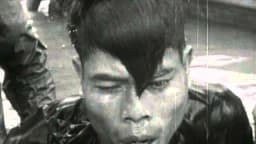
Running across April 20 to 22, 2023, as reported by adsofbrands.net, the activation occupied the distinctive arched span of the Via Elevado Presidente João Goulart, a structure as familiar to São Paulo's residents as any landmark in the city. The faces and stories of William, Vinicius, Tamara, Pricila, Jean, Sandra, Rogério, Patrick, Miguel, Charles, José, Ubiratan, and Lucas were projected in scale above the overpass, ensuring that people who routinely live beneath it were placed, however briefly, above it. The campaign operated at the intersection of experiential and outdoor media disciplines, using the physical and cultural authority of an existing artwork to amplify a humanitarian message across the Brazilian public. Clapboard rates this campaign 69 out of 100.
SP Invisível has pursued social inclusion through storytelling since its founding. The NGO's core method is to photograph people experiencing homelessness and publish their stories, directly confronting the tendency of urban societies to overlook those without stable housing. For "I Knew You Existed – Part II," that method was scaled into the physical environment of São Paulo rather than confined to digital channels, using the already-established cultural weight of Felipe Morozini's mural as infrastructure for the message.
The strategic logic is precise. Morozini's mural on the Minhocão had already achieved recognition as one of the most-photographed art installations in Brazil, meaning the campaign could borrow an audience that had already self-selected around engagement with public art. By projecting homeless individuals' portraits onto a surface people actively sought out and photographed, the campaign inserted those individuals into an existing visual ritual. The unhoused population living beneath the overpass was placed into a frame that São Paulo's residents were already pointing their cameras at.
The broader market context reinforces why this approach carries weight. Brazilian NGO individual donations totalled BRL 12.8 billion in 2022, according to the Instituto para o Desenvolvimento do Investimento Social, known as IDIS, suggesting a population with demonstrated capacity for civic engagement. In the same research period, institutional donations to homeless-serving organisations in Brazil rose from 1% to 10%, per IDIS, indicating growing formal recognition of the issue. Within the public service advertising landscape in Brazil, campaigns addressing homelessness compete for attention against those focused on health, education, and environmental causes. SP Invisível's decision to work through urban art and experiential OOH rather than conventional television or digital placements distinguishes it from peers such as Médicos Sem Fronteiras Brasil, which operates primarily through direct-response fundraising, and Teto Brasil, which pursues community construction projects. The Minhocão execution sidesteps donation mechanics entirely and focuses instead on visibility as the primary act of advocacy.
Felipe Morozini stands at the centre of this campaign's creative architecture. As the author of the original mural and an active participant in the 2023 sequel, Morozini provided not only the physical canvas but also some of the portrait photography used in the projections, as documented by clapboard.com. His dual role — artist whose work became the stage, and photographer who populated that stage — gives the campaign an unusual coherence. The subjects were not grafted onto someone else's aesthetic framework; they entered a space that had already been built around the act of seeing people who are overlooked.
Direction of the campaign documentation was handled by Player 2, with Patrícia Monegatto and Will Martins serving as directors, as credited on adsofbrands.net. Production was carried out by Zepp Filmes, with Dudu Venturi as executive producer and Thiago Venturi as production director. João Frohlich served as director of photography, Jeff Médici as producer, and Nathalia Rebouças in a production role. Executive sound production was handled by James Feeler. Projection work involved the partner studio Projetemos, as reported by adsofbrands.net and confirmed by clapboard.com.
The creative execution balances restraint with scale. The projections did not add graphic design embellishment or broadcast-style narration. Instead, they relied on the faces and words of the thirteen named individuals — their portraits and their stories — to carry the entire communicative load. Screening these images above São Paulo's most distinctive elevated overpass meant they were visible to pedestrians, cyclists, and residents of surrounding buildings simultaneously, reaching multiple vantage points without requiring a single media placement in the conventional sense. The mural's existing text, declaring "I Knew You Existed," functioned as a headline that the projections then answered with evidence. That structural relationship between existing artwork and new digital layer is the defining craft decision of the campaign.
No independently verified audience measurement data or post-campaign performance metrics for "I Knew You Existed – Part II" are publicly available through named research sources at the time of this writing. The campaign's impact is therefore assessed through its structural properties and the documented context in which it operated.
The activation ran for three days in April 2023, as reported by adsofbrands.net, on a structure that serves as a central artery in São Paulo's urban geography. The Minhocão is used by pedestrians, cyclists, and residents of adjacent buildings, meaning the projections reached a cross-section of the city's population without requiring any individual to seek the content out. The choice of a location that is already a cultural destination, documented by SP Invisível as one of the most-photographed art installations in Brazil, creates an inherent amplification mechanism: audience members who photographed or filmed the projections became secondary distributors of the content across social media channels.
The campaign's public service objectives are grounded in a documented and urgent social reality. Brazil's unhoused population was estimated at a minimum of 206,044 people in 2023 according to the Homeless World Cup organisation, with SP Invisível's own figures citing 281,472 as the 2022 total. In São Paulo specifically, the NGO documented more than 50,000 people living on the streets. Against that scale, the campaign's most significant structural achievement is the act of naming: by projecting thirteen specific individuals — William, Vinicius, Tamara, and their peers — the campaign transformed a statistical crisis into a human one. The campaign received attention from regional creative press including adobomagazine.com and was archived by Clubedecriacao Com Br, Brazil's leading creative industry body, indicating recognition within the professional advertising community.
"I Knew You Existed – Part II" is a 2023 public service campaign by SP Invisível and AlmapBBDO in Brazil. It projected digital portraits and personal stories of thirteen unhoused people onto Felipe Morozini's existing mural on São Paulo's Minhocão overpass, using established urban art as a platform for social inclusion advocacy.
The projections appeared on the Via Elevado Presidente João Goulart, commonly known as the Minhocão, in São Paulo. This elevated overpass is one of Brazil's most-photographed urban art locations, home to Felipe Morozini's original "I Knew You Existed" mural, which served as the canvas for the 2023 digital projection activation.
AlmapBBDO served as the agency behind the campaign. Felipe Morozini, photographer and urban artist, was a core creative collaborator, contributing both the original mural and portrait photography. Direction was handled by Player 2, with Patrícia Monegatto and Will Martins directing, and production carried out by Zepp Filmes, as documented by adsofbrands.net.
Brazil's unhoused population grew by 38% between 2019 and 2022, reaching an estimated 281,472 people according to SP Invisível. São Paulo alone has more than 50,000 people living on the streets. SP Invisível, founded in 2014 by André Soler and Vinícius Lima, created the campaign to make those individuals visible to Brazilian society.
Clapboard rates "I Knew You Existed – Part II" at 69 out of 100. The score reflects the campaign's strong conceptual foundation and culturally embedded execution on the Minhocão, balanced against the limited three-day activation window and the absence of independently verified post-campaign audience measurement data in the public domain.
The campaign ran from April 20 to 22, 2023, on São Paulo's Minhocão overpass, as reported by adsofbrands.net. The three-day experiential OOH activation projected portraits and stories of thirteen named unhoused individuals onto Felipe Morozini's existing street art mural during evening hours when the projections achieved maximum visual impact.
.webp)
Creative Collaboration Platform: The Backbone of Modern Creative WorkWhat is a creative collaboration platform?Clapboard defines a creative collaboration platform as the operational core for today’s distributed creative teams. This is not a collection of digital collaboration tools stitched together; Clapboard’s system


Understanding the Creative Production MarketplaceWhat is a Creative Production Marketplace?Clapboard defines a creative production marketplace as a structured ecosystem where brands, agencies, and production talent converge to execute video, advertising, and branded content at scale. Unlike the legacy agency or freelanREAD FULL ARTICLE

The Urgent Need for a Creative Production Operating SystemWhy Traditional Creative Production Models Break DownClapboard sees the creative production landscape shifting under pressure. Content velocity is no longer a buzzword—it’s a mandate. Modern advertising demands relentless output across dozens of channels, each wREAD FULL ARTICLE