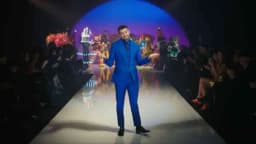
Shutterstock's Moon Landing Exposed film, published in the United Kingdom in July 2019, used Apollo 11's 50th anniversary to parody conspiracy theories and

How Shutterstock Turned Moon Landing Conspiracy Theories Into a Creative Showcase
Shutterstock's Moon Landing Exposed is a 2019 UK film campaign that parodies moon-landing conspiracy theories by contrasting authentic Apollo 11 launch footage with deliberately artificial scenes constructed entirely from Shutterstock stock assets, demonstrating the creative range of the platform's library on the 50th anniversary of the Apollo 11 mission.
The campaign was published in the United Kingdom in July 2019, timed precisely to coincide with the global commemoration of Apollo 11's lunar landing in July 1969. The film opens with genuine archival footage of the Apollo launch, lending it immediate documentary credibility, before transitioning into a sequence of conspicuously artificial green-screen imagery — astronauts, animals in spacesuits, and a Michael Jackson-style moonwalk — all assembled from assets available within Shutterstock's own library. The on-screen copy underscored the joke with the line, according to Campaign, "Humanity took to the stars. And landed on the moon. Which definitely happened." That dry comic register gave the campaign its distinctive tone: neither dismissive of the conspiracy genre nor credulous of it, but using it as a vehicle to prove a product point.
The campaign carried a direct commercial mechanism. Shutterstock offered subscribers a promotional code — APOLLO11 — granting an eleven per cent discount, valid through 31 July 2019, as reported by Ads of the World. The offer anchored the entertainment-led creative to a measurable conversion moment, a structural choice that reflects Shutterstock's dual objective of brand building and direct response. Clapboard Score: 72/100. Moon Landing Exposed sits within Shutterstock's broader 2019 brand platform, described by The Drum as "It's not stock, it's Shutterstock," the company's first major brand campaign in six years, rolled out across the United States, United Kingdom, Canada, and Australia.
Shutterstock entered 2019 with a specific strategic problem to solve. The stock imagery category had long carried associations with generic, lifeless visuals — a perception that actively undermined the platform's value proposition among professional creatives and marketing teams. The "It's not stock, it's Shutterstock" platform, developed with DiMassimo Goldstein in New York City according to The Drum, was designed explicitly to dismantle that assumption by showing, rather than telling, what the library could produce.
The United Kingdom represented a high-priority market within that international rollout. In the UK, the creative industries sector is a significant component of the broader economy, and professional services buyers — agencies, production companies, in-house creative teams — represent a discerning and sceptical audience for stock platforms. Competing directly against Getty Images and Adobe Stock, both of which maintain strong UK market presence, Shutterstock needed a creative intervention that would register as genuinely craft-conscious rather than merely promotional. Getty Images, in particular, held comparable archival depth and had its own associations with documentary and news photography that gave it credibility among professional buyers.
The Apollo 11 50th anniversary provided a culturally resonant hook that cut across professional and consumer audiences simultaneously. By selecting a conspiracy theory as its comedic frame, the campaign also tapped into a media and entertainment conversation that was highly active in the United Kingdom in mid-2019, as broadcasters and publishers across the UK were running anniversary programming. According to Shutterstock's 2019 annual report filed with the SEC, the company completed approximately 187.8 million paid downloads that year, up five per cent year over year, indicating a platform already operating at scale but still seeking to shift qualitative brand perception in markets like the UK.
Moon Landing Exposed was created for Shutterstock by Tribal DDB, according to Ads of the World. The film's construction relies on a deliberate and carefully managed tonal shift: its opening act deploys genuine Apollo-era archival footage with enough fidelity to establish authenticity, before the edit cuts to scenes that are conspicuously, almost theatrically, artificial. Astronauts posed against visible green screens, animals dressed in spacesuits, and a moonwalk sequence evoking Michael Jackson's signature move collectively signal to any informed viewer that what they are watching is assembled from stock assets — which is precisely the demonstration the campaign is built to deliver.
The creative concept parodies moon-landing conspiracy theories, as described in Campaign on 25 June 2019, with the campaign summary noting: "This work taps into conspiracy silliness with a film that pokes fun at those who think the moon landing was faked." That framing performs a dual function. It gives the audience permission to laugh, and it simultaneously positions Shutterstock's library as capable of constructing a convincing — or at least entertainingly unconvincing — alternative reality. The joke only lands if the viewer accepts that the assets are good enough to be mistaken for something real, even while being obviously fake.
Production credits for Moon Landing Exposed beyond the agency attribution to Tribal DDB are not publicly documented in available sources. The film medium was chosen deliberately: a static image could not demonstrate the sequential reveal — real footage giving way to stock construction — that makes the campaign's argument visible. The use of film as the single media asset, as noted by Clapboard, concentrates the creative investment into one execution rather than a fragmented multi-format campaign, a choice that reflects confidence in the central concept's ability to carry full narrative weight across a single viewing.
 ARCHIVE
No verified performance data for Moon Landing Exposed is publicly available. Shutterstock has not disclosed campaign-specific metrics such as view counts, engagement rates, conversion lift from the APOLLO11 promotional code, or brand tracking shifts attributable to the UK film. Analysis therefore rests on structural and contextual evidence.
At the platform level, Shutterstock reported total revenue of $650.5 million for full-year 2019, up from $623.3 million in 2018, representing approximately 4.4 per cent reported growth, according to the company's annual report filed with the SEC via Investor Shutterstock. E-commerce revenue reached $392.2 million, representing approximately sixty per cent of total company revenue, per the same filing. These figures establish that the period surrounding Moon Landing Exposed was one of steady commercial momentum for the business, though no causal link between this specific campaign and those results can be drawn.
Structurally, the campaign demonstrates several characteristics associated with effective brand-building executions. The cultural timing — anchored to the Apollo 11 50th anniversary — gave the film an organic reason to exist that extended beyond paid media placement, creating conditions for editorial coverage and organic sharing. The promotional code provided a direct-response layer that made the campaign's commercial impact at least partially measurable at the point of redemption, even if those figures are not public. The single-asset film format, as observed by Clapboard, concentrated creative quality into one high-craft execution. The Clapboard Score of 72 out of 100 reflects a campaign with a strong conceptual foundation and culturally precise timing, modestly constrained by the absence of a documented multi-market activation or measurable public outcomes.
Moon Landing Exposed is a Shutterstock film published in the United Kingdom in July 2019. It parodies moon-landing conspiracy theories by opening with real Apollo 11 archival footage before transitioning to deliberately artificial scenes built from Shutterstock stock assets, demonstrating the platform's creative range on the 50th anniversary of the lunar landing.
Moon Landing Exposed was created by Tribal DDB for Shutterstock, according to Ads of the World. The campaign was part of Shutterstock's broader "It's not stock, it's Shutterstock" brand platform, developed with DiMassimo Goldstein in New York City, which The Drum described as the company's first major brand campaign in six years.
Shutterstock timed the campaign to coincide with the 50th anniversary of the Apollo 11 Moon landing in July 1969. The anniversary provided a culturally resonant hook across the United Kingdom and international markets. Shutterstock also offered a promotional discount code, APOLLO11, valid through 31 July 2019, connecting the commemorative moment to a direct commercial offer.
The film opens with authentic Apollo launch footage, then cuts to conspicuously artificial green-screen sequences — including animals in spacesuits and a Michael Jackson-style moonwalk — assembled from Shutterstock assets. As Campaign reported in June 2019, the work "taps into conspiracy silliness with a film that pokes fun at those who think the moon landing was faked."
Shutterstock offered the promotional code APOLLO11 for an eleven per cent discount, valid through 31 July 2019, as reported by Ads of the World. The offer provided a direct-response mechanism tied to the campaign's entertainment-led creative, allowing the company to connect brand awareness activity to a measurable subscription conversion opportunity in the UK and other markets.
Moon Landing Exposed is one execution within Shutterstock's "It's not stock, it's Shutterstock" platform, launched in January 2019 according to The Drum. That platform was designed to challenge negative perceptions of stock imagery across the United States, United Kingdom, Canada, and Australia, positioning Shutterstock against competitors including Getty Images and Adobe Stock by demonstrating genuine creative capability.
.webp)
Creative Collaboration Platform: The Backbone of Modern Creative WorkWhat is a creative collaboration platform?Clapboard defines a creative collaboration platform as the operational core for today’s distributed creative teams. This is not a collection of digital collaboration tools stitched together; Clapboard’s system


Understanding the Creative Production MarketplaceWhat is a Creative Production Marketplace?Clapboard defines a creative production marketplace as a structured ecosystem where brands, agencies, and production talent converge to execute video, advertising, and branded content at scale. Unlike the legacy agency or freelanREAD FULL ARTICLE

The Urgent Need for a Creative Production Operating SystemWhy Traditional Creative Production Models Break DownClapboard sees the creative production landscape shifting under pressure. Content velocity is no longer a buzzword—it’s a mandate. Modern advertising demands relentless output across dozens of channels, each wREAD FULL ARTICLE