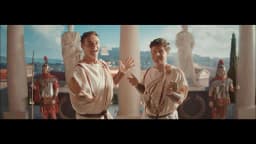
National Lottery's 'Dreams' campaign, created by The Wild in June 2019, connects UK lottery play to grassroots football funding through film and documentary

National Lottery Dreams Campaign Puts Good Causes at the Heart of UK Football
National Lottery's 'Dreams' is a film campaign created by The Wild for Camelot in June 2019, designed to show UK audiences how lottery revenue funds grassroots football projects through the Good Causes programme, making the case for play by foregrounding community impact rather than jackpot aspiration.
The campaign launched in the United Kingdom as the first phase of a wider media initiative. Its opening film established the emotional and social argument — that purchasing a National Lottery ticket contributes directly to local communities — before a planned second phase introduced two mini-documentaries featuring real Good Causes beneficiaries. Those subjects included a 92-year-old footballer and Sophie, a participant in Street Football Wales, both of whose stories gave the campaign its documentary credibility and human texture.
The strategic framing was explicit: Good Causes funding, not prize money, was positioned as the primary reason to play. This represents a meaningful departure from the lottery advertising conventions that dominated earlier decades in the United Kingdom, where campaigns from agencies including Saatchi and Saatchi and AMV BBDO foregrounded personal fortune and the transformative possibility of winning. As reported by The Drum, The Wild was the creative agency behind the campaign, operating as the in-house creative arm of Jungle Creations. The campaign was distributed across social platforms, placing its documentary content where community-minded audiences already spend their attention. Clapboard records the campaign as containing one primary media asset, published in June 2019 under the Gaming category.
The National Lottery raised an average of £30 million per week for Good Causes, and more than £40 billion in total since its 1994 launch, as reported by The Drum. That accumulated social capital represented an underused creative asset. The 'Dreams' campaign recognised that demonstrating tangible community benefit — visible, local, football-shaped — could motivate play among audiences increasingly sceptical of pure aspiration advertising.
The United Kingdom's lottery market was performing strongly at the time. National Lottery ticket sales reached a record £3.92 billion in the six months ending 28 September 2019, up by a substantial margin year-on-year, according to Convenience Store. Returns to Good Causes reached £1.801 billion in FY2019/20, per the Gambling Commission. These figures provided commercial context for a campaign that sought to deepen public understanding of where lottery money actually goes in communities across the UK.
The competitive landscape for the National Lottery in the United Kingdom includes the Health Lottery and a growing field of online instant-win operators, all competing for discretionary leisure spend. Where competitors emphasise immediate reward mechanics, the 'Dreams' campaign chose to compete on purpose — positioning the National Lottery as the only lottery whose play directly and demonstrably funds local social projects. That distinction had been present in National Lottery communications before, but rarely led the creative as forcefully as it does here. The decision to anchor the campaign in grassroots football was also timely, given the sport's deep cultural reach across communities in the United Kingdom and the ongoing public conversation about investment in amateur and community-level participation.
Ben Falk directed the 'Dreams' campaign for the National Lottery, as reported by The Drum. Molly Tappin served as head of creative on the project, which was produced through The Wild, the creative agency operating within Jungle Creations. The involvement of a director and creative lead with documentary sensibilities is evident in the campaign's approach: rather than constructing aspirational scenarios with actors, the work reaches toward the texture of real experience.
The film medium was deployed with deliberate restraint. The opening advertisement established tone and argument, while the planned mini-documentary follow-on films — featuring the 92-year-old footballer and Sophie from Street Football Wales — were designed to carry the emotional and evidential weight of the campaign's central claim. That structural choice, separating the brand narrative from the human evidence and delivering each in a form suited to its content, reflects a considered approach to multi-phase storytelling rather than a single-execution broadcast model.
Distribution through social platforms shaped the creative grammar of the work. Documentary content travels differently on social media than traditional broadcast advertising does, and the campaign's reliance on real subjects and real stories was calibrated to perform in environments where audiences are alert to inauthenticity. The choice to feature Street Football Wales alongside an individual beneficiary of advanced age also broadened the representational scope of the campaign, ensuring that Good Causes funding was shown to reach both institutional grassroots organisations and singular, unexpected individuals across the United Kingdom. The craft priority throughout was credibility over spectacle — a deliberate tonal shift for a lottery brand whose advertising lineage includes considerably more theatrical executions.
No verified performance data for the 'Dreams' campaign is publicly available at the time of writing. The Drum reported on the campaign's launch and creative rationale, and Clapboard records it as a single-asset film submission from June 2019, but neither source documents audience reach, engagement rates, or measurable shifts in lottery play attributable to the campaign.
Structurally, the campaign's effectiveness case rests on the coherence of its strategic logic. By leading with Good Causes impact rather than prize potential, the work occupied a differentiated position in a category where most advertising defaults to transformation fantasy. The two-phase architecture — opening film followed by documentary content featuring real beneficiaries — was designed to move audiences from awareness to belief, a more demanding but potentially more durable objective than simple recall. The decision to focus on grassroots football gave the campaign a culturally resonant anchor in the United Kingdom, where community sport touches a broad demographic range.
The Clapboard Score for 'Dreams' is 63 out of 100, reflecting competent strategic thinking and purposeful creative choices that are partially constrained by limited public documentation of execution and outcome. The campaign represents a credible evolution in how the National Lottery frames its social contract with UK players, even if its full impact remains unquantified in the public record.
The National Lottery's 'Dreams' campaign was created by The Wild in June 2019 to show UK audiences how Good Causes funding supports grassroots football projects. Rather than focusing on jackpot wins, the campaign used film and planned documentary content to connect lottery play directly to community-level social impact across the United Kingdom.
The Wild, the creative agency arm of Jungle Creations, created the 'Dreams' campaign for Camelot's National Lottery, as reported by The Drum. Molly Tappin served as head of creative and Ben Falk directed the work, which was published in the United Kingdom in June 2019 as a film campaign.
The National Lottery's Good Causes fund distributes lottery revenue to social, cultural, and community projects across the United Kingdom. The 'Dreams' campaign used this fund as its central creative argument, showing grassroots football projects as direct beneficiaries and positioning Good Causes impact as the primary reason to purchase a National Lottery ticket.
The planned documentary phase of the 'Dreams' campaign featured two real Good Causes beneficiaries: a 92-year-old footballer and Sophie, a participant in Street Football Wales, as reported by The Drum. Their stories provided human evidence for the campaign's argument that National Lottery funding reaches real individuals and community organisations across the UK.
The National Lottery 'Dreams' campaign holds a Clapboard Score of 63 out of 100. The score reflects the campaign's coherent social-impact strategy and purposeful documentary approach, tempered by limited public documentation of creative execution detail and the absence of verified performance or audience measurement data in the public record.
.webp)
Creative Collaboration Platform: The Backbone of Modern Creative WorkWhat is a creative collaboration platform?Clapboard defines a creative collaboration platform as the operational core for today’s distributed creative teams. This is not a collection of digital collaboration tools stitched together; Clapboard’s system


Understanding the Creative Production MarketplaceWhat is a Creative Production Marketplace?Clapboard defines a creative production marketplace as a structured ecosystem where brands, agencies, and production talent converge to execute video, advertising, and branded content at scale. Unlike the legacy agency or freelanREAD FULL ARTICLE

The Urgent Need for a Creative Production Operating SystemWhy Traditional Creative Production Models Break DownClapboard sees the creative production landscape shifting under pressure. Content velocity is no longer a buzzword—it’s a mandate. Modern advertising demands relentless output across dozens of channels, each wREAD FULL ARTICLE