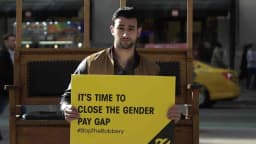
The campaign "The Invisible Salary Gap" by LeCran in partnership with State of African Diaspora seeks to illuminate the often overlooked issue of ethnic pay disparities within the United Arab Emirates. By positioning the ethnic pay gap as a hidden yet systemic problem, the campaign’s core proposition is to raise awareness and foster public discourse that can lead to tangible change. It underscores a commitment to transparency and social justice, urging viewers to recognize and address structural inequalities impacting marginalized communities.
Strategically, the campaign employs a documentary/social experiment format that lends credibility and emotional resonance, engaging a digitally savvy audience interested in social equity and public interest causes. It targets an informed, socially conscious demographic within the UAE, leveraging digital media to maximize reach and encourage active participation through educational resources and calls to action. The creative approach hinges on visibility—making what is "invisible" visible—thereby prompting reflection and dialogue. By framing the ethnic pay gap as a measurable social injustice, it connects with audiences motivated by fairness and advocacy, positioning LeCran and SOAD as authoritative voices championing ethnic representation and economic equality. The campaign’s digital deployment also facilitates direct engagement via social channels and donation pathways, reinforcing a community-driven effort to eradicate pay disparities rooted in ethnicity.
FORMAT#3 SYMBOLIZE THE PROBLEM — Uses symbols or analogies to represent the problem instead of showing it literally.
This campaign, "The Invisible Salary Gap," fits FORMAT#3 because the core of its communications is built around making the "ethnic pay gap" visible—a problem society typically ignores or fails to see. The campaign's very title centers on "invisibility," a symbolic device representing the unacknowledged wage differences faced by ethnic minorities. The genre is Documentary/Social Experiment, hinting that rather than a conventional demonstration or testimonial, the creative likely employs constructed scenarios, metaphors, or analogies to prompt recognition of this hidden disparity. The call to action urges viewers to help "make" the gap visible, underscoring the symbolic reframing of an unseen issue.
1. Human Rights Watch – Market Positioning
Human Rights Watch positions itself as a global watchdog organization focusing on detailed investigative reporting and advocacy to combat discrimination and inequality, including ethnic pay gaps. It leverages rigorous research and international presence to influence policy change and public awareness on social justice issues worldwide, including initiatives within the UAE and diaspora communities.
2. Amnesty International – Market Positioning
Amnesty International strategically emphasizes human rights advocacy through widespread campaigns that engage global audiences and policymakers. Their focus is on equality, fairness, and the elimination of systemic discrimination, often highlighting marginalized groups’ struggles, making them a prominent voice in public interest issues like the ethnic pay gap.
3. The Equality Trust – Market Positioning
The Equality Trust centers its mission on reducing economic and social inequalities via research-based advocacy and public education. They differentiate by providing statistical insights and fostering policy reforms focused on income and opportunity disparities, including ethnic pay gaps, engaging both government and civil society in social justice reforms.
4. The Ethnic Equity Initiative – Market Positioning
This organization uniquely combines community-driven storytelling with data to reveal hidden systemic pay inequalities. Their strategic angle involves collaborating directly with ethnic minority communities to create impactful social experiments and documentaries that make invisible biases visible, driving grassroots and policy-level change.
5. The UAE Gender Balance Council – Market Positioning
Though primarily focused on gender parity, the UAE Gender Balance Council incorporates ethnic and diversity pay gap issues within their broader mandate. Their market position is rooted in national policy advocacy, leveraging government partnerships to institutionalize fair pay practices and promote inclusive economic growth within the UAE.
Q: What is The Invisible Salary Gap about?
A: The Invisible Salary Gap is a 2021 digital campaign created by Publicis for LeCran in partnership with the State of African Diaspora, launched in the United Arab Emirates. The campaign addresses the often overlooked issue of ethnic pay disparities by positioning the pay gap as an invisible but systemic problem. Through a documentary and social experiment format, it aims to raise awareness, foster public discourse, and drive tangible change around salary inequities affecting ethnic minorities. The campaign leverages digital channels to engage a socially conscious audience and encourages active participation through educational resources and calls to action.
Q: What creative device does The Invisible Salary Gap use?
A: The Invisible Salary Gap employs FORMAT#3 SYMBOLIZE THE PROBLEM, as classified by Clapboard's 12-format taxonomy. This creative approach uses symbols and analogies to represent the ethnic pay gap, rather than depicting it literally. The campaign’s title and execution center on the concept of invisibility, making the unacknowledged wage differences faced by ethnic minorities visible to the public. By utilizing constructed scenarios and metaphors within a documentary/social experiment genre, the campaign prompts recognition and dialogue around a hidden social injustice.
Q: What is the campaign proposition for The Invisible Salary Gap?
A: The campaign proposition for The Invisible Salary Gap is to illuminate the ethnic pay gap as a hidden yet systemic issue within the United Arab Emirates, urging viewers to recognize and address structural inequalities impacting marginalized communities. LeCran and the State of African Diaspora position themselves as authoritative voices championing ethnic representation and economic equality. The campaign targets an informed, socially conscious demographic, leveraging digital media to maximize reach and encourage active participation through educational resources, social channels, and opportunities for advocacy, donations, and community engagement.
Q: How does The Invisible Salary Gap rank in Clapboard's archive?
A: The Invisible Salary Gap holds a Clapboard Campaign Score of 64/100 in Clapboard's global ad archive. This score reflects the campaign’s creative ambition, execution quality, and cultural relevance as assessed by Clapboard’s curatorial standards.
Q: Who are the competitors in LeCran x State of African Diaspora's category?
A: In the public interest and social justice sector, LeCran x State of African Diaspora competes with organizations such as Human Rights Watch, which leverages investigative reporting and advocacy to combat discrimination and influence policy; Amnesty International, known for global campaigns focused on equality and the elimination of systemic discrimination; The Equality Trust, which emphasizes research-based advocacy to reduce economic inequalities; the Ethnic Equity Initiative, which combines community-driven storytelling with data to expose hidden pay gaps; and the UAE Gender Balance Council, which advocates for inclusive economic growth and fair pay practices within the UAE.


 ARCHIVE
.webp)