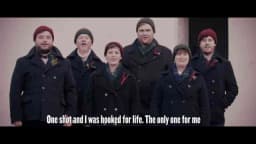
Heineken's The Better Halves campaign by NEXT-DC, Sofia, used voice recognition to turn Bulgarian wives and girlfriends into Champions League ticket winners in

Heineken The Better Halves Turned Bulgarian Football Fans Into Unlikely Casting Directors
Heineken's "The Better Halves" is a 2014 digital campaign created by Sofia-based agency NEXT-DC for Zagorka AD, Heineken's Bulgarian brewing partner, in which wives and girlfriends of football fans used voice-recognition technology to perform the UEFA Champions League anthem and compete for the missing halves of ticket pairs to the Champions League Final.
The campaign launched in Bulgaria in May 2014, timed precisely to the build-up to one of European football's most coveted live events. The core mechanic was elegantly simple. Bulgarian football fans received one half of a UEFA Champions League Final ticket and were challenged to convince their "better halves" to perform the Champions League anthem live, with custom hardware and voice-recognition technology determining whose rendition came closest to the original. Three winners received the corresponding second half of their ticket and attended the Final. Sixty-two wives and girlfriends participated in total, as reported by Adv-Universe Blogspot, making this one of the more intimate and human-scale activations Heineken ran anywhere in its global portfolio that year.
The campaign was published in Bulgaria as a single digital media asset, a deliberate choice that concentrated creative impact rather than diffusing it across multiple formats. By anchoring the experience in a technology-driven performance challenge, NEXT-DC transformed the passive act of watching football into an active, participatory moment shared between partners. The Bulgarian market provided the campaign with a culturally resonant backdrop: football fandom in Bulgaria carries deep communal and domestic dimensions, and the tension between match night and relationship time is a lived reality for many households in Sofia and beyond. Heineken's Clapboard Score for this campaign sits at 78 out of 100, reflecting strong creative originality and strategic alignment with the brand's long-running association with UEFA Champions League sponsorship.
Heineken has held a principal sponsorship of the UEFA Champions League since 1994, according to theheinekencompany.com, giving the brand a durable and globally recognised equity platform to activate locally. "The Better Halves" took that global asset and translated it into an intimate, domestically rooted story specific to Bulgaria, where Zagorka AD operates as Heineken's local brewing and marketing entity. Rather than broadcasting at fans, the campaign recruited the people most likely to compete with football for attention — partners — and turned them into the campaign's protagonists.
The strategic insight was precise. Football fandom creates a recurring domestic negotiation: the fan wants the game; the partner wants the evening. Heineken inverted that tension by making the partner the key to the fan's ultimate prize. Participation required co-operation, not competition, between couples. This framing positioned Heineken not as a brand interrupting domestic life but as one enabling a shared experience. As reported by M Economy Bg, the selection mechanic — voice-recognition technology matched against the Champions League anthem's original timing — gave the campaign a credible, gamified structure that elevated it beyond a simple sweepstake.
In the Bulgarian alcoholic drinks market, Heineken operates through Zagorka AD in a competitive landscape that includes AB InBev-affiliated brands and regional players. Globally, AB InBev, SABMiller, Heineken, and Carlsberg collectively controlled approximately 47% of global beer volume and roughly 74% of industry profits in 2014, according to brauwelt.com. Heineken produced 181.3 million hectolitres in 2014, equivalent to approximately 9.3% of global beer production, as reported by theheinekencompany.com. Within that competitive context, differentiation through cultural and emotional resonance — rather than volume or price — represented a sustainable strategy for premium positioning in a market like Bulgaria.
NEXT-DC assembled a focused creative team in Sofia to bring "The Better Halves" to life as a digital execution. Maria Todorova served as chief creative officer, with Momchil Zakhariev credited as creative director and copywriter, and Kamen Kamenov as art director. Alexander Antonov led interactive design, George Yanakiev served as head of digital, and Ivan Ralchev managed the project as digital project manager. The team's configuration reflected the campaign's essential nature: this was a technology-forward creative idea that required equal competence in concept, interaction design, and digital production.
The centrepiece of the execution was the custom hardware and voice-recognition system built to evaluate participants' performances of the UEFA Champions League anthem. As reported by adv-universe.blogspot.com, performers were assessed on how closely their rendition matched the original anthem's timing, introducing an objective and repeatable selection criterion into what could otherwise have been an arbitrary judging process. This technical choice was not incidental — it gave the campaign integrity and gave participants a genuine sense of fair competition, both of which are prerequisites for earned media traction in a digitally connected market like Bulgaria.
The campaign existed as a single digital media asset, a constraint that forced creative discipline. There was no multi-channel diffusion to carry weak ideas; the entire creative proposition had to be legible, compelling, and shareable from a single point of entry. The combination of a culturally loaded object — the Champions League Final ticket — with an emotionally resonant challenge and a technically credible evaluation system produced a coherent creative system. Sixty-two women performed, and three winners attended the Final, as confirmed by m.economy.bg, which underscores the activation's capacity to convert creative curiosity into genuine behavioural participation at a human scale specific to the Bulgarian market.
No verified campaign-specific sales lift, market-share movement, or brand-tracking data for "The Better Halves" is publicly available. No award records from Cannes Lions, Effie Awards, The One Show, D&AD, Clio Awards, Webby Awards, or WARC Awards have been confirmed for this campaign. What the public record does confirm, as reported by adv-universe.blogspot.com and m.economy.bg, is that 62 participants engaged with the voice-recognition mechanic and three winners received tickets to the Champions League Final — a participation volume that, for a market the size of Bulgaria, represents meaningful voluntary engagement with a branded challenge requiring genuine effort and personal performance.
Structurally, the campaign demonstrates several characteristics associated with high-performing digital activations. The prize was culturally and emotionally significant — a Champions League Final ticket is not a commodity reward. The mechanic introduced a skill element through voice-recognition technology, raising perceived legitimacy and shareholder investment in the outcome. The domestic framing created natural word-of-mouth potential, since every participant's story was inherently social. These structural qualities consistently correlate with stronger earned media amplification and brand recall, even when formal tracking data is absent. Heineken's Clapboard Score of 78 out of 100 reflects this structural strength, placing the campaign in the upper tier of digitally executed local activations within the alcoholic drinks category in Bulgaria and more broadly across the Food and Drink sector.
"The Better Halves" was a May 2014 digital campaign by NEXT-DC for Heineken in Bulgaria. Football fans received half a Champions League Final ticket and challenged their partners to perform the UEFA Champions League anthem using voice-recognition technology, with three winners receiving the ticket's missing half and attending the Final.
Custom hardware and voice-recognition technology evaluated each participant's performance of the UEFA Champions League anthem. As reported by adv-universe.blogspot.com, performances were assessed against the original anthem's timing, producing an objective selection criterion. Three performers whose renditions matched most closely won the corresponding halves of the Champions League Final tickets.
Sofia-based agency NEXT-DC created the campaign for Zagorka AD, Heineken's Bulgarian partner. Maria Todorova served as chief creative officer, Momchil Zakhariev as creative director and copywriter, Kamen Kamenov as art director, and Alexander Antonov as interactive design director, with George Yanakiev and Ivan Ralchev leading digital delivery.
Sixty-two wives and girlfriends performed the Champions League anthem as part of the activation, according to reporting by adv-universe.blogspot.com and m.economy.bg. Three participants won the matching halves of Champions League Final tickets. The campaign operated as a single digital asset targeted specifically at the Bulgarian market in May 2014.
Heineken's "The Better Halves" holds a Clapboard Score of 78 out of 100. The score reflects strong creative originality and strategic alignment, recognising the campaign's effective use of voice-recognition technology, its culturally resonant domestic framing within Bulgaria, and the structural coherence of its digital mechanic within the alcoholic drinks category.
No verified award records for "The Better Halves" have been confirmed across Cannes Lions, Effie Awards, The One Show, D&AD, Clio Awards, Webby Awards, or WARC Awards. Despite the absence of formal industry recognition, the campaign's participation figures and structural creative quality position it as a notable digital activation within the Bulgarian Food and Drink advertising landscape.
.webp)
Creative Collaboration Platform: The Backbone of Modern Creative WorkWhat is a creative collaboration platform?Clapboard defines a creative collaboration platform as the operational core for today’s distributed creative teams. This is not a collection of digital collaboration tools stitched together; Clapboard’s system


Understanding the Creative Production MarketplaceWhat is a Creative Production Marketplace?Clapboard defines a creative production marketplace as a structured ecosystem where brands, agencies, and production talent converge to execute video, advertising, and branded content at scale. Unlike the legacy agency or freelanREAD FULL ARTICLE

The Urgent Need for a Creative Production Operating SystemWhy Traditional Creative Production Models Break DownClapboard sees the creative production landscape shifting under pressure. Content velocity is no longer a buzzword—it’s a mandate. Modern advertising demands relentless output across dozens of channels, each wREAD FULL ARTICLE