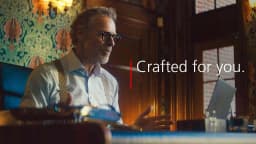
FirstBank's 2024 Courage campaign by TDA_Boulder uses absurdist humor across OTT, CTV, print, and out-of-home to champion entrepreneurs in the United States.

FirstBank Bets on Absurdist Humor to Champion Entrepreneurial Courage
FirstBank's "Courage" campaign, created by TDA_Boulder and launched in the United States in August 2024, uses absurdist humor to dramatize the earliest pitch moments of now-iconic business ideas, arguing that visionary entrepreneurs need both personal courage and a financially committed banking partner to succeed.
The campaign centers on a thirty-second hero spot titled "Lights" and two fifteen-second companion films — "Search Engine" and "Ride Share" — each of which reconstructs a fictional founding-era pitch meeting for a concept audiences now take for granted. As reported by MediaPost, the campaign launched on August 16, 2024, with TDA_Boulder announcing it formally on August 20, 2024. The "Search Engine" film is set in a 1998 narrative, depicting skepticism toward the idea of a global search tool delivering unsourced information from a personal computer. The "Ride Share" film is set in a 2009 narrative, rendering early resistance to the concept of paying strangers to drive you in their own cars. Both scenarios mine obvious hindsight comedy to make a pointed argument: the ideas that reshape industries routinely sound absurd before they succeed.
Distributed across OTT, CTV, social media, print, and out-of-home advertising channels, the integrated campaign reaches United States entrepreneurs and small-to-midsize business owners across multiple touchpoints. FirstBank, a Colorado-based institution, has built a 60-year track record of supporting small and midsize business customers, and the "Courage" campaign directly extends that positioning by paying tribute to the audacity required to transform seemingly ridiculous ideas into successful enterprises. The campaign carries a Clapboard Score of 63 out of 100, reflecting solid creative distinction within a category that rarely invites humor at this register.
Fintech disruption is reshaping the competitive landscape for community and regional banks across the United States. In a market where digital-first challengers such as Chime and SoFi have accelerated the commoditization of retail and small-business banking services, FirstBank's strategic response is to lean into what those platforms structurally cannot offer: human interaction and genuinely personalized service. The "Courage" campaign makes that positioning emotionally legible through comedy rather than corporate reassurance.
TDA_Boulder, based in Boulder, Colorado, has held the FirstBank account for approximately fifteen years, a relationship that began around 2007 to 2009, according to thefinancialbrand.com. Before that partnership, FirstBank's advertising was described as straightforward and conventional, per thefinancialbrand.com. The agency's introduction of humor-infused, culturally resonant creative marked a deliberate pivot toward distinctiveness in a category defined by sameness. By 2017, TDA_Boulder had already been described as FirstBank's agency of record for approximately ten years, according to thefinancialbrand.com, underscoring the depth of creative alignment the two organizations have developed.
The strategic logic of the "Courage" campaign rests on a simple but powerful insight: entrepreneurial confidence is emotional before it is financial. By dramatizing the moment when a great idea sounds most ridiculous — before the market has validated it — the campaign positions FirstBank not merely as a lender but as a believer. That framing is especially resonant in the United States, where small-business culture is a durable part of national identity and where the gap between an entrepreneur's vision and an institution's willingness to finance it carries real narrative weight. The humor advertising approach also serves a media function, cutting through the visual and tonal uniformity that dominates banking category communications across US markets.
TDA_Boulder constructs each film in the "Courage" campaign around a single dramatic irony: the audience knows exactly how the story ends, and the fictional skeptics in the room do not. That structural gap is the engine of both the comedy and the emotional argument. The thirty-second hero spot "Lights" establishes the campaign's tonal register, while the two fifteen-second executions — "Search Engine" and "Ride Share" — apply the same logic to specific, recognizable business categories with tight comic precision.
The "Search Engine" film places its scene in 1998, rendering the concept of a global information retrieval tool — one whose name has since become a verb in everyday American English — as the kind of proposition that invites blank stares in a conference room. The "Ride Share" film moves the clock forward to 2009, staging early resistance to the idea of using a smartphone application to summon a stranger's personal vehicle as a taxi. Both films depend on period-accurate detail and performance restraint to sustain the joke without over-explaining it, a discipline that reflects genuine craft in the writing and direction.
Jeremy Seibold, Creative Director and Partner at TDA_Boulder, articulated the campaign's intent directly, stating — as cited by agencycompile.com — that "through humor and relatability, we hope to inspire business owners to pursue their dreams with confidence and courage." That statement aligns the creative ambition with the strategic objective cleanly. The integrated campaign extends the same sensibility across print and out-of-home executions in the United States, ensuring that the tonal consistency of the humor advertising is maintained regardless of format or context. Production credits beyond Seibold's creative direction are not publicly documented in available campaign records.
No verified third-party performance metrics for the "Courage" campaign — such as brand lift percentages, recall scores, or directly attributable business outcomes — are publicly available at the time of this analysis. What the public record does confirm, as reported by MediaPost in an article by Fern Siegel published August 16, 2024, is that campaign sentiment was described as favorable, and that the work was received as positioning FirstBank's human touch and personalized service as a meaningful differentiator in the United States digital banking environment.
Structurally, the campaign demonstrates several qualities that correlate with effectiveness in financial services humor advertising. The three-film architecture — one thirty-second hero spot supported by two fifteen-second executions — is efficiently designed for the OTT and CTV environments where attention windows are compressed and brand recall depends on tonal consistency across exposures. The use of historical hindsight as a comedic device reduces the persuasion load on any single execution by making the core argument self-evident: the audience supplies the punchline from their own knowledge. The extension of the campaign into print, out-of-home, and social media channels across the United States gives the platform sufficient reach to build genuine awareness among the small and midsize business owners FirstBank serves.
The Clapboard Score of 63 out of 100 reflects a campaign that earns its creative distinctiveness within a category where the baseline for memorable work remains low, while acknowledging that the executional ambition stops short of the kind of category-redefining craft that pushes scores into the upper quartile.
FirstBank's Courage campaign uses absurdist humor to dramatize early pitch meetings for now-famous business ideas. Created by TDA_Boulder, it launched in the United States in August 2024, featuring three films across OTT, CTV, social, print, and out-of-home channels to position FirstBank as a courageous partner for entrepreneurs.
TDA_Boulder created the Courage campaign for FirstBank. The Boulder, Colorado agency has held the FirstBank account for approximately fifteen years, according to thefinancialbrand.com. Jeremy Seibold, Creative Director and Partner at TDA_Boulder, led the creative direction, as cited by agencycompile.com.
The Courage campaign includes three films. The thirty-second hero spot is titled Lights. The two fifteen-second companion films are Search Engine, set in a 1998 narrative, and Ride Share, set in a 2009 narrative. All three launched in the United States in August 2024, as reported by MediaPost.
The Courage campaign ran across OTT, CTV, social media, print, and out-of-home advertising channels in the United States. This integrated campaign structure ensured tonal consistency for the humor advertising across multiple touchpoints reaching small and midsize business owners who represent FirstBank's core customer base.
FirstBank's Courage campaign received a Clapboard Score of 63 out of 100. The score reflects creative distinctiveness within the banking and finance category, where humor advertising at this register is rare, while noting the executional ambition does not reach the upper quartile of scored campaigns on Clapboard.
The Courage campaign extends a fifteen-year creative partnership between FirstBank and TDA_Boulder that began around 2007 to 2009, according to thefinancialbrand.com. Before that relationship, FirstBank's advertising was described as straightforward and conventional. The 2024 campaign continues the agency's humor-driven strategy to differentiate FirstBank in the competitive United States banking market.
.webp)
Creative Collaboration Platform: The Backbone of Modern Creative WorkWhat is a creative collaboration platform?Clapboard defines a creative collaboration platform as the operational core for today’s distributed creative teams. This is not a collection of digital collaboration tools stitched together; Clapboard’s system


Understanding the Creative Production MarketplaceWhat is a Creative Production Marketplace?Clapboard defines a creative production marketplace as a structured ecosystem where brands, agencies, and production talent converge to execute video, advertising, and branded content at scale. Unlike the legacy agency or freelanREAD FULL ARTICLE

The Urgent Need for a Creative Production Operating SystemWhy Traditional Creative Production Models Break DownClapboard sees the creative production landscape shifting under pressure. Content velocity is no longer a buzzword—it’s a mandate. Modern advertising demands relentless output across dozens of channels, each wREAD FULL ARTICLE