Dunkin' Bets on Benny Blanco to Sell Summer Coffee Culture
Dunkin' released a 60-second film titled "Will's Go To Guy" in July 2024 as part of its broader Marketingdive.clapboard.com/archive/dunkin-dunkinterns-food-drink">Dunkin'Terns summer campaign, featuring music producer Benny Blanco alongside content creator Will Arnott and viral corporate persona Corporate Natalie, produced by Artists Equity for the United States market.
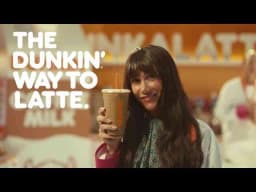
The Dunkin'Terns concept launched on June 17, 2024, according to reporting by Marketing Dive, positioning actor Will Arnett and content creator Corporate Natalie — whose full name is Natalie Marshall — as the leaders of a class of Dunkin'Tern creators. That rollout, as documented by Marketing Dive, included one 30-second hero advertisement and four 15-second creator-specific spots, with the Benny Blanco execution arriving as a longer-form chapter on July 19, 2024, according to En Wikipedia. The campaign promoted Dunkin' iced coffee, Dunkin' Refreshers, and SPARKD' Energy products, widening the brand's summer beverage proposition beyond its core hot-coffee identity.
In the United States, where quick-service restaurant coffee competition has intensified sharply, the "Will's Go To Guy" film positions Dunkin' as a dependable, culturally fluent presence in everyday life. The choice of Artists Equity — the production company co-founded by Ben Affleck and Matt Damon — signals Dunkin's ongoing commitment to entertainment-grade creative execution rather than conventional advertising formats, according to WARC. The film's narrative personalises the brand through recognisable characters operating in professional and casual settings, reinforcing Dunkin's long-standing accessibility message while updating it for a pop-culture-literate audience. The Clapboard Score for this execution is 60 out of 100, reflecting competent craft and clear strategic intent within a crowded celebrity-endorsement landscape.
Dunkin' built the Dunkin'Terns campaign around a hybrid casting model that blends traditional celebrity recognition with creator-economy credibility. The broader summer 2024 effort featured Will Arnett, Corporate Natalie, Joey Fatone, AJ McLean, and gaming creator SypherPK, according to Muse by Clios, which described the campaign as a splashy, celebrity-filled summer effort and credited Dunkin' with demonstrating genuine pop-culture staying power. The "Will's Go To Guy" film extends that logic by adding Benny Blanco — a producer whose crossover appeal spans music, social media, and mainstream entertainment — as a personality capable of reaching younger US consumers who engage more readily with creator content than with broadcast advertising.
The strategic rationale connects directly to competitive pressure in the United States. Starbucks holds an estimated 36.6% of the global coffee-shop market in 2024, according to Jadhav Arba Business Intelligence, making it the dominant benchmark against which Dunkin' must differentiate. Dunkin' and McCafé together represent approximately 20% of the global coffee-shop market, though individual brand shares are not separately reported, per the same source. In this environment, Dunkin' cannot compete on premium positioning alone; its historical advantage lies in speed, value, and everyday accessibility — qualities the Dunkin'Terns campaign attempts to translate into cultural relevance rather than functional messaging alone.
The film format on digital platforms also reflects a documented shift in US consumer media behaviour. Dunkin's creative direction in 2023 and 2024 moved decisively toward entertainment-led, celebrity-heavy storytelling, according to research documented by Selfstorming, departing from the utility-focused "America Runs on Dunkin'" platform that had anchored the brand's communications through the early 2020s, as noted by Media Shower.
Artists Equity directed the creative execution of "Will's Go To Guy" as a 60-second film, a format choice that affords more narrative room than the 15-second creator spots that anchored earlier Dunkin'Terns rollouts. The production company, co-founded by Ben Affleck and Matt Damon, brought a cinematic sensibility to what is structurally a quick-service restaurant advertisement, and that tension between production ambition and product category is central to the film's creative identity. The campaign is identified in archive records as a July 2024 Artists Equity production for Dunkin', created for the United States market.
The casting of Benny Blanco operates on multiple levels within the film. As a music producer with a well-documented public persona — self-deprecating, culturally omnivorous, and genuinely popular across age groups — Blanco functions less as a traditional brand spokesperson and more as a narrative device that personalises the "go-to guy" concept the title foregrounds. Will Arnott and Corporate Natalie provide structural continuity with the wider Dunkin'Terns series, anchoring the individual execution within the campaign's ensemble logic. The corporate character archetype that Corporate Natalie embodies gives the film a workplace-comedy register that makes Dunkin' legible as an office-culture staple rather than merely a morning routine.
Production credits for the "Will's Go To Guy" execution beyond the Artists Equity production company designation are not publicly documented in available sources. The film's tone — humour-forward, lightly absurdist, and paced for digital consumption — is consistent with Artists Equity's broader output for Dunkin', which has consistently prioritised entertainment value as the primary vehicle for brand messaging across the United States in 2024.
Campaign archive records document 2,767 views, 34 likes, and zero comments on the "Will's Go To Guy" Benny Blanco execution at the time of indexing. These figures reflect the performance of a single archived asset rather than the campaign's total digital footprint, which would encompass Dunkin's owned channels, paid media distribution, and the earned reach generated by Benny Blanco's own social audience. No verified aggregate performance data for the Dunkin'Terns 2024 campaign is publicly available from Dunkin' or Artists Equity.
What the archive metrics do indicate is a modestly engaged direct viewership for this specific film asset. The absence of comments is notable in structural terms: it suggests either a distribution context that limited audience interaction or a viewing environment — such as a brand-controlled upload — that suppressed organic conversation. The 34 likes-to-2,767-views ratio points to passive consumption rather than active advocacy, which is a common pattern for brand-produced content hosted outside creator-native platforms.
Structurally, the campaign's effectiveness rests on earned media and cross-platform amplification rather than any single asset's standalone metrics. Muse by Clios credited the broader Dunkin'Terns effort with demonstrating pop-culture relevance, and the ensemble casting strategy — which spans legacy pop acts, gaming creators, and music producers across the United States — is designed to generate cumulative cultural presence rather than moment-specific viral performance. The Dunkin'Terns model reflects an industry-wide recognition in the United States food and drink category that sustained creative salience across multiple touchpoints outperforms single-execution reach optimisation.
Dunkin' released "Will's Go To Guy" as a 60-second film in July 2024. Produced by Artists Equity, it features Benny Blanco, Will Arnott, and Corporate Natalie as part of the broader Dunkin'Terns summer campaign in the United States, promoting iced coffee, Dunkin' Refreshers, and SPARKD' Energy products.
Artists Equity created the Dunkin'Terns campaign for Dunkin'. It launched on June 17, 2024, according to Marketing Dive, with Will Arnett and Corporate Natalie leading a class of creator personalities across one 30-second hero ad and four 15-second spots, followed by the Benny Blanco film in July 2024.
Dunkin' cast Benny Blanco for his crossover appeal across music, social media, and mainstream entertainment. His self-deprecating public persona aligns with the campaign's humour-forward tone, and his cultural reach extends Dunkin'Terns beyond traditional celebrity advertising to connect with younger United States audiences through creator-economy credibility.
The Dunkin'Terns summer 2024 campaign featured Will Arnett, Corporate Natalie, Joey Fatone, AJ McLean, and gaming creator SypherPK, according to Muse by Clios. The Benny Blanco execution adds a music-industry dimension to an ensemble cast spanning pop culture, entertainment, and the creator economy across the United States.
The Dunkin'Terns "Will's Go To Guy" execution received a Clapboard Score of 60 out of 100. This reflects competent strategic craft and clear brand positioning within a competitive celebrity-endorsement landscape, while indicating room for stronger creative distinctiveness in the United States food and drink advertising category.
Dunkin' moved decisively toward entertainment-led, celebrity-heavy storytelling in 2023 and 2024, according to Selfstorming, departing from the utility-focused "America Runs on Dunkin'" platform documented by Media Shower. Dunkin'Terns represents that strategic evolution, using Artists Equity's production capabilities to compete for cultural relevance in the United States market.
.webp)
Creative Collaboration Platform: The Backbone of Modern Creative WorkWhat is a creative collaboration platform?Clapboard defines a creative collaboration platform as the operational core for today’s distributed creative teams. This is not a collection of digital collaboration tools stitched together; Clapboard’s system


Understanding the Creative Production MarketplaceWhat is a Creative Production Marketplace?Clapboard defines a creative production marketplace as a structured ecosystem where brands, agencies, and production talent converge to execute video, advertising, and branded content at scale. Unlike the legacy agency or freelanREAD FULL ARTICLE

The Urgent Need for a Creative Production Operating SystemWhy Traditional Creative Production Models Break DownClapboard sees the creative production landscape shifting under pressure. Content velocity is no longer a buzzword—it’s a mandate. Modern advertising demands relentless output across dozens of channels, each wREAD FULL ARTICLE