 ARCHIVE
Apê Kids Offline Toys Turns Screen Time Into Playtime
Apê Kids' Offline Toys campaign is a June 2019 Brazilian experiential retail initiative created by agency NBS, in which NFC-enabled wooden toys dock a parent's smartphone, suppress incoming notifications, and unlock more than 120 interactive activities through a companion app — turning the device from a distraction into an engine for uninterrupted parent-child play.
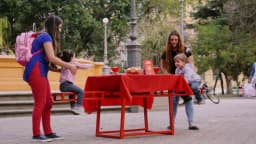
Apê Kids positions itself as a developer of playful and functional objects for children. The Offline Toys line reflects that brief precisely: three wooden toy formats — a car, a stove, and a human-body model — each embed NFC technology that the companion app uses to recognise the specific product the moment a smartphone is placed inside it. Recognition triggers two simultaneous actions: the phone's notification stream is suppressed, and the app surfaces a curated set of interactive experiences matched to that toy's theme. The car produces police-vehicle sounds, the stove introduces food-related interactions, and the anatomy toy guides children through an exploration of the human body, according to Trend Hunter's June 2019 feature by Laura McQuarrie.
The campaign was published in Brazil in June 2019 and archived across the house and garden, public interest, recreation and leisure, and retail services categories. Its geographic market is the Brazilian retail sector, where the intersection of rising smartphone penetration and growing parental concern about screen culture created a precise cultural opening for a product that reframes the phone not as a rival to play but as its infrastructure. The campaign contains one primary media asset and was submitted to the Clapboard archive, where it holds a Clapboard Score of 63 out of 100. Ads of the World also documents the campaign as a notable example of experiential retail craft from Brazil in this period.
Apê Kids identified a specific behavioural tension present in Brazilian households. Parental smartphone distraction during play is the central consumer insight the Offline Toys campaign was built to address. Rather than moralising about device use, NBS engineered a product mechanic that made putting the phone down feel rewarding rather than punitive — the smartphone becomes more valuable to the play experience when it is docked inside the toy than when it sits in a parent's pocket.
The strategic rationale sits within a broader global context for the traditional toy category. The global traditional toys market was valued at approximately US$61.9 billion in 2018, up from US$55.4 billion in 2014, representing a compound annual growth rate of about 2.8%, according to Toy Book. That same market was projected to grow at approximately 3.2% compound annual growth rate for the 2018 to 2023 period, also according to Toy Book. In Brazil, a market characterised by strong cultural investment in family and childhood development, a product that elevates the quality of parent-child interaction carries significant retail appeal alongside its public-interest dimension.
Competitors in the connected and smart-toy space include VTech and Tomy, both identified among major toy market participants by Toy Book. Where those brands typically embed technology inside the toy itself, NBS's solution for Apê Kids routes the intelligence through the parent's existing device — reducing manufacturing cost and eliminating the need for a child to learn a proprietary interface. The campaign therefore competes not only on product novelty but on a more efficient technology architecture. Trend Hunter scored the campaign 4.8 out of 10 with 92% activity at the time of its June 2019 publication, signalling strong real-time engagement with the concept among the audiences tracking innovation in the children's retail space.
NBS built the Offline Toys creative around material honesty. The choice of wood as the primary material is not incidental — it communicates warmth, craft, and a deliberate distance from the plastic-and-screen aesthetic that dominates mass-market children's retail, reinforcing the campaign's core argument that analogue and digital can coexist productively. The three toy formats each carry their own creative logic: the car invokes movement and emergency-service role play through police-vehicle sound design; the stove channels domestic imaginative play through food-related interactions; and the human-body model opens an educational dimension, guiding children through anatomical exploration, as documented by Trend Hunter in Laura McQuarrie's June 21, 2019 feature.
The NFC integration is the campaign's most precise piece of craft. Rather than requiring parents to open an app and manually select a toy, the dock-and-recognise mechanic removes friction entirely — the system responds to the physical act of placing the phone inside the toy. This interaction design decision keeps the experiential moment intact: the parent is not navigating a menu but simply playing. The companion app then delivers more than 120 interactive experiences mapped to each toy's thematic territory, a content depth that suggests sustained creative development behind the scenes.
Production credits for the Offline Toys campaign are not publicly documented in available sources. The campaign was produced by NBS in Brazil and published in June 2019. Ads of the World archives the work as an experiential campaign spanning the house and garden and retail services categories, which confirms the dual-channel ambition of the execution: the product functions as both a retail object and a public-interest intervention in screen-time culture.
ARCHIVENo verified independent performance data for the Offline Toys campaign — such as sales lift, app download volume, or campaign reach figures — is publicly available at this time. The analysis that follows is therefore structural rather than metric-driven.
The campaign's effectiveness case rests on three observable foundations. First, the mechanic solves a real and widely felt problem — parental smartphone distraction during child play — without requiring a behaviour change that feels like sacrifice, which gives the product genuine retail utility beyond its novelty value. Second, the content depth of more than 120 interactive experiences creates a compelling reason for repeat engagement, extending the product's commercial lifespan well beyond a single purchase occasion. Third, the NFC-based recognition system reduces the onboarding friction that typically limits adoption of connected toys, addressing a known structural weakness in the broader smart-toy category.
Trend Hunter's coverage, published on June 21, 2019, recorded 92% activity against the campaign at the time of publication, indicating strong contemporaneous interest among innovation-tracking audiences. Ads of the World's inclusion of the campaign in its archive provides an additional signal of peer recognition within the creative industry in Brazil and internationally. The Clapboard Score of 63 out of 100 reflects a campaign with a well-defined insight and a technically coherent mechanic that stops short of the executional ambition required to achieve top-tier creative distinction.
Offline Toys is a June 2019 Brazilian experiential retail campaign created by NBS for Apê Kids. It features three NFC-enabled wooden toys — a car, stove, and human-body model — that dock a parent's smartphone, block incoming notifications, and unlock more than 120 interactive play experiences through a companion app.
Each wooden toy contains NFC technology that recognises the specific product when a smartphone is placed inside it. Recognition triggers two actions simultaneously: the companion app suppresses incoming notifications on the device and activates a set of interactive experiences tailored to that toy's theme, as documented by Trend Hunter in June 2019.
NBS, a Brazilian advertising agency, created the Offline Toys campaign for Apê Kids. The campaign was published in Brazil in June 2019 and is archived on Ads of the World and Clapboard as an experiential retail campaign spanning the house and garden, recreation and leisure, and retail services categories.
Offline Toys holds a Clapboard Score of 63 out of 100. The score reflects a campaign with a well-grounded consumer insight and a technically coherent NFC mechanic that does not fully reach the executional ambition required for top-tier creative distinction in the Brazilian experiential retail category.
The Offline Toys line includes a wooden car that produces police-vehicle sounds, a wooden stove that features food-related play interactions, and a wooden human-body model that guides children through anatomical exploration. All three toys use NFC technology and the companion app, as reported by Trend Hunter's Laura McQuarrie in June 2019.
.webp)
Creative Collaboration Platform: The Backbone of Modern Creative WorkWhat is a creative collaboration platform?Clapboard defines a creative collaboration platform as the operational core for today’s distributed creative teams. This is not a collection of digital collaboration tools stitched together; Clapboard’s system


Understanding the Creative Production MarketplaceWhat is a Creative Production Marketplace?Clapboard defines a creative production marketplace as a structured ecosystem where brands, agencies, and production talent converge to execute video, advertising, and branded content at scale. Unlike the legacy agency or freelanREAD FULL ARTICLE

The Urgent Need for a Creative Production Operating SystemWhy Traditional Creative Production Models Break DownClapboard sees the creative production landscape shifting under pressure. Content velocity is no longer a buzzword—it’s a mandate. Modern advertising demands relentless output across dozens of channels, each wREAD FULL ARTICLE