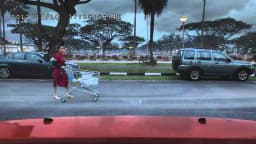
The Allianz 'Drunk Mirror' campaign leverages an innovative ambient approach to communicate a critical safety message against drunk driving. By employing a cleverly designed mirror that distorts reflections to mimic the impaired vision caused by alcohol consumption, the campaign visually demonstrates the direct consequences of drinking and driving. This tangible and immersive device serves as a compelling metaphor for compromised judgment and risk, reinforcing Allianz’s brand proposition of prioritizing safety and well-being. The campaign’s core value lies in Allianz positioning itself not just as a financial services provider, but as a socially responsible entity committed to protecting individuals beyond standard insurance products.
Strategically, the campaign targets drivers in Brazil by aligning its message with the national recognition of Driver’s Day, thereby rooting its communication in a culturally relevant context. The insight driving this execution recognizes that abstract warnings about drunk driving often fail to resonate deeply; instead, visualizing the impairment through the 'drunk mirror' creates an immediate emotional and cognitive impact. The use of ambient media situates the message in real-world environments where drivers are likely to encounter it, increasing engagement and recall. Coupled with a narrative structure and concise messaging, the campaign transforms a conventional safety advisory into a memorable experiential interaction. Furthermore, its relatively high online viewership and engagement metrics suggest effective audience connection and message dissemination. Overall, Allianz’s integration of behavioral insight with creative design establishes a meaningful dialogue on risk prevention, reinforcing its market position as a guardian of customer welfare within the finance sector.
FORMAT#3 SYMBOLIZE THE PROBLEM — Uses symbols or analogies to represent the problem instead of showing it literally.
The ‘Drunk Mirror’ campaign creatively employs a symbolic device: a mirror that distorts the viewer’s reflection to mimic the effects of alcohol-impaired vision. This indirect, experiential representation alerts viewers to the dangers of drunk driving, fulfilling the brief of ‘symbolizing the problem.’ The narrative and genre cues, as well as the description (“uses a different mirror to present a very important warning”), suggest that rather than showing literal drunk driving consequences or telling a linear story with a classic resolution, the campaign uses the mirror as an analogy for intoxication’s real-world impact. No testimonial, celebrity, ongoing character, or direct demonstration is signaled; instead, the campaign builds its impact on this symbolic transformation, aligning perfectly with Format #3.
ADVERTISING FORMATS EXPLAINED: https://www.clapboard.com/blog/branding-and-advertising/brand-strategy/12-advertising-creative-formats
1. Itaú Unibanco – Itaú positions itself as an innovative and customer-centric bank, leveraging digital transformation and extensive branch networks to offer accessible, personalized financial solutions. It emphasizes convenience, trust, and technology-driven experiences to lead Brazil’s retail and corporate banking sectors.
2. Banco Bradesco – Bradesco differentiates through a strong focus on comprehensive financial services and widespread accessibility, especially in underserved regions. Its broad product range, coupled with investment in digital channels and personalized customer service, reinforces its image as a reliable, inclusive financial institution.
3. Banco do Brasil – As a government-backed bank, Banco do Brasil leverages its stability and institutional heritage to dominate agribusiness and government-related financial services, positioning itself as a secure and traditional leader offering tailored banking and insurance solutions across Brazil.
4. Caixa Econômica Federal – Caixa focuses on social impact and mass-market banking, promoting housing, social welfare, and savings products targeted at lower-income segments. Its role in government programs underscores its market positioning as a catalyst for social development and inclusive finance.
5. Santander Brasil – Santander differentiates by blending global expertise with local market knowledge, prioritizing digital innovation and customer experience. It targets mid to high-income clients with a diversified portfolio of banking and insurance products, emphasizing agility and modernization in services.
Q: What is Drunk Mirror Allianz - Se beber, não dirija! about?
A: Drunk Mirror Allianz - Se beber, não dirija! is a professional campaign launched in Brazil in 2012 by Ogilvy for Allianz. Developed within the finance sector, the campaign was released to coincide with Driver’s Day and centers on an innovative ambient installation: a mirror that distorts reflections to simulate the impaired vision experienced after drinking alcohol. This creative device is used to deliver a powerful, real-world warning against drunk driving, reinforcing Allianz’s commitment to public safety and well-being. The campaign’s message is delivered in Portuguese and targets Brazilian drivers with a culturally resonant and memorable safety intervention.
Q: What creative device does Drunk Mirror Allianz - Se beber, não dirija! use?
A: Drunk Mirror Allianz - Se beber, não dirija! employs the FORMAT#3 SYMBOLIZE THE PROBLEM technique, as classified by Clapboard’s 12-format taxonomy. Rather than depicting the literal consequences of drunk driving, the campaign uses a symbolic device—a mirror that distorts the viewer’s reflection to mimic alcohol-impaired vision. This indirect, experiential approach transforms an abstract risk into a tangible, relatable experience, prompting viewers to confront the dangers of impaired driving in a memorable and emotionally resonant way. The creative execution relies on analogy and symbolism, not testimonials or direct demonstrations.
Q: What is the campaign proposition for Drunk Mirror Allianz - Se beber, não dirija!?
A: The campaign proposition for Drunk Mirror Allianz - Se beber, não dirija! positions Allianz as a brand deeply invested in the safety and well-being of its customers and the broader public. By aligning the campaign with Driver’s Day in Brazil, Allianz targets drivers at a moment of heightened relevance, using the distorted mirror to make the risks of drunk driving immediately visible and emotionally impactful. This strategy underscores Allianz’s role as a socially responsible financial services provider, extending its protective mission beyond insurance products to champion responsible behavior and risk prevention in everyday life.
Q: How does Drunk Mirror Allianz - Se beber, não dirija! rank in Clapboard's archive?
A: Drunk Mirror Allianz - Se beber, não dirija! holds a Clapboard Campaign Score of 79/100 in Clapboard’s global ad archive. This score reflects the campaign’s creative ambition, the quality of its execution, and its cultural relevance within the context of Brazilian ambient advertising and public safety messaging.
Q: Who are the competitors in Allianz's category?
A: In Brazil’s finance and insurance sector, Allianz faces competition from several major players. Itaú Unibanco leads with a focus on digital innovation and customer-centric banking experiences, while Banco Bradesco emphasizes comprehensive financial services and accessibility, particularly in underserved regions. Banco do Brasil leverages its government backing and institutional heritage to dominate agribusiness and public sector financial services. Caixa Econômica Federal is recognized for its social impact initiatives and mass-market banking, especially among lower-income segments, and Santander Brasil blends global expertise with local market knowledge, prioritizing digital modernization and a diversified product portfolio.


 ARCHIVE
.webp)