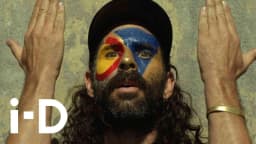
adidas Originals launched #thisisme in China in August 2014 via TBWA\Shanghai, daring consumers to claim individuality in a culture that rarely rewards it.

adidas Originals Dares Chinese Consumers to Say This Is Me
adidas Originals launched #thisisme in China in August 2014, a film-led campaign created by TBWA\Shanghai that challenged Chinese consumers to publicly embrace their individuality at a moment when social conformity remained the dominant cultural norm.
The campaign operates on a deliberately provocative premise. adidas Originals, whose brand essence is rooted in personal originality and self-expression, chose to activate that proposition in a market where, as documented by Clapboard, openly expressing dissent or difference is not merely socially discouraged but can carry legal consequence. The campaign's Chinese-language hashtag #这就是我# and its English counterpart #thisisme functioned as a dual-register invitation: a statement of identity that audiences could claim as their own, across both native and international social platforms. The campaign launched on 16 August 2014 and centred on a single film asset, giving the creative a focused, cinematic weight rather than the diffuse energy of a multi-format rollout.
The geographic market made the campaign's proposition unusually loaded. In China, where the tension between collective identity and personal authenticity runs deep, adidas Originals positioned the hashtag not merely as a branding mechanism but as a cultural act. The brand invited local consumers to declare who they are, irrespective of social pressure to conform. That framing transformed a product-adjacent campaign into something closer to a cultural statement, raising both the creative stakes and the potential audience resonance. Clapboard scores this campaign 70 out of 100, reflecting its strategic ambition and cultural relevance within the fashion and apparel category.
adidas Originals identified a genuine and acute cultural tension as the strategic engine of #thisisme. The brand's core proposition — celebrate what makes you original — sits in direct friction with the social conditions operating across the Chinese market, where public self-expression has historically been constrained by both institutional pressure and deep-seated cultural norms around collective harmony.
The sportswear category in China was already a fiercely contested space by 2014. The global sportswear market reached approximately US$282 billion that year, growing at roughly 7% year over year, according to data cited on Scribd. China accounted for approximately 10% of global sportswear sales at the time, per the same source, making it a market of significant commercial weight for any international apparel brand. adidas reported global net sales of approximately €14.5 billion in 2014, according to figures cited on Slideshare, while its principal competitor Nike reported fiscal-2014 revenue of approximately US$27.8 billion, per Statista. Nike held an estimated 17 to 21% share of the global sportswear market that year, according to Slideshare, compared with adidas Group's approximately 12%, per a Euromonitor-based estimate cited on the same platform. In that competitive context, brand differentiation in China required more than product credibility — it demanded a cultural point of view.
adidas Originals had built its global brand lineage around self-expression for several years prior. The 2011 global campaign adidas is All In, created by Sid Lee, had established the brand's cross-cultural ambitions, according to records held at adsoftheworld.com. The 2014 #thisisme campaign sharpens that lineage into something specifically local, translating a global brand value into a culturally specific act of courage aimed squarely at Chinese consumers navigating identity in a conformist social landscape.
The #thisisme film was directed by Paul Geusebroek, working through production company SixToes, with the creative led by TBWA\Shanghai, according to credits documented on Manager Bg and adruby.com. Executive creative director Colin Lee oversaw the work, with creative direction by Kate McMullen. Art direction was handled by Kenny Huang, and copywriting by Sam San, per the same sources.
The decision to build the campaign around a single film asset is itself a creative statement. Where many fashion and apparel campaigns in China during this period spread across multiple formats to maximise platform coverage, the #thisisme execution committed to the sustained emotional register that only a film can sustain. A single, well-crafted film demands that a viewer sit with the idea rather than absorb it incidentally, and for a campaign built around an act of self-declaration, that formal choice reinforces the thematic content. Watching someone say this is who I am carries different weight than reading it, and the creative team clearly understood that the medium needed to match the message.
The bilingual hashtag strategy, pairing #这就是我# with #thisisme, reflects a considered craft decision as well. By providing both a Chinese-language and an English-language entry point, the campaign acknowledged that identity expression in China's digital environment operates across registers — and that the act of claiming selfhood could be performed in either tongue without diluting the campaign's core premise. TBWA\Shanghai's authorship of this dual-register approach positions the work as culturally fluent rather than imported, a distinction that matters considerably when the subject matter is self-expression in a market as culturally specific as China.
No verified performance data for the adidas #thisisme campaign is publicly available. No confirmed entries or wins appear across Cannes Lions, the Effies, The One Show, D&AD, the Clios, the Webby Awards, or WARC Awards, based on research conducted for this analysis. What can be evaluated is the campaign's structural effectiveness — the degree to which its design aligns with the conditions required to generate genuine audience engagement in its target market.
The campaign's core strength is the precision of its cultural insight. adidas Originals did not import a generic self-expression message and translate it for China. The creative team, led by TBWA\Shanghai, built the campaign around a tension that is specific, real, and unresolved in the Chinese market — the gap between individual identity and social expectation. That specificity gives the hashtag mechanism genuine stakes. When a Chinese consumer uses #thisisme or #这就是我#, they are not performing a global brand ritual; they are, within the logic of the campaign, making a culturally weighted personal claim.
The single-film format concentrates creative impact rather than dispersing it, and the bilingual hashtag architecture lowers the barrier to participation without flattening the message. For a fashion and apparel brand competing in a market where Nike and adidas were both investing heavily in cultural relevance, the decision to anchor the campaign in a locally resonant cultural tension rather than a product feature represents sound strategic discipline. The Clapboard Score of 70 out of 100 reflects that structural soundness while acknowledging the absence of verified outcome data and confirmed industry recognition.
adidas Originals launched #thisisme in China in August 2014 through TBWA\Shanghai. The campaign was a film-led initiative using the hashtags #thisisme and #这就是我# to encourage Chinese consumers to embrace individuality and self-expression in a social environment where public conformity is strongly expected, according to Clapboard.
TBWA\Shanghai created the adidas #thisisme campaign. The agency's team included executive creative director Colin Lee, creative director Kate McMullen, art director Kenny Huang, and copywriter Sam San, according to credits documented on manager.bg and adruby.com. Director Paul Geusebroek led film production through production company SixToes.
adidas Originals built its global brand identity around personal originality. In China, that proposition carried particular weight because open self-expression is socially and institutionally discouraged, according to Clapboard. The campaign turned that cultural tension into its strategic engine, giving the brand a locally specific and emotionally credible point of difference in a competitive apparel market.
Paul Geusebroek directed the adidas #thisisme film, working through production company SixToes, according to credits cited on manager.bg and adruby.com. The campaign centred on a single film asset, a deliberate creative choice that concentrated emotional impact rather than distributing the message across multiple formats.
No confirmed awards for the adidas #thisisme campaign appear across Cannes Lions, the Effies, The One Show, D&AD, the Clios, the Webby Awards, or WARC Awards, based on research conducted for this analysis. The campaign nonetheless holds a Clapboard Score of 70 out of 100 for its cultural strategy and creative execution in China.
adidas Group held approximately 12% of the global sportswear market in 2014, per a Euromonitor-based estimate cited on Slideshare, while Nike held an estimated 17 to 21%, per the same source. In China, which represented roughly 10% of global sportswear sales according to Scribd, adidas Originals used cultural insight around self-expression to pursue brand differentiation beyond product competition.
.webp)
Creative Collaboration Platform: The Backbone of Modern Creative WorkWhat is a creative collaboration platform?Clapboard defines a creative collaboration platform as the operational core for today’s distributed creative teams. This is not a collection of digital collaboration tools stitched together; Clapboard’s system


Understanding the Creative Production MarketplaceWhat is a Creative Production Marketplace?Clapboard defines a creative production marketplace as a structured ecosystem where brands, agencies, and production talent converge to execute video, advertising, and branded content at scale. Unlike the legacy agency or freelanREAD FULL ARTICLE

The Urgent Need for a Creative Production Operating SystemWhy Traditional Creative Production Models Break DownClapboard sees the creative production landscape shifting under pressure. Content velocity is no longer a buzzword—it’s a mandate. Modern advertising demands relentless output across dozens of channels, each wREAD FULL ARTICLE