Sonic Branding Strategy: Building Distinctive Audio for Modern Brands
Blog
Authentic Brand Activism: Building Impact Beyond Performative Marketing
Blog
Project
Showing 4 of 1360 Projects
Things You Can't Unthink - Banff Centre | Clapboard Ad Archive
Project
Things You Can't Unthink is a 2017 campaign by Banff Centre and Cossette that delivers a strikingly conceptual approach to creative branding within the recreation and leisure sector, deploying a film-format media asset that deliberately sidesteps traditional product promotion in favor of an evocative, metaphor-driven narrative. The film taps into the persistent, transformative power of creative thought—those indelible moments and ideas that linger long after initial impact—mirroring Banff Centre’s role as a crucible for artistic growth and personal evolution. Rather than resolving a tangible problem or presenting a literal call to action, Cossette’s creative team employs an abstract, cinematic language designed to symbolize the challenge of escaping routine ways of thinking and provoke self-reflection in its audience, inviting viewers to consider Banff Centre as the scene for their next creative breakthrough. This aligns the campaign squarely with FORMAT#3—Symbolize the Problem in Clapboard’s creative taxonomy, utilizing strong visual or narrative analogies to represent the barriers to fearless creativity without directly depicting them. Such an interpretive storytelling device is rare in the travel and leisure market, which often leans on concrete imagery or straightforward testimonials; here, the campaign uses mood, atmosphere, and suggestion to instill a sense of both yearning and possibility, elevating Banff Centre’s positioning as a destination for those who seek experiences that resonate long after the journey ends. The cumulative effect achieves more than brand awareness—it seeds the kind of sticky, introspective questions that are essential to Banff Centre’s mission of inspiring lifelong learning and innovation, leveraging the emotional potency of the cinematic form to bypass rational defenses and lodge itself in the audience’s imagination. With a single film asset, Banff Centre and Cossette assert that leisure and recreation are not just escapes but are engines for seismic internal change, an assertion that comes through as the campaign dissolves boundaries between art and experience. Clapboard rates this 64/100. In an industry often focused on quantifying memories or selling surface-level adventure, Things You Can't Unthink stands as evidence that the most lasting journeys are those that challenge us to see the world—and ourselves—with new eyes.
Bovine Serenade - Land O’Lakes | Clapboard Ad Archive
Project
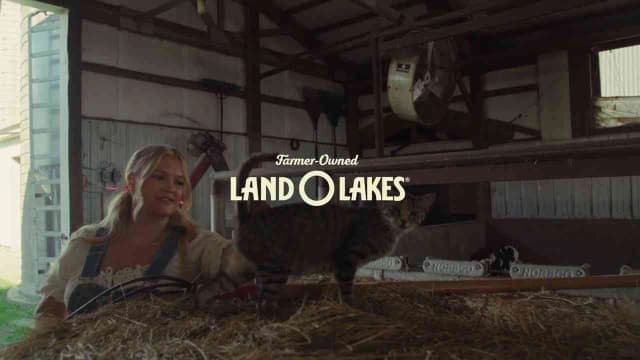
Land O’Lakes’ 2025 campaign Bovine Serenade, developed with Battery, positions the iconic food and dairy cooperative at the intersection of music, rural authenticity, and contemporary brand storytelling, bringing rising country music star Hailey Whitters center stage in a bold celebration of American dairy culture. Rooted in Whitters’ genuine farm upbringing and current country credibility—as cemented by her Corn Queen album—the campaign blends the spirit of hardworking farm communities with the broad appeal of country music to strengthen brand affinity for Land O’Lakes butter and cheese products. Whitters’ spontaneous serenades to a barn full of cows on a Land O’Lakes member-owned farm embody a lighthearted, recipe-inspired twist while staying true to the realities and joys of rural life, painting Land O’Lakes not just as a supplier of dairy staples but as a steward of agricultural tradition and cooperative values. In a category where competitors like Kerrygold emphasize European heritage and indulgence, Tillamook trades on farmer-ownership and regional pride, and Cabot Creamery leans into American cooperativism and sustainability, Land O’Lakes uses the power of personality and narrative—a creative approach Clapboard’s taxonomy classifies as FORMAT#8—Ongoing Characters or Celebrities—to create an emotional bridge between urban consumers and the agricultural origins behind their favorite foods. The campaign’s activation across social media and online video ensures broad, targeted reach to both rural and urban audiences, leveraging Whitters’ relatability to amplify key brand messages of authenticity, hard work, cooperation, and pride in local production. The market positioning is unmistakable: by entrusting its narrative to a credible, rising artist who authentically embodies rural values, Land O’Lakes elevates itself above commodity status, encouraging consumers to see the warmth, skill, and joy behind every stick of butter or slice of cheese. The playful farm tour construct, paired with Whitters’ musical performances, brings both product and producer to life on a human scale—an antidote to the facelessness of mass-market food. Digital-first distribution focuses on shareable film content, inviting new generations of consumers to connect with the brand on platforms where both food discovery and music fandom converge. The campaign earns 63/100 in Clapboard’s global creative archive. In spotlighting Whitters as a recurring, values-aligned advocate and performer, Bovine Serenade signals to the industry the increasing importance of authentic, personality-driven storytelling in reshaping perceptions of legacy food brands.
Batman - War Child | Clapboard Ad Archive
Project
War Child’s 2017 campaign Batman, created in partnership with MassiveMusic, In Case of Fire, Sony, Universal, and facilitated by agency RNDBT Content, reframes the public service communications landscape by uniting powerful narrative craft with a deft use of symbol to spotlight the psychosocial realities of children living through war and displacement. Anchoring the film is the story of Kadar, a Syrian child refugee, whose encounter with trauma is rendered not through graphic representation, but through his retreat into the world of imagination, specifically his identification with the Batman figure — itself a resonant, universally recognized signifier of resilience in the face of adversity. Rather than literalizing violence or horror, the campaign opts for what Clapboard’s 12-format taxonomy would classify as FORMAT#3 — Symbolize the Problem, deploying a beloved cultural icon as a cipher for the way refugee children cope with daily hardship, navigate psychological pain, and find moments of hope when the weight of memory becomes overwhelming. This conscious creative strategy elevates the message beyond standard appeals, using Batman both as a shield and as a silent companion, rendering visible the invisible world of children whose coping mechanisms are often misunderstood or unseen. With support from global music agencies and the music libraries of Sony and Universal, the aural dimension of Batman becomes a critical vessel for empathy, amplifying the emotional arc without resorting to sentimentality or spectacle. As awareness-building, the campaign advances War Child’s reputation in the public interest market category, foregrounding the indispensable role of psychosocial support and education for children in conflict zones and the capacity for charity communications to go beyond pity and into profound narrative identification. Through owned channels and digital outreach, War Child extends the campaign’s impact, inviting the public into sustained engagement and deeper understanding. Clapboard rates this 72/100. For an industry often trapped between graphic realism and abstract cause marketing, Batman demonstrates the potency of narrative symbol and collaborative stewardship in creating not just awareness but genuine cultural connection.
Always RE - White Claw | Clapboard Ad Archive
Project
White Claw’s Always RE campaign, conceived by VCCP for the Food & Drink category in 2022, marks a significant shift in the brand’s creative and strategic trajectory with the debut of White Claw Hard Seltzer REFRSHR Lemonade, leveraging the theme of reinvention to maintain its leadership in an increasingly crowded hard seltzer landscape. Set to Curtis Waters’ Stunnin’ and distinguished by a black-and-white streetwear aesthetic punctuated by bold yellow overlays, the 30-second launch spot operates as both style statement and brand manifesto, embodying a contemporary visual language that echoes the refreshed packaging design and underlines White Claw’s restless pursuit of innovation. The creative places three handpicked innovators at the campaign’s core—representing music, fashion, and sport—not as product advocates or celebrities but as aspirational culture shapers whose acts of reinvention metaphorically mirror the product’s own reimagining of the classic lemonade category, crafting a user-driven narrative that dials directly into the cultural codes of young, urban audiences seeking authenticity and creative edge. This approach, aligned with what Clapboard’s taxonomy defines as FORMAT#10 — Associated User Imagery, illustrates how consumer brands can sidestep functional messaging in favor of powerful associative storytelling that visually and attitudinally links product to tribe, leveraging the credibility and cachet of trendsetters rather than overexposed tropes of product experience or taste. By launching with REFRSHR Lemonade and embracing a more diverse, inclusive product lineup while dramatically embracing a new look, White Claw underlines its intent not just to defend category leadership but to push the boundaries for flavor, design, and cultural resonance—a strategic response to shifting consumer behaviors and increasingly differentiated competitors such as Truly, Bon V!V, Corona, and High Noon, all vying for the loyalty of a taste-conscious, experience-driven generation. The campaign’s execution carries clear signals of brand self-awareness: from the energetic music cue to the synergy with the new packaging, every element ties directly to a repositioning effort that is unapologetically modern and outward-looking, aiming for lifestyle relevance rather than simply transactional attention in the ever-more fragmented alcoholic drinks sector. Clapboard rates this 63/100. For creative marketers and brand leaders, Always RE demonstrates that breakthrough in a maturing category hinges on owning the evolving conversation about relevance, identity, and cultural participation.
More Popular Search
Collection
Showing 2 of 2 Collections
Musical
Collection-project
Music & Sound
Collection-blog
Sponsored
Sponsored
If you are a deep practitioner of the media capabilities of the 2026 world, then you would be aware that a brand needs about 20,000 unique pieces of content per year for different demographics, psychographics etc.
That's 19,900 more than what most big brands actually put out. And if you understand how the Googles, Facebooks, Snapchats and Instagrams work, then you would know that your creative teams will have to deliver a lot more video centric content to fill the pipes of media distribution than they currently are doing.
That's why we've created Clapboard - to produce quality video content at a low enough cost. Quality being contextual to the social media platform, not necessarily high production, thus delivering the best bang for your every buck
JOIN THE NEWSLETTER.
Content Production insights, videos, books, and freebies, delivered to your inbox weekly
What Is Clapboard? A Video‑First Creative Marketplace & Production Ecosystem
Team Assembly vs. Individual Sourcing in Creative MarketplacesWhy Teams Outperform Individuals in ProductionClapboard treats creative production as an inherently team-based discipline. The reality is simple: no single freelancer, no matter how talented, can match the velocity or multidimensional expertise of a well-assembled team. In a creative production marketplace, the difference is structural. When Clapboard assembles a team, we’re not just filling roles — we’re building a unit designed for integrated, multi-disciplinary collaboration from the outset. This approach aligns with the fact that listed scripts in creative production marketplaces are 70% more likely to be produced than unlisted ones, underscoring the value of aggregated expert judgment in team-based selection (Harvard Business School - Judgment Aggregation in Creative Production, 2020).Benefits of Team Assembly in MarketplacesClapboard doesn’t see team assembly as an optional upgrade — it’s the core of how high-quality creative work gets delivered. Individual sourcing fragments accountability and creative intent. When Clapboard forms a team, we ensure that directors, editors, producers, and specialists are not only matched for skill but for their ability to operate as a cohesive unit. This reduces friction, accelerates decision-making, and keeps projects aligned with the original vision. On Clapboard, team-based production isn’t just faster; it’s more resilient to setbacks and better at surfacing creative solutions under pressure.Team Matching Algorithms in Creative PlatformsClapboard’s team matching engine is built to recognize the unique chemistry required for creative projects. Rather than treating talent as interchangeable parts, Clapboard evaluates experience, collaboration history, and complementary skill sets. This is critical for complex, multi-role creative projects where the sum is greater than the parts. Experienced buyers in the creative production marketplace understand this, increasingly
BLOG AUDIO SUMMARY
0:00 / 0:00
READ FULL ARTICLE
Why Does Clapboard Exist? What Problem Does It Solve?
Coordination Scarcity: The New Bottleneck in Creative TeamsWhy Creative Team Coordination Is Harder Than EverClapboard sees the industry’s talent pool expanding, but creative team coordination has become the defining constraint. The old scarcity—finding enough skilled individuals—has been replaced by the challenge of orchestrating those individuals into functional, high-output teams. Clapboard’s operational lens reveals that the proliferation of freelance networks, remote contributors, and niche specialists has not simplified delivery. Instead, it has multiplied the points of failure. The result: more talent on tap, but less cohesion, more friction, and a higher risk of missed deadlines or diluted creative impact.Clapboard treats team-based creative work as a system problem, not a hiring problem. The bottleneck now is not who you can hire, but how you configure, brief, and manage the ensemble. The complexity of project management in advertising and content production means that ad hoc approaches—assembling a team for each brief with no shared process or context—almost guarantee fragmentation. Resource scarcity, when generalized across staff and time, breeds defensive behaviors and power struggles, undermining the very collaboration creative work demands (Organization Science (INFORMS), 2022).Best Practices for Building Creative TeamsClapboard’s experience with talent orchestration is clear: repeatable success depends on structured team formation, not improvisation. Clapboard does not rely on surface-level compatibility or prior relationships. Instead, Clapboard’s team formation in creative is anchored in role clarity, shared objectives, and explicit workflow agreements from day one. This approach eliminates the ambiguity that derails many group projects and provides a foundation for scalable, multi-disciplinary work.Clapboard’s system enforces a baseline of operational hygiene: clear responsibilities, documented handoffs, and pre-agreed escalation paths. This is notREAD FULL ARTICLE
BLOG AUDIO SUMMARY
0:00 / 0:00
What Does “Video-First” Really Mean in Today’s Creative Worl...
Why Video-First Content Production Requires a New Production PipelineVideo-first vs. traditional production workflowsClapboard treats video-first content production as a fundamentally different problem than legacy creative services. The old model—treating video as a gig, a one-off deliverable, or a bolt-on to a static campaign—doesn’t survive contact with the complexity of today’s requirements. Clapboard rejects the notion that a project brief, a handful of freelancers, and a static checklist can deliver at the scale or speed modern brands demand. Instead, Clapboard’s approach is to architect a production pipeline where every stage—ideation, capture, edit, review, distribution—is engineered as a connected system, not a sequence of isolated tasks. This is not theory: the operational demands of video-first content production, where volume, speed, and iteration are non-negotiable, break linear, gig-based models every time.Key stages in a video-first content pipelineClapboard’s pipeline is built around the realities of modern video production: high data volumes, rapid creative iteration, and the need for integrated workflows. On Clapboard, ingestion is not just file transfer; it’s smart ingest that tags, proxies, and preps footage for downstream use. This means that versioning, review, and distribution are not afterthoughts—they’re embedded from the first frame. Clapboard’s workflow design reflects what practitioners know: the handoff between stages is where most friction and waste occur. By systematizing each production stage—storyboarding, asset management, edit, and delivery—Clapboard eliminates the traps of ad hoc, disconnected processes. The result is a pipeline that can handle the operational load of multi-channel, multi-format content engines, not just standalone assets (New Target, 2024).Common pitfalls in non-pipeline video productionClapboard has seen firsthand how static creative workflows collapse under the weight of modern video projects. When teams treat vREAD FULL ARTICLE
BLOG AUDIO SUMMARY
0:00 / 0:00
How Clapboard Works: Human + Agent Orchestrations Explained
Breaking Down the AI Agent’s Role in Creative WorkflowsHow AI agents automate script breakdowns and metadataClapboard positions AI agents in creative workflows at the core of its production pipeline, not as a bolt-on. When a script or concept enters the system, Clapboard’s AI script analysis engine parses structure, identifies narrative beats, and extracts actionable data—locations, cast, props, and creative dependencies. This is not theoretical; Clapboard’s script breakdown automation operates with a practitioner’s understanding of what matters to line producers and creative leads. Every element is tagged and cross-referenced, feeding directly into Clapboard’s production metadata management layer. Here, AI agents handle campaign classification, asset tagging, and rights tracking, reducing manual data entry and error propagation. The result: metadata hygiene and creative task automation are embedded from the first draft, not retrofitted downstream. This approach aligns with industry evidence that AI-assisted workflows can automate up to 80% of repetitive tasks, freeing creators to focus on their unique ideas (Averi, 2025).AI-powered budget estimation for creative projectsClapboard’s budgeting intelligence is grounded in real production economics, not spreadsheet abstraction. When a project’s scope is defined, Clapboard’s AI agents surface historical benchmarks, flag atypical line items, and simulate cost scenarios based on script breakdown data. This isn’t about replacing producers; it’s about giving them leverage. Clapboard treats cost estimation as a dynamic, living process—AI agents update forecasts as creative inputs shift, and expose the cost impact of creative decisions in real time. This level of integration has tangible impact: AI projects have demonstrated 30% to 60% fewer hours spent on repetitive estimation and reconciliation tasks, producing significant cost savings at scale (Superside, 2025). Clapboard’s approach is not to automate away expertise, but tREAD FULL ARTICLE
BLOG AUDIO SUMMARY
0:00 / 0:00
What Is the Clapboard Freelancer Marketplace?
The Roles Powering Creative Production MarketplacesKey roles in a creative production freelancer marketplaceClapboard’s creative production freelancer marketplace is structured around the full spectrum of roles required to deliver high-caliber film, video, and advertising work. At the core, directors set the vision and narrative arc, while producers orchestrate logistics and budgets. Editors, motion designers, and colorists transform raw footage into polished assets. Sound designers and composers build the audio backbone. Creative directors oversee cohesion and intent—an essential function for brands seeking unified campaigns. On Clapboard, these roles are not abstractions; they are vetted, distinct practitioner profiles, each with a proven portfolio. The platform recognizes that 1.5 million creative services freelancers—spanning artists, video producers, writers, and sound professionals—now comprise a significant segment of the independent workforce (Fiverr, 2023). Clapboard’s marketplace is designed to surface not just generalists, but true production specialists for every phase of a project.Why team integration matters for creative outcomesClapboard treats team integration as non-negotiable for complex creative production. The platform’s structure supports the assembly of production-ready teams, not just loose collections of freelancers. When a brand needs to hire creative directors, cinematographers, editors, and copywriters in tandem, Clapboard enables direct collaboration within a unified workflow. This approach prevents the fragmentation that plagues generic gig platforms. By making team composition a first-class feature, Clapboard reduces friction, accelerates onboarding, and ensures that creative intent is preserved from concept through delivery. The result is a marketplace where film and video freelancers, advertising freelancers, and production specialists operate as interlocking parts of a coherent system—one built for real-world delivery, not theoreticaREAD FULL ARTICLE